First Order Lowpass Instrument, Accuracy, Time constant, Phase Angle

Thread Starter

Biomed27

Joined Jan 30, 2015
9
I am not sure how to answer the following questions. What is the maximum allowable time constant for the instrument? And what is the phase angle at 50Hz?

The circuit below shows the "instrument", the problem provides that the max frequency content is up to 100Hz and the instrument has an Amplitude inaccuracy of less than 5%.

I believe the transfer function can be written as Vout= (Vin*sin(wt+phi))/sqrt(1+w^2*(RC)^2)) but am unsure where to go from here . . . I think I can write an additional equation with the inaccuracy constraint making Vout=0.95V, but then am stuck.
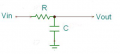
upload_2015-2-7_14-33-52.png
 

Thread Starter

Biomed27

Joined Jan 30, 2015
9
No, I thought you were...
No, that's ok though, these are my questions, maybe there is some relation? . . .I am not sure how to answer the following questions. What is the maximum allowable time constant for the instrument? And what is the phase angle at 50Hz?
 

MikeML

Joined Oct 2, 2009
5,444
To find the phase angle at any frequency, you need to know the value of R and C.

When characterizing instruments, it is common to talk about their bandwidth. It is usually stated as the frequency when their response is down to 0.707 (-3db). That occurs when R=Xc
 
Last edited:

Thread Starter

Biomed27

Joined Jan 30, 2015
9
I agree except that the corner frequency generally signifies -3dB, correct?

I am not provided with R or C in this case so I'm guessing that if I can relate the inaccuracy of 5% to the Voltage, then I may be able to solve for the time constant tau=RC in this case. However, when I set Vout=0.95V, I am left with an equation that contains a sinusoidal component in the numerator, which confuses me.

0.95V=Vsin(wt)/(sqrt(1+w^2*(tau)^2)), where w=omega=2pif . . . What do you think?
 

WBahn

Joined Mar 31, 2012
32,712
Your expression has sin(wt) in it, which is a function of time. It is not possible to set that equal to a constant, is it?

You know that you have a low-pass filter, right?

You know that the amplitude of the output signal will decrease with frequency, right?

You know that the amplitude needs to be at least 95% of the input signal over the range of frequencies of interest, right?

At what frequency (within the range of frequencies of interest) will the accuracy be the worst?

What does the gain need to be at that frequency?

What time constant will give you that gain at that frequency?
 

Thread Starter

Biomed27

Joined Jan 30, 2015
9
Your expression has sin(wt) in it, which is a function of time. It is not possible to set that equal to a constant, is it?

You know that you have a low-pass filter, right?

You know that the amplitude of the output signal will decrease with frequency, right?

You know that the amplitude needs to be at least 95% of the input signal over the range of frequencies of interest, right?

At what frequency (within the range of frequencies of interest) will the accuracy be the worst?

What does the gain need to be at that frequency?

What time constant will give you that gain at that frequency?
I was able to create a relation between the maximum sinusoid inaccuracy and the output signal, based on the problem statement. In this case I calculated a tau value of around 0.52ms which corresponds to a phase shift of about 10 degrees at 50Hz, which seems reasonable in this case.

Cheers!
 
Top