And how many frequency bands would you use for an audio signal?if multiple frequencies can occur at the same time, split signal in frequency bands using filters, use individual delay for each band, then sum the signals back...
Your were proposing a solution as if you understood the specs.questions about specs should be directed at TS.
constant phase shifteres work at one frequencyIt can be done for a constant phase shift of 90 degrees. However my initial looking into it indicates that producing a constant phase shift of 135 degrees is problematic. Constant phase shifters were first developed in the 1950s.
does the op want this to work for all frequency over the range, or only one at any paticular time ?programmable delay line... measure input frequency and set desired delay.
perhaps LTC6994 or similar..
no... i was pointing in a direction of one possible solution.Your were proposing a solution as if you understood the specs.

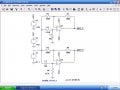
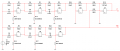
Okay.Here is a simulation that I did that does what I wanted.
The later.Okay.
Using two all-pass phase-shift filters do appear to give a constant shift between the two outputs within that frequency range.
But you need the phase-shift from the input to the output, right?
Or can you use the difference in the phase-shift from the two signals you generated?
That took seven posts. In TV-land that's called "Burying the lead".The later.
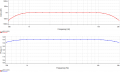
Take a detour via allpass filters that are 90° apart over the needed 1...10kHz frequency range. You can synthesize any phase shift you want from two outputs that are in quadrature. An example is attached. Output voltages have the same magnitude and are 135° apart over the whole frequency range.Here is a simulation that I did that does what I wanted. The upper shifter in the circuit produces -70 degrees of phase shift at 1 kHz. The lower shifter produces +70 degrees of shift also at 1 kHz.When the outputs of the two shifters are added, the phase difference to a large extent equals 140 degrees from 500 Hz to 2 kHz. A 140 degree phase difference is close enough to 135 degrees to do what i want to do.
Indeed.It would seem that you, @crutschow and I have very different interpretations of the TS's vague requirements.
To me "in the audio spectrum" implies an audio signal, i.e. a mix of frequencies. White noise as an representative example contains EVERY frequency, so phase shifting each one of them (delaying by θ/f) would therefore be impossible.
To mean the input is a sine wave of some frequency between 1 and 10 KHz. So it is always a single frequency.I'm sorry, I should have been more specific. Say over the range from 1 kHz to 10 kHz, I would want to shift the phase of each sine wave in that frequency range by 135 degrees.
All frequencies over the range.does the op want this to work for all frequency over the range, or only one at any paticular time ?
my interpritation was for all,
but I await to hear
At the same time?All frequencies over the range.
Wouldn't it be possible to understand the difference between a complex waveform at input to a constant phase shifter and the waveform at output of the shifter by Fourier analysis?Indeed.
I interpreted this:
To mean the input is a sine wave of some frequency between 1 and 10 KHz. So it is always a single frequency.
Change the spec to any arbitrary waveform, and I agree it is impossible by analog means, though it could be done by digital analysis and synthesis.
What is a sine/ cosine resolver?There is another scheme for producing a phase shift at AUDIO frequencies. It is simple but not at all elegant: Use a sine/cosing resolver! I played with one feeding audio into both sides of a stereo amplifier, back in about 1964. It WILL NOT PRODUCE STEREO, but it will deliver interesting effects. Very simple to implement as well.