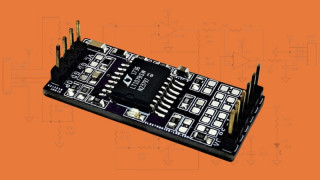
Constant current source

ronsimpson

Joined Oct 7, 2019
4,692
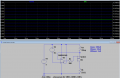
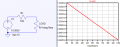
I stepped RL from 1meg to 10meg in 1meg steps. The current is 999.9468nA in all cases. (green trace) The voltage starts out at 0.0999volts and ends at 0.999 volts. (blue trace)
Not shown, I stepped V2 from 0.1V to 0.01V in 0.01v steps.
1732998957773.png
I cannot find a real P-MOSFET that works with that little current!
 
Last edited:

WBahn

Joined Mar 31, 2012
32,833
Coz i need a circuit whose current remains constant for load from 1Mohm to 10Mohm, so that circuit will be independent of load for certain range of load resistance.
But you just said:

I am trying to build a circuit that can give me a low current of 1nA even i can go high upto 2 to 4 nA. My load will be between 1Mohm to 10Mohm and for that range of load the variation of current cannot be grater than 1nA.
Now you are saying that it can't vary even by even as little as 14 pA.

How can anyone help you when you keep making drastic changes to what you are trying to achieve?

Why won't you post the actual text of the assignment so that we can first help you understand just what it is you need to accomplish?
 

WBahn

Joined Mar 31, 2012
32,833
I stepped RL from 1meg to 10meg in 1meg steps. The current is 999.9468nA in all cases. (green trace) The voltage starts out at 0.0999volts and ends at 0.999 volts. (blue trace)
Not shown, I stepped V2 from 0.1V to 0.01V in 0.01v steps.
View attachment 337073
I cannot find a real P-MOSFET that works with that little current!
Is the simulation model taking into account the drain-source leakage current?

The data sheet for the si1013 indicates that it can be in the microamp range even with a Vgs of 0 V .
 

ronsimpson

Joined Oct 7, 2019
4,692
So what's the problem with using a 10G ohm resistor with a 10V source as I proposed in post #20?
A very very high voltage source and a resistor makes a constant current source.

I made a constant current source without an output transistor. I need some time to play with it.
 

WBahn

Joined Mar 31, 2012
32,833
A very very high voltage source and a resistor makes a constant current source.

I made a constant current source without an output transistor. I need some time to play with it.
Doesn't have to be that high at all if the current is small. If you want 1% regulation, then the source voltage needs to be about 100x the max voltage across the load.
 

ronsimpson

Joined Oct 7, 2019
4,692
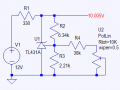
A different current source. Must have a special OP-amp.
Input voltage works from 0 to 2V.
The graph is for 1meg ohm to 10meg of load. RL
With input = 0.02V the current is 2nA.
OP-Amp has sub pA of input current that causes an error. Works with the voltage across RL of 0 to 2.4V.
1733015715615.png
-----edited-----
Most things I post I have tried or have in production. This I have not made a real circuit. This is only a SPICE circuit. It is hard to understand. The math is hard. When R1,2,3,4 are the same value the math is easy. The math said you need very accurate resistors. Digikey has 10meg +/-0.1% resistors, in R0805 or larger.
 

Attachments

Last edited:

WBahn

Joined Mar 31, 2012
32,833
I've been fighting this problem for literally years, and i'm now following this thread because of it.
What problem, specifically? Getting 1 nA of current in a load that varies between 1 MΩ and 10 MΩ? Or some other aspect of the discussion?
 

MisterBill2

Joined Jan 23, 2018
27,514
I see two immediate challenges, which relate directly to the previous comments. The late Bob Pease had presented quite a bit of commentary on this sort of efforts.
The things that I see being immediately obvious are, first, getting a "ten Gig-ohm" resistor", and then including it in a circuit, and second, measuring the voltage across whatever resistance composes the load to that current source.
The challenge to the first is the always present but seldom constant leakage resistance across most materials. Bob had a lot to say about that.
The challenge to the second is having any calibrated measuring system with an adequate input resistance to avoid changing the voltage being measured.
Two serious challenges!!!
 

ronsimpson

Joined Oct 7, 2019
4,692
The challenge to the second is having any calibrated measuring system with an adequate input resistance to avoid changing the voltage being measured.
Two serious challenges!!!
There are op-amps that could make a buffer so measuring the voltage will not load thing down much. I am using a 0.1pA input current amp. I have used fA buffers.

I think the real problem is that we don't see the entire picture. It is common for the truth to come out at about post #80. We are not there yet. There has been sever important questions asked and not answered. There are several plot twists yet to be seen. Probably this is to work at 2mhz or have a negative 1nA not positive or it must run form 1.2V rechargeable battery or.....

I have learned to not to invested in a project when we are not getting the entire picture. I keep telling myself this is not going to get fixed in the next 36 posts.
 

MisterBill2

Joined Jan 23, 2018
27,514
Certainly dealing with any circuit having a ten gig-ohm source resistance will be tedious at best.
And the fact that a whole lot of needed information is not provided is a problem.
 

WBahn

Joined Mar 31, 2012
32,833

Danko

Joined Nov 22, 2017
2,169
How do you figure ±0.05%???
The resistors you link don't even give a tolerance, but I would be surprised if they are even 1% resistors.
You should understand that ±0.05% is current deviation
at changes load resistance in range 0-10 MΩ.
But accuracy of 1 nA depends on accuracy of your picoammeter,
which used for calibration by pot U2, before work.
 
Top