Constant current source

Danko

Joined Nov 22, 2017
2,169
For a 10 G ohm 1% resistor you will pay almost 50 dollar:
You do not need 1% resistor because voltage changes in process of calibration.
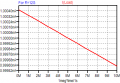
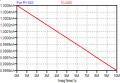
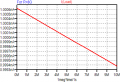
Let's show 3 cases for current deviation Δ in range of load resistance, with 20% resistor:
1. +20%; R=12 GΩ; V=12.005 V. Then Δ is +0.04%, -0.04%
2. ±00%; R=10 GΩ; V=10.005 V. Then Δ is +0.05%, -0.05%
3. -20%; R=08 GΩ; V=08.005 V. Then Δ is +0.06%, -0.06%
1733185012787.png___1733184546981.png__1733183768158.png
 

WBahn

Joined Mar 31, 2012
32,829
And the likelihood that the TS as a suitable picoammeter handy is....?

Current deviation with load is a nonissue if the series impedance is 1000x the max load impedance.
 

Danko

Joined Nov 22, 2017
2,169
Current deviation with load is a nonissue if the series impedance is 1000x the max load impedance.
Good!
And the likelihood that the TS as a suitable picoammeter handy is....?
Only two scenario: yes or no. Fifty-fifty ;).
He can steal, borrow, rent, purchase picoammeter etc., it is his headache.
I am trying to build a circuit that can give me a low current of 1nA (1.01234 nA and 1.01321 nA you mentioned is good enough)
6 digits!!! I hope he will agree with 4 digits...
Use a 1.5 V battery with a 1.5 GΩ resistor in series with your load.
Accuracy of such variant, even with 1% resistor, seems is not enough for him.
it needs to be stable and precise since i am trying to use it for calibration of a load which resistance may vary from 1Mohm to 10Mohm.
it should be stable for 100ms to complete my calibration
It is like that TS wants to inject current pulse 100 ms through load,
to measure μV/mV voltage drops on load and calculate resistance of load.
Interesting, impedance of his meter is giga ohms,
to prevent resistive/capacitive losses of signal?
Should be saved 4-6 digits accuracy!
 

WBahn

Joined Mar 31, 2012
32,829
Good!

Only two scenario: yes or no. Fifty-fifty ;).
He can steal, borrow, rent, purchase picoammeter etc., it is his headache.
Then he might as well go steal, borrow, rent, or purchase a 1 nA current source and be done with it.
Accuracy of such variant, even with 1% resistor, seems is not enough for him.
According to what little information we've been able to drag out of him, it is FAR more than enough for him.

I am trying to build a circuit that can give me a low current of 1nA (1.01234 nA and 1.01321 nA you mentioned is good enough)even i can go high upto 2 to 4 nA. and My load will be between 1Mohm to 10Mohm and for that range of load the variation of current cannot be grater than 1nA. and it should be stable for 100ms to complete my calibration. you need more info let me know?
But a 10% 1 GΩ resistor on a 1.5 V battery whose voltage might be between 1.2 V and 1.5 V.

On the low side, you have a 1100 MΩ resistor in series with a 10 MΩ load and a cell voltage of 1.2 V yielding 1.08 nA.

On the high side, you have a 900 MΩ resistor in series with a 1 MΩ load and a cell voltage of 1.5 V yielding 1.66 nA.
 

sparky 1

Joined Nov 3, 2018
1,218
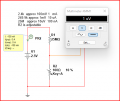
Building a practical low voltage source.
I thought I should build a practical low voltage source that progressively lowers using selectable range R1. R2 is adjustable.
A 2.5V Voltage reference and just a few parts that you can calibrate to some degree. An appropriate attenuation ratio such as
Giving 1 mV 10uA can be measured on a DMM.

Going beyond the adjustable low voltage source,
replace R2 with fixed resistor 0.01Ω which is also 10mΩ This results in 1nV the reference of interest.
We need an op amp for very low current set up as a V to I converter.
the circuit needs good dielectric isolation and low noise among other things.
The V/I output could be off some to get more precise R1 could be 24.98M + 50k pot

Low current Voltage Source.png
 
Last edited:
Top