Constant current source

Thread Starter

ashish123456789

Joined Nov 6, 2024
11
I am trying to make a constant current source 1uA simulation with high output impedance. so that the load current will not change for a range of load impedance. Anyone has a design for such type of circuit?
 

dendad

Joined Feb 20, 2016
4,636
You need to tell us more info, like the load variation as that will determine the power supply voltage limits.
"high output impedance" is not enough as that is not a measurement but a relative term.
 

WBahn

Joined Mar 31, 2012
32,764
I am trying to make a constant current source 1uA simulation with high output impedance. so that the load current will not change for a range of load impedance. Anyone has a design for such type of circuit?
What, exactly, is the assignment? What constitutes a "high" output impedance? What qualifies as not changing? What is the range of load impedance?

Again, what, exactly, does the assignment require?

What components are you allowed/expected to use?

What is your power supply?

Are you only doing it in simulation, or do you have to build and demonstrate it?
 

crutschow

Joined Mar 14, 2008
38,419
Anyone has a design for such type of circuit?
Yes, there are many designs for such a circuit, but need to know values for the "range of load impedance", and how much variance in the constant-current can be tolerated for that range.

Does the load need to be grounded?
 
Last edited:

Thread Starter

ashish123456789

Joined Nov 6, 2024
11
I need a current source that can drive constant current near 1nA for load resistance of 1 to 10 Mohm, for which i need output impedance high.
and load is connected to ground.
 

MisterBill2

Joined Jan 23, 2018
27,323
Does that current need to be actually CONSTANT???, or is it allowed to vary within some range?? For an actual constant current there must be some sort of regulation device. Otherwise it is a current "Not changing very much", but by no means constant.
 

ronsimpson

Joined Oct 7, 2019
4,663
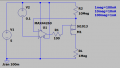
this circuit but it is not working as expected. I am also looking for alternative circuits that produces desired result.
That circuit is upside down. You said the load goes to ground. Or is R4 the load?
Please post you SPICE file.
The opamp needs a higher supply voltage. probably.
You should be seeing 100nA.
You need a op-amp with very low input current. Some op-amps pull more current in the inputs than your entire current source.
 

WBahn

Joined Mar 31, 2012
32,764
I need a current source that can drive constant current near 1nA for load resistance of 1 to 10 Mohm, for which i need output impedance high.
and load is connected to ground.
So now it's 1 nA instead of 1 µA.

At least now we have a range of resistances. Sort of. Is it 1 MΩ to 10 MΩ? Or, since the 1 doesn't have units, are we to conclude that it is 1 Ω to 10 MΩ?

How accurate/precise/stable does the assignment require your 1 nA to be? How long does it have to be stable for?

Use a 1.5 V battery with a 1.5 GΩ resistor in series with your load.

Why make it more complicated than it needs to be, unless your assignment requires it. Which, since we don't have a crystal ball in order to see what your assignment actually requires....
 

WBahn

Joined Mar 31, 2012
32,764
Yes, this circuit but it is not working as expected. I am also looking for alternative circuits that produces desired result.
View attachment 337003
Well, how do you expect it to work?

Where did this circuit come from?

Do you understand how it would be expected to work?

If everything is ideal, that circuit would be expected to deliver 100 nA to R4. Which your simulation shows it is doing.

But it is anything but a constant current source. If your 1 MΩ resistor is change to a 10 MΩ resistor, you would expect about 10 nA.

What opamp are you using?
 

Thread Starter

ashish123456789

Joined Nov 6, 2024
11
it needs to be stable and precise since i am trying to use it for calibration of a load which resistance may vary from 1Mohm to 10Mohm. i am now using universal op amp1 .
 

WBahn

Joined Mar 31, 2012
32,764
it needs to be stable and precise since i am trying to use it for calibration of a load which resistance may vary from 1Mohm to 10Mohm. i am now using universal op amp1 .
Just where do you expect to buy a "universal op amp 1" when you go to build this thing?

"news to be stable and precise" is NOT a meaningful specification!

How can anyone help you design something to meet your needs when you won't or can't figure out what your needs even are?

You need to stop with the marketers weasel words and phrases and start talking and thinking like an engineer.

If your circuit delivers a current that is always between 1.01234 nA and 1.01321 nA, is that stable and precise enough?

If your circuit delivers a current that is always between 0.99 nA and 1.01 nA, is that stable and precise enough?

If your circuit delivers a current that stays between 1.00001 nA and 1.00002 nA today, but tomorrow it stays between 1.00050 nA and 1.00051 nA, is that stable and precise enough?

How stable is stable enough?

How precise is precise enough?

Ask yourself (or your instructor) the following questions:

Assume that the circuit puts out a truly constant current that never changes, but it's not exactly 1 nA. How large can it be and still be acceptable? How small can it be as still be acceptable?

Now assume that the circuit puts out, on average, 1 nA, but that it varies over time. What is the minimum and the maximum that it can be, and over what time frame, and still be acceptable?

Now assume that the circuit puts out a perfectly constant current into a fixed load, but that current varies a bit with the load. For instance, let's assume that it is exactly 1 nA into a 5 MΩ load but it puts out a bit more into a 1 MΩ load and a bit less into a 10 MΩ load. What is the most that it can deliver to the 1 MΩ load and the least it can deliver to the 10 MΩ load and still be acceptable?

If you would just post the actual assignment, we could possibly help you figure out what your requirements actually are.
 

Thread Starter

ashish123456789

Joined Nov 6, 2024
11
I am trying to build a circuit that can give me a low current of 1nA (1.01234 nA and 1.01321 nA you mentioned is good enough)even i can go high upto 2 to 4 nA. and My load will be between 1Mohm to 10Mohm and for that range of load the variation of current cannot be grater than 1nA. and it should be stable for 100ms to complete my calibration. you need more info let me know?
 

ronsimpson

Joined Oct 7, 2019
4,663
RL sits on ground, see post #6.
OP-amp chosen for sub pA input current. R-R input, small input offset voltage. All these op-amp errors look good at room temp but go wrong at -40C and +85C.
M1 picked because it is small. Need a low leakage current P-MOSFET.
1732978597369.png
I think you will have problems with current flow in the PCB. The layout is important. The board must be clean. Humidity will cause problems at 1nA. You will have problems getting more than 10meg ohms (good) resistors.
V2 sitting on +5V might be a problem but that can be fixed.
 

Attachments

crutschow

Joined Mar 14, 2008
38,419
I am only simulating now @rosimpson can we make this supply constant current for a range of load from 1Mohm to 10Mohm
Getting 1nA current with active devices is problematic.
Even a small MOSFET, for example, will have an OFF leakage current of a few hundred nA.

The easiest way is to use a high-resistance resistor with a DC voltage supply to generate the current.
These glass encased resistors, can be had up to 10,000,000 megohms.

For example, If you use a 10GΩ resistor powered by a 10V supply to give 1nA of current, then the current will only vary by 0.1% when going from a 1Mohm to 10Mohm load.
Note that at that low a current, the resistor must be isolated and never touched by bare fingers to avoid problems with leakage currents,
 

WBahn

Joined Mar 31, 2012
32,764
I am trying to build a circuit that can give me a low current of 1nA (1.01234 nA and 1.01321 nA you mentioned is good enough)even i can go high upto 2 to 4 nA. and My load will be between 1Mohm to 10Mohm and for that range of load the variation of current cannot be grater than 1nA. and it should be stable for 100ms to complete my calibration. you need more info let me know?
So why won't a 1 GΩ resistor in series with a 1.5 V battery and your load suffice?
 
Top