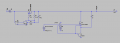
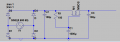
It behaves exactly the same when placing a diode there except that the current floor is lower at extremely low load resistances with the transistor. Are there advantages/disadvantages to transistor vs diode?
Well, unless there's another aspect of audio impedances I don't know about, the rated impedance of the tubes is not lower than 280 ohms so I wouldn't think operation in <50ohm loads would matter.
I used different diode models and the schottky diodes with the lowest breakdown voltages allowed for a lower current floor at low loads. I'm curious as to why this is.
There must be a common trait between the transistor and the diode that is allowing a lower current floor.
I am also wondering if there is some noise factor with the diode vs transistor, I would have to bypass it with a cap to reduce the noise right?
The voltage drop at the output is between .7v and .9v at the opamp Probably having something to do with the transistor saturation requirements. If anyone can figure out what that transistor does that would be great. It seems to be the heart of the circuit.View attachment 101981
Your idea of a constant current supply for an audio amp doesn't make any sense to me. Do you have a link to where you heard it was a good idea? I could (kind of ) understand why you might want a low ripple constant voltage supply. But having said that your circuit is really not either one. If you look at the op amp FET diode circuit the op amp just wants to make the - input the same as the + input. So it makes the current thru the diode higher and higher until they match. Usually where you have the diode there is a small resistor. If all the stuff you have on the left is the input, what you have is a current shunt. It draws a constant current from the power supply. I think you want the resistor on the right to represent the load. Is that right? If you want constant current in the load put it in series with the drain to the supply and get rid of all the 'stuff" on the left.
Edit: If you are really talking about a current audio amp that is different than a constant current power supply.
Your idea of a constant current supply for an audio amp doesn't make any sense to me. Do you have a link to where you heard it was a good idea? I could (kind of ) understand why you might want a low ripple constant voltage supply
CCS loaded tubes isn't some novelty, it's a common practice for decades. It's one of the main things you decide to use or not when designing a tube amp. It puts a horizontal load line on the tube.
That "stuff" is the constant current source that sources the current for the shunt element to sink.
I could simply use it as a standalone constant current source to the load but a shunt regulator is heralded to have an ultra low output impedance at audio frequencies with the ability to both source and sink current to/from the load. I was going to use the supply to power a constant current source anyway so instead of designing the feedback loop of the shunt to maintain constant voltage I set it up to maintain constant current to the load. Which is presumably superior to a normal CCS since it maintains its ultra low output impedance.
I'll use a capacitor multiplier before the shunt reg and some reservoir caps before and after the shunt reg which should keep it noise free with a super low output impedance at audio frequencies.
The voltage drop at the output is between .7v and .9v at the opamp Probably having something to do with the transistor saturation requirements. If anyone can figure out what that transistor does that would be great. It seems to be the heart of the circuit.View attachment 101981
What the transistors are doing is pretty straightforward.
Q2 is a diode-connected transistor. You could literally replace it with a diode. As with any diode, the current through it is a function of the voltage across it. The opamp is controlling the voltage across it, and thus the current through it. Q1 is a cascode transistor whose purpose is to act as a current buffer so that Q2 isn't exposed to the voltage on the top rail. As you increase V1, the opamp output voltage is servoed until the collector voltage on Q2 matches V1 and then the current passing through the two transistors is whatever corresponds to a the diode (Q2) having V1 across it.
Replace Q2 with a resistor and you will have a programmable current supply that is linear.
But in either case your circuit relies on already having a constant current source available. Where is that going to come from?
You should try to understand why you are trying to do whatever you are trying to do. Here, you want to maintain a constant current through the load, right? and you want to be able to adjust the current.
What your circuit does it exactly the opposite: it can adjust the circuit to be diverted away from the load. So to the extent that the output of your "constant current source" fluctuates, the current through your "shunt regulator" will be steady and all the variations are directed towards your load.
You should try to understand why you are trying to do whatever you are trying to do. Here, you want to maintain a constant current through the load, right? and you want to be able to adjust the current.
What your circuit does it exactly the opposite: it can adjust the circuit to be diverted away from the load. So to the extent that the output of your "constant current source" fluctuates, the current through your "shunt regulator" will be steady and all the variations are directed towards your load.
I'm not following. The constant current source feeds the load at a constant 600ma.
The shunt shunts away some of that current in order to get a desired voltage.
The shunt is set up to be a constant current sink so it will always sink the same current meaning the load will always be getting the same current through it since the load is getting the other half of the split, which is exactly what LTspice is showing me.
As long as the constant current source and sink are constant there are no "variations" on the output.
I don't understand why you are claiming that you have a low output impedance here. The mere fact that you said that you could change the load resistor by a significant amount, which means the output voltage changed by a significant amount, yet the output current only changed by a small amount means that you have a high output impedance -- which is precisely what you want for a current source.
I'm not following. The constant current source feeds the load at a constant 600ma.
The shunt shunts away some of that current in order to get a desired voltage.
The shunt is set up to be a constant current sink so it will always sink the same current meaning the load will always be getting the same current through it, which is exactly what LTspice is showing me.
Put some ripple into that constant current source and you will see that nearly all of it is reflected in the load. It's trivial to put a noise-free current source in a simulation. But how low noise is the actual current source that you will be using?
That's why I said I was going to use a capacitor multiplier and reservoir caps before and after the regulator. Besides, any regulator is going to show ripple at the load.
I don't understand why you are claiming that you have a low output impedance here. The mere fact that you said that you could change the load resistor by a significant amount, which means the output voltage changed by a significant amount, yet the output current only changed by a small amount means that you have a high output impedance -- which is precisely what you want for a current source.

 Facebook
 Google
 GitHub
 Linkedin



 .
.