Facebook
 Google
 GitHub
 Linkedin
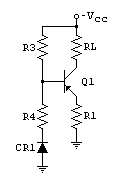
An excellent constant current circuit has been posted by Bill Marsden. The circuit diagram is attached as a pdf. I am explaing how the circuit acts as constant current source in the steps below, please check my steps and confirm if i am right.
Ie=Ib + Ic
Ib << Ie,Ic Ie=Ic=Iout
Ie= (Ve-Vcc)/R1 (please see location of points a, b, c in the diagram attached) ...................(1)
Ve=Veb + Vrs.....................(2)
Let the pot between q and s have resistance R3 in top half and R4 in bottom half as shown.
Vrs=(R4/R3)(Vcc-Vd)................(3)
By combining (1),(2),(3) and assuming Veb=Vd=0.6V
Ie=(Vcc-Vd)(R4/R3-1)/R1....(4)
Ideally we will seek an expression like Ie=(Vcc){ R4/(R3* R1)}
Now the extra diode put does not cancel the Vbe drop of transistor as in (4). I guess the reason for diode addition is to nullify the Vbe drop of transistor. So, is my analysis correct?
Ie=Ib + Ic
Ib << Ie,Ic Ie=Ic=Iout
Ie= (Ve-Vcc)/R1 (please see location of points a, b, c in the diagram attached) ...................(1)
Ve=Veb + Vrs.....................(2)
Let the pot between q and s have resistance R3 in top half and R4 in bottom half as shown.
Vrs=(R4/R3)(Vcc-Vd)................(3)
By combining (1),(2),(3) and assuming Veb=Vd=0.6V
Ie=(Vcc-Vd)(R4/R3-1)/R1....(4)
Ideally we will seek an expression like Ie=(Vcc){ R4/(R3* R1)}
Now the extra diode put does not cancel the Vbe drop of transistor as in (4). I guess the reason for diode addition is to nullify the Vbe drop of transistor. So, is my analysis correct?
Attachments
-
288 KB Views: 233