Facebook
 Google
 GitHub
 Linkedin

Hi All,
Looking for some advice on a pulse input circuit as per the image below. I don't fully understand the circuit, it was found as an example to someone else and fit my needs. It works fine if I apply a pulse to it anywhere from about 2V to 24V, however have found that when a standard fluid flow meter is connected such as the FS300A with a 5V supply the output pulse voltage is only around 1.3V, being pulled down by the circuit. Open circuit output voltage is about 4.8V. Current draw on the pulse in line is about 5.5mA
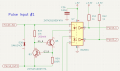
Below is a description of the circuit as supplied.
Using Pulse 1 Input as an example,
When voltage is applied, Q5 is turned on by R37
The current in R39 rises until Q3 is turned on when R39 voltage drops about 0.6V
Q3 now clamps the base of Q5 at a level that maintains its turn on voltage
I(Q5) = V / R = 0.6 / 100
= 6 mA approx
Can be changed to suit optocoupler requirements if needed
At 3V in, V_Q5_b = Vb1_Q3 + Vbe_Q5 ~= 1.2V
so V across R37 ~= 3Vin - 1.2V = 1.8V
Ib_Q5 = VR37 / R37 = 1.8 / 10000 ~= 0.02 mA
To support the required 6 mA in this case Beta_Q5 must be IC_Q5 / Ib_Q5 = 6 mA / 0.02 mA = 300.
R37 can be made smaller to increase I_R37 and so reduce the required beta of Q5
Using a ZXTN25100DFH for Q5, guaranteed beta @ 2V of 300 - 900, typically 450.
At Vin = 39V (D36 Vbr), dissapation in R37 = V^2 / R = 1521 / 10k = 0.15 W (250 mW would be suitable)
Q5 maximum dissapation ~= Iopto * Von = 6 mA * 39V = 234 mW
ZXTN25100DFH package thermal resistance of Rtja = 171 C/w
At 300 mW temperature trise is 171 * 0.234 = 40 deg C.
Looking for some advice on a pulse input circuit as per the image below. I don't fully understand the circuit, it was found as an example to someone else and fit my needs. It works fine if I apply a pulse to it anywhere from about 2V to 24V, however have found that when a standard fluid flow meter is connected such as the FS300A with a 5V supply the output pulse voltage is only around 1.3V, being pulled down by the circuit. Open circuit output voltage is about 4.8V. Current draw on the pulse in line is about 5.5mA
Below is a description of the circuit as supplied.
Using Pulse 1 Input as an example,
When voltage is applied, Q5 is turned on by R37
The current in R39 rises until Q3 is turned on when R39 voltage drops about 0.6V
Q3 now clamps the base of Q5 at a level that maintains its turn on voltage
I(Q5) = V / R = 0.6 / 100
= 6 mA approx
Can be changed to suit optocoupler requirements if needed
At 3V in, V_Q5_b = Vb1_Q3 + Vbe_Q5 ~= 1.2V
so V across R37 ~= 3Vin - 1.2V = 1.8V
Ib_Q5 = VR37 / R37 = 1.8 / 10000 ~= 0.02 mA
To support the required 6 mA in this case Beta_Q5 must be IC_Q5 / Ib_Q5 = 6 mA / 0.02 mA = 300.
R37 can be made smaller to increase I_R37 and so reduce the required beta of Q5
Using a ZXTN25100DFH for Q5, guaranteed beta @ 2V of 300 - 900, typically 450.
At Vin = 39V (D36 Vbr), dissapation in R37 = V^2 / R = 1521 / 10k = 0.15 W (250 mW would be suitable)
Q5 maximum dissapation ~= Iopto * Von = 6 mA * 39V = 234 mW
ZXTN25100DFH package thermal resistance of Rtja = 171 C/w
At 300 mW temperature trise is 171 * 0.234 = 40 deg C.