20 amp 10uS pulsewidth constant-current pulse

Thread Starter

swr999

Joined Mar 30, 2011
58
Hello All,

I run an electronics shop at a university. A researcher has asked me about designing a circuit to produce a DC current pulse of 20 amps with a pulse width of 10 uS (10 micro-sec). They are thinking along the lines of discharging a capacitor into a load which can vary +/- 20% above/below a nominal 0.5 ohms during the pulse period. The charging voltage has not been specified but is expected to be <100 VDC. During the 10 uS pulse they want the current to be actively held constant despite the varying load.

The current measurement would be with a Pearson 8535 current monitor which has a useable rise time of 25 nanoseconds:
https://www.pearsonelectronics.com/pdf/8535.pdf

At this point I would appreciate any comments the gurus would care to make regarding approaches to this project, mainly suggestions on methods of doing active control of a 20A current during a 10 uS pulse, or anything else I should be worried about.

Happy to supply additional details of the project.
Thanks!
Steve
 

wayneh

Joined Sep 9, 2010
18,087
A number of things come to mind but you're going to need more precise specifications about the pulse: Acceptable rise/fall times, acceptable amperage range, nature of the load (resistive versus inductive), and I'm sure there are a few more things folks here will need.

I would challenge the researcher just a bit about what they really need. I mean, if they're powering a laser for instance maybe what they really want is constant intensity during the pulse. That might call for a different/better approach than a constant-current pulse. It's always best to go into these things fully understanding the need. It's frequently the case that someone has already come up with a solution and re-inventing the wheel is not needed.
 

Papabravo

Joined Feb 24, 2006
22,058
Hello All,

I run an electronics shop at a university. A researcher has asked me about designing a circuit to produce a DC current pulse of 20 amps with a pulse width of 10 uS (10 micro-sec). They are thinking along the lines of discharging a capacitor into a load which can vary +/- 20% above/below a nominal 0.5 ohms during the pulse period. The charging voltage has not been specified but is expected to be <100 VDC. During the 10 uS pulse they want the current to be actively held constant despite the varying load.

The current measurement would be with a Pearson 8535 current monitor which has a useable rise time of 25 nanoseconds:
https://www.pearsonelectronics.com/pdf/8535.pdf

At this point I would appreciate any comments the gurus would care to make regarding approaches to this project, mainly suggestions on methods of doing active control of a 20A current during a 10 uS pulse, or anything else I should be worried about.

Happy to supply additional details of the project.
Thanks!
Steve
I don't know of anything that could react fast enough to control that level of current. Modifying the exponential discharge characteristics of a capacitor seems like a dubious enterprise at best. Many SMPS (Switch Mode Power Supplies) use PWM to create an average current through an inductor for delivery to a load. I can imagine a design in the low RF range 3-10 MHz. That might be able to achieve this, but I could also be wide of the mark.
 

WBahn

Joined Mar 31, 2012
32,703
NOTE: 10 uS is 10 microsiemens, a unit of conductance. For 10 microseconds, you want 10 us (or, better, 10 µs).

If keeping the current constant is important, I would recommend charging an inductor into a dummy load and then switching it to the real load (being careful to either use make-before-break switching or just switching the real load in parallel with the dummy load.

How constant is constant? That will drive a lot of decisions.

Just throwing some thoughts out there, let's say that your dummy load were 5 Ω (10x the real load's nominal resistance). Then, assuming negligible coil resistance, which may not be a good assumption in the end), 20 A would dissipate about 2 kW when the coil is charged. That may or may not be tolerable, but there are ways to manage that, such as precharging into a lower resistance, then bringing in a high ballast resistance just before firing a pulse, which might allow you to bring in even something like 100 Ω. But let's stick with 5 Ω. If you just switch the real load in parallel, you would need to charge the coil to 22 A.

Let's say that the total resistance with the real load switched in is 1 Ω and that "constant current" means a current within 1%. That means that you need the L/R time constant to be at least 100x your 10 µs pulse period, or 1 ms. For a 1 Ω load, that's just a 1 mH inductor. Make it perhaps 10x to 100x that, depending on how large you want your ballast load to be.

So this is what my (very rough) vision would be. A constant-current DC feeding an inductor in series with three parallel loads. A short-circuit pre-charge load (the resistance is just that of your switch), a fixed ballast load of, say, 10 Ω, and your real load in series with a suitable switch. When you want a current pulse, you turn on the precharge switch and set the DC current to the desired current (20 A plus what is needed by the ballast). Once that is adjusted, you fire the pulse using a circuit that first turns off the precharge switch, which then forces all of the current to switch over to the ballast resistor. This will result in the voltage rising, possibly beyond what the current source can deliver, so you need a supply that can handle that by still providing a path for the current (magnet supplies almost always have that ability, so you might look into them). This will cause the current to start decaying at the L/R associated with the ballast, so at a specified amount of time after the precharge switch is opened, you want to close the load switch. After your 10 µs pulse duration, you can open the load switch and then almost immediately close the pre-charge switch.

The pre-charge circuit let's use a much lower power supply and not dump a bunch of heat while you are getting ready for the pulse. The ballast resistor serves a couple of purposes. First, since it is always in the circuit, it prevents the coil from being open-circuited (you will want to put diodes and dump resistors across it as well). Second, it allows for a well-controlled transition between pre-charge and test pulse. You might be able to get by without it and just turn off the precharge switch to produce your pulse. It depends on how good good-enough is.
 

ronsimpson

Joined Oct 7, 2019
4,646
What is the load? That is important. If it is resistive this is simple. If it is a coil then we probably need the 100V supply.
0.5ohm +/-20%, 20A needs 10V.
If the load is a constant 0.5 ohms and does not change this is simple. If the load could change from 0.5 to 0.6 and down to 0.4 over time and heat then we must have feedback.
Do we need to use the Current Transformer (in the link) to monitor the current supply. Or can we make the current without looking at the CT?
Will there be time between tests. There will be 200 watts in the load. If the test is once every 5 minutes then the heat is not much. But if you are doing 100s/second then we need to remove heat from the current driver.
How constant must the current be? +/-1% or 10%?
 

MrChips

Joined Oct 2, 2009
34,628
If they are asking for 20 A constant current lasting for 10 μs I think they have to rethink this requirement.
I think they are asking for 20 A amplitude independent of the load.

When you have to take into account rise time and fall time you are not going to have much time remaining.
Hence, yes, you can output a 20 A amplitude pulse by shutting down the supply once 20 A is detected, assuming that you take into account the response time of the control system.
 

Thread Starter

swr999

Joined Mar 30, 2011
58
What is the load? That is important. If it is resistive this is simple. If it is a coil then we probably need the 100V supply.
0.5ohm +/-20%, 20A needs 10V.
If the load is a constant 0.5 ohms and does not change this is simple. If the load could change from 0.5 to 0.6 and down to 0.4 over time and heat then we must have feedback.
Do we need to use the Current Transformer (in the link) to monitor the current supply. Or can we make the current without looking at the CT?
Will there be time between tests. There will be 200 watts in the load. If the test is once every 5 minutes then the heat is not much. But if you are doing 100s/second then we need to remove heat from the current driver.
How constant must the current be? +/-1% or 10%?
The load is "0.5 ohms +/- 20%", but I don't know if simple resistance or a coil.
The current transformer was for getting the feedback.
Test frequency would be approx every ~15 minutes.
3-5% on current control would be enough.
Thanks for the comments!

Thanks to all, these are all very thoughtful comments, and much appreciated. I can see I need to nail down more specifics from the researcher. I have asked for a published paper they have which gives more context and specifics on what they need to get out of the experiment.
 

ronsimpson

Joined Oct 7, 2019
4,646
I don't know if simple resistance or a coil.
1) If the coil was 0.5 ohms (about) and resistive I could just jam 10V across it to get 20A. or 0.6 ohms needs 12V. or 0.4 needs less volts. There would have to be a calibration to know what voltage is needed.

2) With a resistive load I can make a constant current source that will output the needed voltage (8 to 12V) It will monitor the voltage. There would be no need to calibrate.

3) If the load is a coil or it has inductance then the voltage will not be constant but needs to change with time.
Sorry I drew the waveforms poorly; I need to draw them later. If it is a coil the voltage will start out at 0, jump to 100V, hold until the current ramps to 20A, then the voltage will pull back to 10V and hold. This will take more work.
 

ronsimpson

Joined Oct 7, 2019
4,646
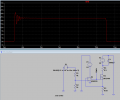
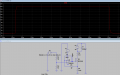
The ringing in the waveform can be fixed. This is just a first shot at a simple 20A constant current driver. R4 is the load.
R3 measures the current. T=10uS on time.
1738974577606.png
 
Since closed loop regulator is too slow for 10us I would go an open loop method like:
1) Measure the load resistance R right before applying the pulse.
2) Prepare the voltage for pulse according V=R.20
Use some converter for this.
3) Generate the pulse from this voltage.
 

ronsimpson

Joined Oct 7, 2019
4,646
Since closed loop regulator is too slow for 10us
Please explain why?

With simple "old school" parts I can get 100nS rise and fall times. The rise and fall time is about 1% of the waveform. No where has there been a specification on speed. I think I can to 10nS with new parts.

Back in #8 I suggested an unregulated voltage (with calibration) I know this is faster. I have done 50A in 3nS but the PCB layout is way beyond most people's ability. The wires to the load become more of a problem than the speed of the MOSFETs. I would need transmission lines.
 

MisterBill2

Joined Jan 23, 2018
27,164
What could be rather "straight-forward" is a constant voltage selected to provide 20 amps for a ten microsecond time. A fast voltage regulated power supply is not that difficult if size and cost are not issues. That same power supply could be used to hold a constant voltage across a series current sense resistor, as an alternative.
 

ronsimpson

Joined Oct 7, 2019
4,646
A fast voltage regulated power supply
Just add capacitors.
If anyone can make a power supply that regulates in a uS then you can make a current source that responds in the same time.

I have a capacitor bank where I charge up at 1A and pull out 1000A for a short time. I have not thought about a small project like this one. If you charged up the caps to 10.5V and in 10uS it discharged to 9.5V you would have a 21A to 19A pulse. That might be OK. Double the cap size and 20.5A to 19.5A. That is very simple. Likely that slope in the current is not acceptable.
 

BobTPH

Joined Jun 5, 2013
11,463
What could be rather "straight-forward" is a constant voltage selected to provide 20 amps for a ten microsecond time
What constant voltage puts 20 Amps through a .4Ω load AND a .6Ω load?

Did you miss that the load varies by ±20%?

I really like the solution @WBahn proposed of using an inductor, which, for a short period acts like an a constant current source with an infinitesimal response time, the same way a capacitor acts like a constant voltage source for a very short time.
 
Last edited:

DickCappels

Joined Aug 21, 2008
10,661
At this point I would like to point out that if you set up a differential pair with a constant current source feeding the emitters, the current can be switched from one collector to another very quickly by putting a pulse into one of the bases.

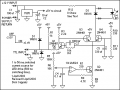
Below is a circuit I put together for studying the the pulse response of a rabbit's retina. It worked great but but you might notice that Q3 and Q4 are small signal transistors and would vaporize quickly if supplied with 20 amps.
1739105641442.png

The rub is that high current transistors in my experience tend to have slower switching times, though I remember some pretty fast horizontal drive transistors that were probably fast enough for your use, in the day they were available.

Perhaps an array of parallel transistors would do it. For the purpose of this circuit, the 2N4401 is roughly equivalent to the 2N3904, which makes me think that to handle your 20 amp pulses an array of 100 2N3904's or better yet a parallel array of the faster 2N2222's might do the job.

I suspect that you can come up with a differential pair connected of MOSFETs would work really well, but I have not tried it.
 

MisterBill2

Joined Jan 23, 2018
27,164
OK, after a few posts we got the accuracy of the current control:: 3-5% on current control would be enough. " so now we can see that possibly a simple circuit might not provide adequate accuracy.
BUT for a fast current control, consider that there are presently Radio Frequency transistors able to perform very well at OVER 100 MEGAHERTZ, and so it would be a case of needing to select the correct components for the task. It is certainly a different realm than common home experimenter components. Of course, if the primary target is low cost, then some compromises will be required, because the much faster transistors do cost more.
 

Ya’akov

Joined Jan 27, 2019
10,226
The nature of this problem—not the pulse circuit, the one facing the TS—is very familiar to me.

In my experience there are two kinds of faculty members, with varying intensities of each kind:

1. The kind that approaches the support staff with the problem they are trying to solve, first describing the goal and then discussing the way(s) in which the staff may be able to help—in other words, treating the staff as colleagues and not creating a silo isolating them from the ultimate goal of the project/experiment/project.

2. The kind that, although they lack the knowledge/experience/skill to create a solution themselves, approach support staff with a specific, abstract requirement based on their mistaken beliefs that 1. they understand what the solution to a sub-problem should be, and; 2. their description will be sufficient to deliver it as they imagine it.

Very rarely, when the abstracted product is delivered, does it solve the problem at hand. In the best scenarios, this failure provokes the need to provide more information to the staff who can then—at the cost of the initial wasted time—solve the actual problem, not the imagined one.

In the worst scenarios, the staff member(s) are blamed for the failure, and due to budgetary depletion, are forced to somehow adapt the work product that was successful when seen in the light of the specification, to a problem is was neither intended to solve, nor is it suited to. The result is a sub-optimal solution with the blame for subsequent insufficiencies resting on the staff.

Tenure exacerbates this pattern, but it is by no means required with youth more than making up for that in newer faculty with something to prove.

When I was providing various services to research groups, I had a process for such requests that produced several documentary artifacts (“We can’t succeed without a definition of success“, the faculty was reminded as frequently as necessary) and also made the project goal explicit, and the staff participation clear.

This was a win-win, with the faculty getting what they needed and the staff getting the information necessary to give it to them. It does require being assertive, and having a reputation among most faculty for delivering results.
 
Top