Connecting 2 Access Controls to a single 12V DC powered Electric Lock

Thread Starter

zwoeler

Joined Nov 18, 2024
8
Hello,

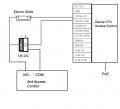
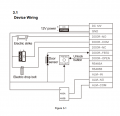
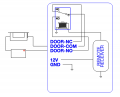
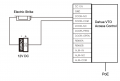
I would like to connect 2 Access Controls to a single Electric Lock. I currently have a single Access Control (Dahua model VTO3211D-P2-S2) that is powered via PoE, and have connected it with an Electric Lock as the following diagram shows:
system.png
Can anyone tell me if I can connect a second RFID based access control to the same Electric Lock (Strike) and how that will affect the current circuit? Also, since I still haven't bought the second access control, what specs should I pay attention to?

Thank you in advance
 

Tonyr1084

Joined Sep 24, 2015
9,744
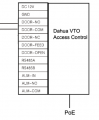
This is just a guess, but looking at the diagram it appears that the controller has a common (DOOR-COM), a normal open (DOOR-NO) and a normal closed (DOOR-NC) connection point. IF I read this right, battery positive goes to the DOOR-COM. When a command is given the DOOR-NO closes the contacts between COM and NO. IF, and that's a BIG "IFFF", IF NC is not connected to anything, in other words, just a dry contact (not powered or grounded) then simply putting a second controller in parallel with the lock should work. HOWEVER, IF (again with the big if), IF NC is connected to something else such as ground, though that doesn't seem likely, connecting a second controller in parallel COULD create a short circuit. Without knowing the inner workings of the controller, it's anyone's guess. Unless you can talk to someone who knows specifically how it works. All I've done is make a guess that it would be OK.

ON THE OTHER HAND, if polarity is not important then switch the battery around so that negative battery connects to COM. That way IF NC is grounded then there will be no short circuits. Test and verify before you make any hard connections. You COULD burn something out. Be careful. Test and verify using very low current. Something like maybe 12mA through a 1KΩ resistor. Again, test and verify.
Screenshot 2024-11-18 at 9.00.57 AM.png
 

Thread Starter

zwoeler

Joined Nov 18, 2024
8
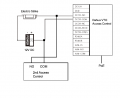
Thank you for your nice answer. By connecting the devices parallelly is this what you have in mind?
system2.png
Also, since the first Access control gets its power through PoE, I wonder if the second device will be able to work properly with this kind of connection, or would I have to connect the power differently?

Thank you again
 

ElectricSpidey

Joined Dec 2, 2017
3,316
Simply paralleling the two controls will work if:

The "strike" is a momentary dis-locking mechanism.

The "strike" is a constantly energized unit keeping the door locked and only one control unit is used at a time.

If one unit needs to override the other, then it becomes a little more complicated.
 

Thread Starter

zwoeler

Joined Nov 18, 2024
8
Simply paralleling the two controls will work if:

The "strike" is a momentary dis-locking mechanism.

The "strike" is a constantly energized unit keeping the door locked and only one control unit is used at a time.

If one unit needs to override the other, then it becomes a little more complicated.
You're right, if both devices close the circuit at the same time, it could again lead to short circuit.
I'm thinking of adding relays, but I'm learning constantly and I'm still rookie in this... :)

On an additional note... is there a way to reuse the same DC power for the second device and the Strike? The first device has no problem, since it's PoE powered.

Thanks
 

Thread Starter

zwoeler

Joined Nov 18, 2024
8
Dose the first device power the unit and electric lock through the PoE?
The first device is powered through PoE, but I have an additional 12V DC supply as drawn in the first image. The question is now, can I use the same supply for the second device as well... :/
 

ElectricSpidey

Joined Dec 2, 2017
3,316
You're right, if both devices close the circuit at the same time, it could again lead to short circuit.
No, that's now what I'm saying.

What I'm saying is for example if control "A" has the strike energized, control "B" cannot de-energize it.

For example, with a 3-way light switch circuit you can control the light from either position no matter what position the other switch is in. You will not be able to do this with the simple parallel configuration.

Frankly I'm not quite sure how an electric strike works so this might not be the case, but I would check and see before you commit to a design.
 

Thread Starter

zwoeler

Joined Nov 18, 2024
8
Frankly I'm not quite sure how an electric strike works so this might not be the case, but I would check and see before you commit to a design.
I'm quite sure that they are quite simple. Once a valid swipe of a RFID card is recorded, they close the circuit (COM and NO) and they send electricity to the electric strike for an amount of seconds (it's configurable on the device). While electricity is passed (circuit is closed), the electric strike stays open.
I'm still not sure what might happen if you swipe correctly 2 cards on both devices and they both close the circuit. Wouldn't it be a problem with the parallel setup?
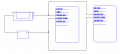
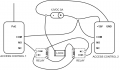
I made this possible solution using 2 relays, which I think will do the trick (while device #1 sends electricity, the device #2 should be disabled and even if someone successfully swipes a card on the #2 device, no electricity will be passed from #2 to the electric strike). Could someone check if what I'm suggesting makes sense?
Azure_IOT-Page-10.drawio (1).png
 

sghioto

Joined Dec 31, 2017
8,634
Wouldn't it be a problem with the parallel setup?
No. You don't need those two extra relays. Besides the lock is shown in series with the relay coils in your drawing.
It won't matter if both cards are used at the same time since there is only one power supply and one lock.
I'm still trying to figure out why you need to two Access controllers to operate one door unless there's a controller on both sides of the door.
 
Last edited:

Tonyr1084

Joined Sep 24, 2015
9,744
Your drawing has me thoroughly confused.
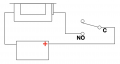
Essentially this is what you have: A controller that closes a set of points whether by relay or by electronic means. I'm using a relay to simulate what the controller does according to how you have it drawn in your first post. This is similar to the drawing in post #6. It's just drawn out with some possible internal means of operation. You can ignore the NC wiring because you aren't using it.
Screenshot 2024-11-18 at 4.36.50 PM.png
This is an equivalent schematic of the overall function. The switch is there only to show how a relay closes a switch.
Screenshot 2024-11-18 at 4.39.27 PM.png
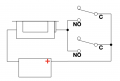
If you parallel the two controllers - assuming they're simple switches, then this is the equivalent schematic of the overall function of TWO controllers. Again, the switch is there only to show how a relay closes a switch.
Screenshot 2024-11-18 at 4.39.43 PM.png
Closing either switch will activate the lock. And I have to admit I am not sure of what an electric strike is.
 

ElectricSpidey

Joined Dec 2, 2017
3,316
I'm quite sure that they are quite simple. Once a valid swipe of a RFID card is recorded, they close the circuit (COM and NO) and they send electricity to the electric strike for an amount of seconds (it's configurable on the device). While electricity is passed (circuit is closed), the electric strike stays open.
I'm still not sure what might happen if you swipe correctly 2 cards on both devices and they both close the circuit. Wouldn't it be a problem with the parallel setup?
I made this possible solution using 2 relays, which I think will do the trick (while device #1 sends electricity, the device #2 should be disabled and even if someone successfully swipes a card on the #2 device, no electricity will be passed from #2 to the electric strike). Could someone check if what I'm suggesting makes sense?
If I'm reading your description correctly then the parallel configuration should work as needed and there is no problem with both controllers being activated at the same time.
 
Top