Common emitter amplifier BJT

Thread Starter

IbrahimF

Joined Jul 21, 2017
25
Hello

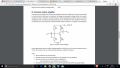
I have an assignment to do I am currently stuck in something. I need to use a BJT transistor BC109 to provide a voltage gain of 80. I have uploaded the requirements in PDF, I did task 1 and 2, I just need help in Task 3. how can I calculate the resistor value and capacitors in order to get a voltage gain of 80. also, can you provide an explanation of how the circuit works? for example, how can I change the frequency and why when changing the frequency the amplification changes.

Thanks
 

Attachments

Bordodynov

Joined May 20, 2015
3,431
I'm sorry, but I will not give you a solution to homework. I showed you that there is a solution. But this decision is very bad. The spread of the current amplification of the transistor and its base-emitter voltage will greatly change the mode of direct current. A more complex circuit with an additional resistor and capacitor in the emitter of the transistor is needed.
 

shteii01

Joined Feb 19, 2010
4,644
Also why does gain decrease when frequency increases?
GBWP

Gain BandWidth Product

Gain times Bandwidth == X

X is some value, this value does not change.
Therefore, if gain increases, then bandwidth has to decrease. If Bandwidth increases, than gain has to decrease.

Example.
Let us look at 741 op amp.
It has GBWP of 1 MHz.

This can be used for a buffer where gain is 1, then bandwidth of the buffer will be 1 MHz/Gain= 1 MHz.

Or you can have a gain of 10 (amplify input by 10, 1 V goes in, 10 V comes out), then the amplifier will work for signals 1 MHz/10= 100,000 Hz (100 kHz).

As you can see, we increase the gain, we, automatically, reduce the range of frequencies where this new gain will actually work.
 

MrAl

Joined Jun 17, 2014
13,702
Hello

I have an assignment to do I am currently stuck in something. I need to use a BJT transistor BC109 to provide a voltage gain of 80. I have uploaded the requirements in PDF, I did task 1 and 2, I just need help in Task 3. how can I calculate the resistor value and capacitors in order to get a voltage gain of 80. also, can you provide an explanation of how the circuit works? for example, how can I change the frequency and why when changing the frequency the amplification changes.

Thanks
Hi,

In general you loose low frequency response with capacitors that are in series with the signal path, and you loose high frequency response with capacitors that are in parallel to the signal path. This makes AC amplifiers really bandpass filters where the pass band width is acceptable for the given application.
In circuits with negative feedback, the opposite is true, where the overall low frequency response is less where there are caps in parallel to the feedback signal path, and the overall high frequency response is less where there are caps in series with the feedback signal path.

In order to really calculate this though we would have to have the entire circuit, with everything known including the source output impedance and load impedance.
 

Thread Starter

IbrahimF

Joined Jul 21, 2017
25
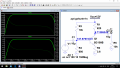
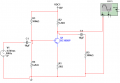
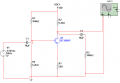
I have actually simulated your circuit in multisim but didnt get a voltage gain of 80
here is my simulation in multisim
upload_2017-9-25_14-8-33.png
I am putting 4.5V in and the oscillscope is showing 11.5V out. is there anything wrong with circuit.
I needed a gain of 80.
so that should Vout/Vin= 80
so it should give me 360 but thats too much. but thats what the lab report is asking in the last lab task.
 

Attachments

MrChips

Joined Oct 2, 2009
34,807
4.5V times gain of 80 = 360V

Where are you going to get 360V from?
Your power supply is only 12V.

There is no free lunch.
 

Thread Starter

IbrahimF

Joined Jul 21, 2017
25
4.5V times gain of 80 = 360V

Where are you going to get 360V from?
Your power supply is only 12V.

There is no free lunch.
Thanks for that sweetheart.
Also do you know how to do calculations or where I can find a resource to tell me how to calculate the components needed.
Thanks love
 
Top