Cleaner that doesnt affect photorest?

Thread Starter

Darkg

Joined Jun 1, 2018
11
I have some boards where a black sticky residue remains after removíng the protective film. Mostly at the edges, so often I just don't use the entire board, but at times I really would like to be able to use it all. Also, the flecks are a bit random, so I cannot reliably plan for it.

Maybe there exists some cleaning agent that is effective yet photoresist safe?

I have tried to remove the tar-like goo with iso-alcohol, but the photoresist layer dissolves also.

(The reason, I think, for this problem is that I stored the boards too hot för some time)
 

jpanhalt

Joined Jan 18, 2008
11,087
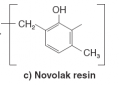
There are different types of photoresists. The chemistries differ. I will assume you are using a positive resist based on Novolac resin with a photosensitizer added (probably napthoquinone diazide).

The base resin (Novolac) has this repeating unit:
upload_2018-8-6_23-53-58.png

The resin is non-polar and water will bead off of it. The sensitizer is more polar. Soap and water might remove the goo, but it might remove some of the sensitizer too. Most strong organic solvents (e.g., toluene, xylene, acetone) will probably remove both. Even plain weak solvents like mineral spirits or VM&P naptha may remove it.

My first try would be to use ordinary masking tape. Stick it to the black smudges and then rapidly pull it off. There is a slight risk of removing the coating. That is what I do with very sensitive plastics, like the plastic used for CD cases.

If that doesn't work, I would try water with a little surfactant, like window cleaner or dish soap (few drops). Water with a little alcohol (but not pure alcohol) might also work. The last thing I would try would be mineral spirits or light naptha.

Any of the above suggestions might ruin the photoresist, so test in a small area you won't be using.
 

Thread Starter

Darkg

Joined Jun 1, 2018
11
Thanks! Several sensible things to try right there. I'll try and report any success or failure. Maybe I will also try 'soft soap' or såpa, potassium soap, that seems to work differently and occasionaly superior to common soap and dish detergent.

I really doubt tape will work, the smudges are pretty sticky. But it is worth a shot!

Yes, positive resist, not sure what brand though.
 

jpanhalt

Joined Jan 18, 2008
11,087
Remember to keep whatever you do acidic or at least close to neutral. Both the resin and photosensitizer are soluble in strong alkali. The resin has a phenolic structure (aromatic OH), which is more acidic than an alcohol (ROH). Mild alkali and short exposure might be tolerated.

As for using tape, you'll be surprised. I use it routinely to get goo from other tape off stuff. A high-grab tape (e.g., 3M tan) will probably work better than the lower grab stuff (e.g., 3M blue).
 

Thread Starter

Darkg

Joined Jun 1, 2018
11
I thought I would have had the chance to try just now, ironically this PCB had only a negligable smudge. I am so dissappointed. My 'soft soap' is said to be at pH 10, concentrated.

Hopefully the next one will be quite awful.
 

Thread Starter

Darkg

Joined Jun 1, 2018
11
Actually, since I worked with a "1 ½ layer" design (l leave the upper layer as is, no etching, as a ground plane or shield or whatnot), I had one more go at goo. Another smudge-nudge. And masking tape really did do a very decent job, albeit I had to make several repetitions. Because I never developed it, I am not absolutely sure there were no ill effects, but I think it will be safe.
Great idea!
 

jpanhalt

Joined Jan 18, 2008
11,087
Yes, it typically takes a few applications. I will often wrap a piece around my finger, sticky side out, which makes it a little easier to do multiple times. And of course, you will need a few fresh pieces. If your making tape is good, that is it doesn't leave goo itself, the final surface should be pretty clean. At least on clear polystyrene plastic (like CD boxes) they are left optically clean.
 

ian field

Joined Oct 27, 2012
6,536
I have some boards where a black sticky residue remains after removíng the protective film. Mostly at the edges, so often I just don't use the entire board, but at times I really would like to be able to use it all. Also, the flecks are a bit random, so I cannot reliably plan for it.

Maybe there exists some cleaning agent that is effective yet photoresist safe?

I have tried to remove the tar-like goo with iso-alcohol, but the photoresist layer dissolves also.

(The reason, I think, for this problem is that I stored the boards too hot för some time)
The usual CFC solvents have been banned - I usually use car paint cellulose thinners ("gunwash" is cheaper) - the resist is fairly robust, some need specialist resin disintegrator solvents to do anything.
 

jpanhalt

Joined Jan 18, 2008
11,087
The usual CFC solvents have been banned - I usually use car paint cellulose thinners ("gunwash" is cheaper) - the resist is fairly robust, some need specialist resin disintegrator solvents to do anything.
I am a little surprised that automotive lacquer thinner does not affect typical Novolac positive photoresist, as the solvent for the photoresist contains similar solvents as are in that lacquer thinner.

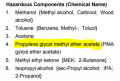
Here is one formulation for lacquer thinner:
upload_2018-8-7_17-21-31.png

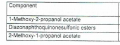
Here are the solvents in mungolux positive resist:
upload_2018-8-7_17-24-49.png
(Source: http://nanofab.asrc.cuny.edu/wp-content/uploads/sites/7/2015/11/AZ-5214-E-Photoresist-msds.pdf )

1-Methoxy-2-propanol acetate and propylene glycol methyl ether acetate are the same chemical, excepting for possibly different isomers (different isomers will not greatly change the solvent power). Furthermore, MEK by itself will remove the unexposed photosentive coating. It is an alternative for cleaning off resist after etching. It is possible that you are simply "re-flowing" the photoresist layer in the process of cleaning it. Also, some of the DuPont photoresists are quite different and use fairly aggressive solvents just to develop the board prior to etching.

In any event, if the TS decides to use lacquer thinner, I hope he will test a small part only and report back.
 

Thread Starter

Darkg

Joined Jun 1, 2018
11
Well, learning how well tape worked, other dry methods may be worth exploring too, I wouldn't rule out an eraser for example.
 

ian field

Joined Oct 27, 2012
6,536
I am a little surprised that automotive lacquer thinner does not affect typical Novolac positive photoresist, as the solvent for the photoresist contains similar solvents as are in that lacquer thinner.

Here is one formulation for lacquer thinner:
View attachment 157699

Here are the solvents in mungolux positive resist:
View attachment 157700
(Source: http://nanofab.asrc.cuny.edu/wp-content/uploads/sites/7/2015/11/AZ-5214-E-Photoresist-msds.pdf )

1-Methoxy-2-propanol acetate and propylene glycol methyl ether acetate are the same chemical, excepting for possibly different isomers (different isomers will not greatly change the solvent power). Furthermore, MEK by itself will remove the unexposed photosentive coating. It is an alternative for cleaning off resist after etching. It is possible that you are simply "re-flowing" the photoresist layer in the process of cleaning it. Also, some of the DuPont photoresists are quite different and use fairly aggressive solvents just to develop the board prior to etching.

In any event, if the TS decides to use lacquer thinner, I hope he will test a small part only and report back.
yup - I misread "photoresist". That's designed to be easy to remove undeveloped coating, so you have to be pretty careful! Might get away with dilute isopropyl - see if the contamination interferes with developing the chemical first. Might be least bad to put up with it.
 
Top