Circuit for LED flashlight

Ya’akov

Joined Jan 27, 2019
10,235
Real 365nm LEDs do produce some visible light but it is very high frequency and hard on the eyes. This is because LEDs are not monochromatic. The rating of 365nm is "dominant frequency". Good 365nm flashlights include high pass optical filters so the unwanted visible light is suppressed. You can't tell they are turned on without pointing them at something fluorescent.

Some emit at both 365nm and 395nm. Those look very purple but also cause fluorescence. This is less desirable for some applications where the fluorescence is the desired effect but for UV curing the only downside is some power going to a less useful wavelength than 365nm.

Good quality 365nm emitters are expensive. A 5mm 20ma device will cost about $1.00.
 

Thread Starter

PsySc0rpi0n

Joined Mar 4, 2014
1,786
Well, the voltage drop I can measure is 3.117V in 6 of the 9 leds and 3.12V on the other 3 leds. But I couldn't see the stripe in a 10€ bill. I recorded a small video clip from a top position because the screens I posted above were taken in a lateral position and indeed, they look very blue-ish, but observed from above, the purple becomes more clear!

However, I couldn't cure 2 small drops of solder mask. I had almost to completely flatten out the 2 drops so that they become a very thin layer of solder mask on the paper to be able to harden it!


MrSalts

Joined Apr 2, 2020
2,767
Well, the voltage drop I can measure is 3.117V in 6 of the 9 leds and 3.12V on the other 3 leds. But I couldn't see the stripe in a 10€ bill. I recorded a small video clip from a top position because the screens I posted above were taken in a lateral position and indeed, they look very blue-ish, but observed from above, the purple becomes more clear!

However, I couldn't cure 2 small drops of solder mask. I had almost to completely flatten out the 2 drops so that they become a very thin layer of solder mask on the paper to be able to harden it!

Either your UV LED is counterfeit or your 10€ note is.
 

bloguetronica

Joined Apr 27, 2007
1,544
That voltage drop seems to be more in the ballpark for what is expected of a blue LED, although a tad high. Your LEDs were clearly sold as UV, but they are not. They are near UV, but that's it.

A photon energy of 3.11eV corresponds to a wavelength of 398nm.
 

Thread Starter

PsySc0rpi0n

Joined Mar 4, 2014
1,786
Blue to violet is 3.2.
3.2 to 3.5 for violet to barely UV

3.5 to 5v for UV A, 7.5V to 12V+ for UVC.
So, that means I was kinda scammed, no? Regarding the LEDs.

That voltage drop seems to be more in the ballpark for what is expected of a blue LED, although a tad high. Your LEDs were clearly sold as UV, but they are not. They are near UV, but that's it.

A photon energy of 3.11eV corresponds to a wavelength of 398nm.
How do you perform that conversion from (what is that eV unit of measure?) eV to wavelength?
 

bloguetronica

Joined Apr 27, 2007
1,544
eV basically is electron-volt, and it is the unit that represents the of energy of a photon. It is directly (rather, inversely) correlated to the wavelength by the Plank's constant. Basically:

E = h * c / l, where E is the energy, h the Plank's constant, c the speed of light and l the wavelength.

However, you can simply search the web for "KMLabs"+"Photon Unit Calculator". Mind that LEDs are not 100% efficient, and since some energy is lost on heat, the wavelength of the emitted photons may be a tad higher. However, this gives a close enough (and rather optimistic) figure.
 

Thread Starter

PsySc0rpi0n

Joined Mar 4, 2014
1,786
eV basically is electron-volt, and it is the unit that represents the of energy of a photon. It is directly (rather, inversely) correlated to the wavelength by the Plank's constant. Basically:

E = h * c / l, where E is the energy, h the Plank's constant, c the speed of light and l the wavelength.

However, you can simply search the web for "KMLabs"+"Photon Unit Calculator". Mind that LEDs are not 100% efficient, and since some energy is lost on heat, the wavelength of the emitted photons may be a tad higher. However, this gives a close enough (and rather optimistic) figure.
And you consider eV the same as simply V, right?
 

bloguetronica

Joined Apr 27, 2007
1,544
Yes, but this is just a guideline. I've seen perfectly good blue LEDs dropping 3.6V when driven at 16mA, which means that, in reality, some energy is lost (account for resistance, and some other obscure mechanism). It depends on many other factors, but mainly on the substrate of the die itself. There are substrates more "efficient" than others. GaN LEDs, for instance, require a significant voltage in order to be driven, although they don't emit any light near violet, as they are purely blue.
 

Thread Starter

PsySc0rpi0n

Joined Mar 4, 2014
1,786
Ok, so I think I got it it wrong from the beginning. I completely misinterpreted the wavelength and assumed the higher the better to cure solder masks and apparently is exactly the other way around, right? The lower the wavelength the more I get into the UV zone of the colour spectrum. I should have chosen a LED with the lowest wavelength I could find.
 

Ya’akov

Joined Jan 27, 2019
10,235
Ok, so I think I got it it wrong from the beginning. I completely misinterpreted the wavelength and assumed the higher the better to cure solder masks and apparently is exactly the other way around, right? The lower the wavelength the more I get into the UV zone of the colour spectrum. I should have chosen a LED with the lowest wavelength I could find.
You should choose according to the data sheet for the solder mask you are trying to cure. It will probably say 365m.
 

bloguetronica

Joined Apr 27, 2007
1,544
The lower the wavelenght, the more energetic the light is. In fact, UVs with shorter wavelengths are far more ionizing. What you'll need is radiation that is capable of "ionizing" the resin and make it cure. However, you don't need to go into UVB or UVC territory. Just make sure that your LED emits well under UVA.

As Yaakov pointed out, follow the recommended curing for that resin in particular. By the way, some modern resins are more reactive and even cure under blue light. However, I don't think they are used in that application. I've seen them being used in 3D printing, so you may want to hold on to your prototype and build another version with proper UV LEDs.
 

Ya’akov

Joined Jan 27, 2019
10,235
By the way, some modern resins are more reactive and even cure under blue light. However, I don't think they are used in that application. I've seen them being used in 3D printing, so you may want to hold on to your prototype and build another version with proper UV LEDs.
i think some dental fillers and adhesives might have requirements more to the blue end, perhaps to avoid the more hazardous frequencies.
 

Thread Starter

PsySc0rpi0n

Joined Mar 4, 2014
1,786
You should choose according to the data sheet for the solder mask you are trying to cure. It will probably say 365m.
Bad news. lol
Solder mask was also bought in Aliexpress, so, I'm not sure I'm going to find a datasheet for that particular solder mask! But I'll take a look later when I'm at home!
 

Thread Starter

PsySc0rpi0n

Joined Mar 4, 2014
1,786
What I can see in the solder paste is this reference:
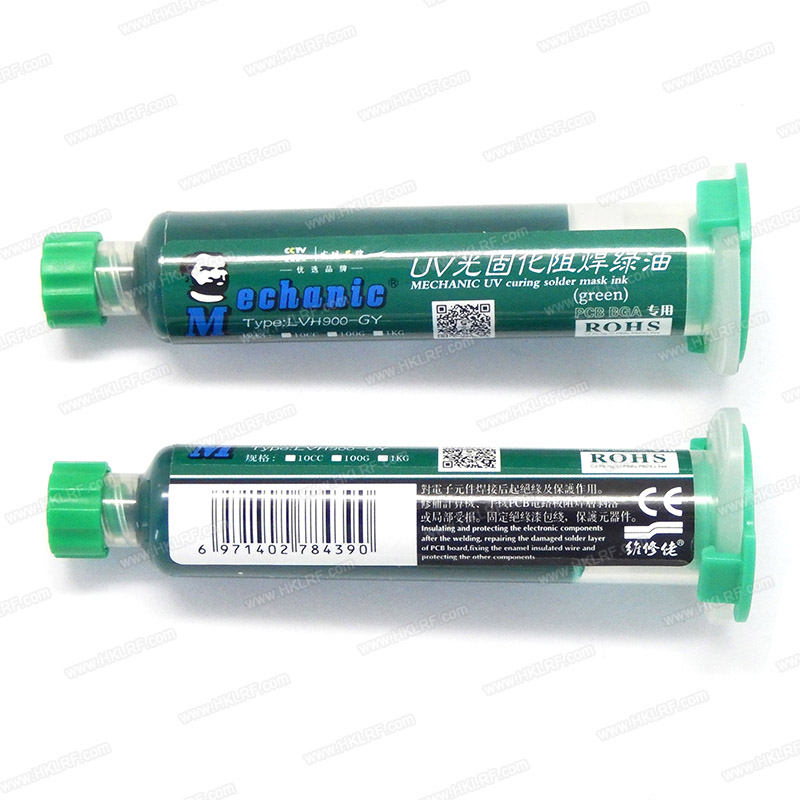
Type: LVH900-GY

This is exactly the seringe I have, but I find no characteristiccs regarding wavelength recommended.
 

MrSalts

Joined Apr 2, 2020
2,767
Did you Google? Looks like the manufacturer says...


Usage:
Apply paint on your PCB.
Spread it on the PCB with covering the transparent mask film.
Expose it under UV light ( or sun ) for a few minutes.
Wash away the extra paint by gasoline or oil base solvent.
 

Thread Starter

PsySc0rpi0n

Joined Mar 4, 2014
1,786
Did you Google? Looks like the manufacturer says...


Usage:
Apply paint on your PCB.
Spread it on the PCB with covering the transparent mask film.
Expose it under UV light ( or sun ) for a few minutes.
Wash away the extra paint by gasoline or oil base solvent.
Of course I googled it. I couldn't find anything saying a wavelength for this mask. Only generic wording just like the one you posted. But that doesn't tell me if 395nm is ok for the mask to be cured!
 

MrSalts

Joined Apr 2, 2020
2,767
Of course I googled it. I couldn't find anything saying a wavelength for this mask. Only generic wording just like the one you posted. But that doesn't tell me if 395nm is ok for the mask to be cured!
Try it. If it fails, try sunlight - in a few days (March 21), the entire world (including the poles) will be covered by it.
 

Thread Starter

PsySc0rpi0n

Joined Mar 4, 2014
1,786
Try it. If it fails, try sunlight - in a few days (March 21), the entire world (including the poles) will be covered by it.
I just tried again, a little bit of solder mask, but this time I didn't let the drop of mask just like a drop. I actually spread the drop wide and made it a thin layer. The mask got cured in like 10 mins or so.
But I0ve seen people getting help of a hot air station and cure it in a few seconds! But probably with a shorter wavelength.
 
Top