Circuit building - Do not know where to post this

Danko

Joined Nov 22, 2017
2,169
DC supply I used had a current control setup as well, but when I switched on the circuit, there were no readings in current but the voltage was set to maximum.
Very good sign. It means your electrode system may take big current and protection circuit is tripped.
What is max current of your PS? 5 A? You can connect in series with one wire wirewound resitor 5-8 Ω
or decrease voltage of PS.
 

MisterBill2

Joined Jan 23, 2018
27,570
Thank you very much for showing concern :)
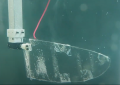
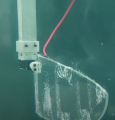
I would have settled for lower voltages if it had worked out. A picture is attached for a trial with 12V DC supply. I do not have video files with 30V supply and they were much better than the attached picture. And bubble generator cannot be used as the wire arrangement is such that it is wound to the object. So I had to choose this way. Any other methods to achieve the same is much appreciated (just that they should not disturb or add other disturbances to the flow other than the disturbance caused by the wing itself).


Thank you very much for the detailed answer. How should I consider the rating of the components, as I mentioned earlier the rectifier (is it the correct one that I purchased)? The pulse timing is to get time dependent data. It may be added at later stages if I am successful with the initial trials. And the timing will depend on where I want to collect my data. So I can skip if it makes the circuit complicated.
Also, where should I connect these components (breadboard, Veroboard etc.)? Will soldering be sufficient for this job?
A similar circuit is also attached here, but this was an old circuit used in 1960 to perform similar experiments. I think you can get more insight if you have a look.


Thank you for the detailed and critical approaches mentioned but following are the things I tried-
The experimental image is attached, and the gap was kept as small as possible. And sodium sulfate was added to the water for more ion availability.
I do not know how to control current, the DC supply I used had a current control setup as well, but when I switched on the circuit, there were no readings in current but the voltage was set to maximum.


Regards all,
Raj Kiran.
In the circuit shown in post #19, the 50 ohm resistor between the NC relay contact and ground serves no purpose at all.
 

Thread Starter

rakkiran

Joined Mar 28, 2023
14
Very good sign. It means your electrode system may take big current and protection circuit is tripped.
What is max current of your PS? 5 A? You can connect in series with one wire wirewound resitor 5-8 Ω
or decrease voltage of PS.
My PS has a rating of 10A and 0-30V .
 

MisterBill2

Joined Jan 23, 2018
27,570
Given that the setup is only intended to produce a small amount of small bubbles, all of those dire predictions do not apply.
Fear is a terrible chain to be burdened with.
Since the purpose is for observation it makes the most sense to have the bubble generation under user control. So I suggest not using that electronic control, but rather a momentary switch to control the mains supply to the transformer. Then the mode of operation would be to switch on until you see enough bubbles forming the cloud to watch it move. Then release the switch.
About as simple as possible, with the user handling all of the logic functions. With such small electrode areas the gas generation will not be so very much.
But the high voltage will still be present and so all of the precautions remain in effect, when the power is switched on.
 

Thread Starter

rakkiran

Joined Mar 28, 2023
14
@Danko @Wendy
Attached are the images for wing movement with a power source of 30-35V DC and 10 A. At speeds with a frequency of 0.1 Hz my bubbles are just vanishing. Any suggestions?

@MisterBill2
Can I send the component links before I purchase, and can you please tell whether they are correct or not?
Also, where should I assemble the circuit? I only used breadboards, and I think they are not compatible with the present setup. So what should be the alternative for breadboards?
 

Attachments

Irving

Joined Jan 30, 2016
5,134
In the circuit shown in post #19, the 50 ohm resistor between the NC relay contact and ground serves no purpose at all.
I beg to differ... the capacitor will be charged to some 200 - 400v depending on line voltage. When the relay is de-energised it serves to discharge the capacitor and hopefully avoid giving someone a nasty reminder not to play with high voltages unless they know what they are doing!
 

Irving

Joined Jan 30, 2016
5,134
So what should be the alternative for breadboards?
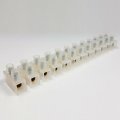
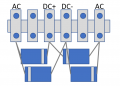
For a high-voltage setup like like this I'd recommend using 'chocolate blocks" screwed to a wooden board. Other components can be screwed to the board or attached to veroboard and screwed down. Your DF10S rectifier is problematic as its a surface mounted part and not easily used this way. You would be better off with four 1N5407 (800v 3A diodes) screwed in the chocolate block like this:

s-l1600.jpg1680270430135.png
 

Wendy

Joined Mar 24, 2008
23,798
Electrolysis requires DC voltage. So you will need a full bridge rectifier in addition to the transformer. Diode bridges do not have to be made with diodes you can buy them as components.
 

MisterBill2

Joined Jan 23, 2018
27,570
Terminal strips attached to a wood block of adequate size to also support the transformer are certainly a valid way to create an assembly that is both stable and fairly durable. There are also solder type strips that cost much less,
And with a bit of advance planning, once a working system is created, sides and a lid can be added to provide a finished package.

And yes, rectification can be provided by either discrete diodes or a bridge package. And any filter capacitor should be upstream from a relay used to switch the bubbles on and off. That will reduce the number of current surges and avoid much wear on the relay contacts. Then a smaller pushbutton can be used to control the power from the observation position.

And if the 300+ volts DC is a lot more than needed, primary and secondary can be exchanged, resulting in about 60 volts AC and about 90 volts DC to make bubbles. A cheap-save if it is needed.
 

Irving

Joined Jan 30, 2016
5,134
Electrolysis requires DC voltage. So you will need a full bridge rectifier in addition to the transformer. Diode bridges do not have to be made with diodes you can buy them as components.
This is true, but given the TS lack of experience wiring up a bridge safely (attaching push-on connectors to wires, or soldering them properly) IMHO is more complex than screwing down into a chocolate block which is easy to do and validate visually.
 

Thread Starter

rakkiran

Joined Mar 28, 2023
14
Hello All,
Thank you for the suggestions @Irving @MisterBill2 @Wendy.
Following are the items I got online according to the circuit given in picture-
Will they meet the given criteria. Kindly let me know for the missing alternatives and the passive components in the circuit -
Mosfet - https://www.amazon.in/Irfz44n-220-N...8442541&sprefix=mosfet+mtp4n50,aps,371&sr=8-2

Opto isolator - https://www.amazon.in/PCS-MOC-3021-...refix=opto+isolator+4n26,aps,325&sr=8-2-fkmr1

Multivibrator - https://www.mouser.in/ProductDetail/Texas-Instruments/SN74121N?qs=gb35HGp1gQLBY4LcSLIySA==

For transformer I am planning to use something as voltage convertor for safety -
https://www.amazon.in/dp/B08ZS4V6ZF?ref_=cm_sw_r_apan_dp_9TBQ8KHJM8GF5MXDCYTP

Kindly comment on the improvements or faults in the equipment. Also the passive components like capacitors, resistors I will add in the mean time.
 

MisterBill2

Joined Jan 23, 2018
27,570
Hello All,
Thank you for the suggestions @Irving @MisterBill2 @Wendy.
Following are the items I got online according to the circuit given in picture-
Will they meet the given criteria. Kindly let me know for the missing alternatives and the passive components in the circuit -
Mosfet - https://www.amazon.in/Irfz44n-220-N-Channel-Transistor-Mosfet/dp/B07LCQ74GJ/ref=sr_1_2?crid=1KAXXW2W55MR3&keywords=mosfet+mtp4n50&qid=1678442541&sprefix=mosfet+mtp4n50,aps,371&sr=8-2

Opto isolator - https://www.amazon.in/PCS-MOC-3021-DIP-Random-ISOLATORS/dp/B07G79YKLM/ref=sr_1_fkmr1_2?crid=21F16TVMP9689&keywords=Opto+Isolator+4N26&qid=1678442842&sprefix=opto+isolator+4n26,aps,325&sr=8-2-fkmr1

Multivibrator - https://www.mouser.in/ProductDetail/Texas-Instruments/SN74121N?qs=gb35HGp1gQLBY4LcSLIySA==

For transformer I am planning to use something as voltage convertor for safety -
https://www.amazon.in/dp/B08ZS4V6ZF?ref_=cm_sw_r_apan_dp_9TBQ8KHJM8GF5MXDCYTP

Kindly comment on the improvements or faults in the equipment. Also the passive components like capacitors, resistors I will add in the mean time.
tHE TRANSFORMER FROM Amazon is terribly expensive and far more than your application requires. It is at least ten times the price of an entirely suitable industrial quality transformer. Generating a few gas bubbles will not require nearly 600 watts, a 100 watt transformer should do quite well.
challenge, I am not familiar with the TS skill set.
And Amazon is probably not a good place to shop for a plain power transformer. A hundred watt unit should cost less than $100 from an industrial electrical shop. And a used or surplus transformer may run well below that price.
And I see that the plan is still to use a pulsed drive rather than just a button to press when bubbles are wanted. Assembling that circuit might be a
 
Last edited:

Thread Starter

rakkiran

Joined Mar 28, 2023
14
tHE TRANSFORMER FROM Amazon is terribly expensive and far more than your application requires. It is at least ten times the price of an entirely suitable industrial quality transformer.
Ok can you suggest like what type of transformer I can go with?
And I am just purchasing it to keep inline with the circuit whereas a switch system is the first thing I will do. As it will make my life easy.
 
Last edited:

MisterBill2

Joined Jan 23, 2018
27,570
A suitable transformer would normally be sold as a step-down or step up, 120 volt to 240 volt transformer, rated for 100 watts. Based on post #1, your mains supply is 120 volts and the transformer in that circuit is probably a controls transformer, stepping up 115 volts to 230, the same ratio.
An added benefit is that if the resulting high voltage is way too much, the connections can be exchanged and it can step down 120 volts to 60 volts.
So what you need is a controls transformer.
 

Thread Starter

rakkiran

Joined Mar 28, 2023
14
A suitable transformer would normally be sold as a step-down or step up, 120 volt to 240 volt transformer, rated for 100 watts. Based on post #1, your mains supply is 120 volts and the transformer in that circuit is probably a controls transformer, stepping up 115 volts to 230, the same ratio.
An added benefit is that if the resulting high voltage is way too much, the connections can be exchanged and it can step down 120 volts to 60 volts.
So what you need is a controls transformer.

And also I am from India so my normal voltage is 220-240 V AC from the plug points.
I am unable to find exactly the control transformer but can I use something like this
https://robu.in/product/4000w-high-...cvEGkrDdfJK6v5Z_3s3poEZgEayO6G3IaAtEbEALw_wcB

Can I use this as a transformer instead?
 

Wendy

Joined Mar 24, 2008
23,798
Are you still planning on converting it to DC? I think you could use that. Never tried it myself. Be sure the diodes can handle the 240 AC volts.
 

MisterBill2

Joined Jan 23, 2018
27,570
Actually, with that device you will only need the isolation transformer in addition.
And in India there certainly should be a seller of industrial transformers.
That controller by itself should be able to provide power suitable for the required bubble generating scheme, the only lacking thing is isolation.
In this application the isolation portion is only to avoid a shock hazard, because that controller is not isolated. For isolation using that controller you would need a 1:1 ratio transformer rated for at least 400 watts. That should not be so difficult to find in surplus.


Contact "Automation Direct" they do sell control transformers for less than others. And they do sell internationally.
 
Top