Facebook
 Google
 GitHub
 Linkedin
Here's the circuit below:
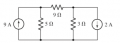
I am tasked with adjusting the size of the 5 Ω resistor so that maximum power is delivered to the 9 Ω resistor. So I approach this as a maximum power transfer question. Turning off the ideal sources leaves me with a 5 Ω and 3 Ω resistance in series. So I would think that replacing the 5 Ω with a 6 Ω resistor will maximize the power transferred (to get a Thévenin resistance of 9 Ω—the same as the load).
But I am wrong! The correct answer is that the wire with the 5 Ω resistor is open-circuited so as to produce a maximum current of 9 A going to through the 9 Ω resistor to deliver maximum power to that resistor.
I was reading through my book and it gives some explanation on why maximum power transfer theorem failed me:
I am tasked with adjusting the size of the 5 Ω resistor so that maximum power is delivered to the 9 Ω resistor. So I approach this as a maximum power transfer question. Turning off the ideal sources leaves me with a 5 Ω and 3 Ω resistance in series. So I would think that replacing the 5 Ω with a 6 Ω resistor will maximize the power transferred (to get a Thévenin resistance of 9 Ω—the same as the load).
But I am wrong! The correct answer is that the wire with the 5 Ω resistor is open-circuited so as to produce a maximum current of 9 A going to through the 9 Ω resistor to deliver maximum power to that resistor.
I was reading through my book and it gives some explanation on why maximum power transfer theorem failed me:
I'm lost on the why this is. I've tried to think about the last sentence but I just don't understand. Could someone give an intuitive explanation as to why maximum power transfer works one way (finding the best load) but not the other (load is already specified)?It is also not uncommon for the maximum power theorem to be misinterpreted. It is designed to help us select an optimum load in order to maximize power absorption. If the load resistance is already specified, however, the maximum power theorem is of no assistance. If for some reason we can affect the size of the Thévenin equivalent resistance of the network connected to our load, setting it equal to the load does not guarantee maximum power transfer to our predetermined load. A quick consideration of the power lost in the Thévenin resistance will clarify this point.