CC driver to power 700mA 9,4V LED from 3S2P battery

Thread Starter

Lagom

Joined Feb 8, 2019
41
Hi, I have the following components:

LEDs: 700mA typ.; Vf typ. 9,4V; low 8,6V; high 10,2V
Li-Ion battery packs: rechargeable 3S2P 15,000mAh; 12,6V max. charge; 11,1V nominal; 9,3V cut-off from protection circuit

There seems no ready made CC buck/boost driver on the market with a near zero voltage drop, so it appears I have to design my own. On which vendor's IC should I base such a circuit? Where must I begin?

Many thanks in advance!
 

Thread Starter

Lagom

Joined Feb 8, 2019
41
RECOM has such a device, but only for up to 500mA. MEAN WELL also, but only for up to 600mA.

From that I would think I could put such a device together for 700mA? But where to start, with which IC?
 

bassbindevil

Joined Jan 23, 2014
918
Just use a resistor? For most applications it doesn't matter much if the LED becomes dimmer as the battery runs down. And as the LED current decreases, the battery run-time will be extended.
 

ronsimpson

Joined Oct 7, 2019
4,646
Just use a resistor?
With a LED voltage of 8,6V to10,2V and a battery voltage of 9.3 to 12.6 what resistor would you use?

Any good PWM will hold the current to with in 1% over the batteries range. Some will regulate temperature first and current second. Some of my torches will run at 135% current on a winter night and 80% on a hot day. The temperature of the LED die was watched to extend the LED's life and to give us a very high light output for the first two minutes. We used big heat sinks on the LEDs.
 

Thread Starter

Lagom

Joined Feb 8, 2019
41
Thanks for the answers so far.

As the battery voltage changes as it depletes, and the LED voltage being in a range, a resistor wont't work, because how could it be well or at least reasonably dimensioned? That leaves 1. designing a circuit with the IC mentioned above or alternative ICs, or 2. using the MEAN WELL component. Regarding the latter, with 600mA, the LED's specification sheet on page 6 suggests that one would achieve around 85% of luminous flux, which might be acceptable, although not ideal.
 

bassbindevil

Joined Jan 23, 2014
918
Measure the LED voltage at the specified maximum current, then use a resistor that gives that current with a battery voltage at 12.6. As current decreases, so will the voltage drop across the LEDs, so it's less of a compromise than you might think. See the "Forward Current vs. Forward Voltage" graph in the data sheet. It'll only cost you a resistor to try this out.
Alternatively, there's the 350 mA constant current driver chip that's found in zillions of flashlight drivers, the AMC7135. They can be paralleled for more current. The current sink pin is OK with up to 18V, but the Vdd pin needs 6V or less, which could be a PWM output from a microcontroller or a 555 timer.
 

Thread Starter

Lagom

Joined Feb 8, 2019
41
Thanks, it sounds like I should first try out the resistor approach, setting the PSU to the rated current at 12.6V, when the solar modules have fully charged the battery.
 

Thread Starter

Lagom

Joined Feb 8, 2019
41
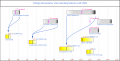
Made myself a chart, to see the various matching issues to solve (resistor or building an own circuit with a suitable IC). Price wise, still settled on an nominally 11,1V Lithium-Ion battery pack.

Not that it matters here, but I find the nominal versus usable voltage range of LiFePO4 batteries the most peculiar. Why do vendors label these as 12V, if the lowest allowed cut-off after hours of use is at 12.8V?

Voltage discrepancies batteries LEDs.png
 

crutschow

Joined Mar 14, 2008
38,316
LEDs: 700mA typ.; Vf typ. 9,4V; low 8,6V; high 10,2V
Li-Ion battery packs: rechargeable 3S2P 15,000mAh; 12,6V max. charge; 11,1V nominal; 9,3V cut-off from protection circuit
From those voltages, I would think you only need a buck converter.
The buck should deliver the full battery voltage if it drops to equal to, or below the LED voltage, and I suspect under low battery voltage conditions you will see very little drop in the LED brightness.

Using a resistor will reduce efficiency and cause a significant change in brightness as the battery discharges.
 
Top