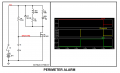
The above circuit after modification, inserting a diode at base of transistor 22, and applying 9V actually works and gives a minute delay. But, since the current is very low toward the cap, the leakage path must be considered and also the type of SCR. I still don't understand why some of the similar SCRs don't work, whereas others do. Regards
The above circuit after modification, inserting a diode at base of transistor 22, and applying 9V actually works and gives a minute delay. But, since the current is very low toward the cap, the leakage path must be considered and also the type of SCR. I still don't understand why some of the similar SCRs don't work, whereas others do. Regards
Regarding the background of circuit, it was a patent for some other application but I am going to use it as a permitter defence i.e security alarm.
I need something compact for tent security when I go camping.
There is a problem with this circuit. The original document specified 3V for power supply. However, the capacitor 13 is only charges to around 0.6v and then stops when I used 3V, and it doesn't trigger SCR 7. I tried 9v and it works sometimes with this voltage. When I disconnect the gate of SCR 7, it seems to be charging fully. I am using TICP106D SCR. In the original document the SCR was BRY55. Both are sensitive gate SCR as far as know, so they should be interchangeable. Both have max Igt 200uA. I don't understand why the current is leaking this much through the gate. Do you have any suggestion? Disregard the rest of the circuit as they have no effect on capacitor 13.
Me too! -- I'm thinking an 'electric fencer' modded for load indication might be a better choice for the additional function of deterrence offered thereby - Be it known, however, that site policy prohibits discussion of such devices is deployment against 'human varmints' anticipated - more's the pity
I go camping in the remote part of the world frequently. Last time in the middle of the light we had a burglar visited our tent, so for the next time I want to install a break wire alarm around our tent to deter intruders or animals. This circuit had a great potential as it had the features I needed, compact, low power consumption and simple but effective design, only if I could the bloody thing to work. Regards
I go camping in the remote part of the world frequently. Last time in the middle of the light we had a burglar visited our tent, so for the next time I want to install a break wire alarm around our tent to deter intruders or animals. This circuit had a great potential as it had the features I needed, compact, low power consumption and simple but effective design, only if I could the bloody thing to work. Regards
Inasmuch as 'floating' an insulated gate produces unpredictable (and, necessarily, undesirable) operation, I strongly suggest that the tripwire intervene T1 and T2 (as intended?) -- as opposed to establishing the gate connection as drawn...
FWIW I'm bound to say that @EM Fields circuit (post #27) is an excellent solution for your application (granting that the 'trip wire' is taken to intervene T1 & T2)...
Inasmuch as 'floating' an insulated gate produces unpredictable (and, necessarily, undesirable) operation, I strongly suggest that the tripwire intervene T1 and T2 (as intended?) -- as opposed to establishing the gate connection as drawn...
Sorry for any confusion. The tripwire is drawn as the dotted line between T1 and T2.
In the case where the tripwire is intact, T1 and T2 will be shorted and the gate of the MOSFET will always be grounded by the tripwire, which will keep the drain-to-source path open, forcing the LED and the buzzer into their OFF states.
However, if the trip wire is broken, the MOSFET will be biased ON through R1's connection to Vcc, the LED will light, and the buzzer will buzz.
Since there's really no need for any LEDs, and it's unlikely that the tripwire will heal itself once it's been broken, an even simpler (more reliable?) version, using a piezo beeper/buzzer, is:
Where, in use, with S1 set to OFF, the tripwire is connected between T1 and T2 and S1 turned ON. If there's a problem with the tripwire connection during setup, the beeper will sound, but if there is no problem the beeper will remain silent until the wire is broken by an intruder.
I have posted a new thread about an improved design based on NAND gates. It can also be used for windows and door protection by replacing tripwire with reed switch or NC contact. It is immune to noises and RF signals. Let me know what you think.
I have posted a new thread about an improved design based on NAND gates. It can also be used for windows and door protection by replacing tripwire with reed switch or NC contact. It is immune to noises and RF signals. Let me know what you think.
I have posted a new thread about an improved design based on NAND gates. It can also be used for windows and door protection by replacing tripwire with reed switch or NC contact. It is immune to noises and RF signals.
To what, might I ask, do you owe that conclusion?! The 'EMI liability' of the CD4000 series is nothing short of 'legendary'!... Inasmuch as you seem determined upon an unnecessarily labor intensive approach to a simple application, I suggest you 'go the extra yard' and bypass all inputs and rails (with 10nF - 100nF capacitors) at the chips!...
The long piece of tripwire can act as an antenna and might pick up RF. I am trying to reduce this effect by twisting the wire loop and adding a ferrite bead, also using a low pass cap. Since this is my own design, I want to improve it as much as I can and utilise it for the house protection as well when I am away. So I can't afford to have false alarms and drive the neighbours crazy. The beauty of this device is you can use any NC contact such as reed switches, normally closed switches etc., thus it can be used for windows and doors. You might ask why I don't buy one? where is the fun in that? beside, most of the commercial alarms are not portable. I just need to make sure that my circuit is stable and reliable. I have to find how to stabilise ( I don't know if this term actually applies) the inputs and outputs of the gates now.
Well hey! -- Thanks for your continued courtesy following my (in retrospect) unduly brusque reply
Inasmuch as you will be implementing your system via digital logic - I suggest the following, readily realized, enhancements:
1) In addition to appropriate bypassing/shielding, liability to false alarms may be further reduced via implementation of a 250ms latency (such will typically be effective against high level RF bursts and EMP magnitudes up to and including those attending nearby lightning strikes).
2) Increased security may be achieved via 'latching' of the alarm condition following said latency (such that the alarm may not be silenced via mere re-connection of the tripwire).
Note that, inasmuch as the above enhancements need be active only during 'trip' or alarm conditions (respectively), they needn't significantly increase standby current...
Thank you HP for the kind reply. Regarding the first suggestion, I assume this latency should be on the inputs of gates that are normally low in the standby mode so the RF and EMP bursts do net get a chance to rise the inputs to high. This is great. what is the standard method to introduce this latency? a resistor and a ceramic capacitor?
assume this latency should be on the inputs of gates that are normally low in the standby mode so the RF and EMP bursts do net get a chance to rise the inputs to high.
No... - What you are describing is bypassing and 'weighting' (the former of which is also a very good idea!)
'Latency', in this context, refers to a scheme whereby an open tripwire condition must persist for a predefined period (CIP 250 ms) prior to triggering an alarm condition (which offering significant 'immunity' to induced TED/EMP, etc)... -- Such a scheme is readily implemented via decoded counter{s} (e.g. CD4017) in conjunction with an appropriate clock... Or, perhaps more practically for your application, via low power analogue timing devices (e.g. TLC555, ICM7555, etc...).
As regards bypassing:
The PS rails should be bypassed via 100nF caps close in to each package whereas bypassing of the I/O lines is a compromise between maintenance of acceptable transition times and noise immunity -- Definitely bypass the 'lower end' of R4 to ground via (at least) 10nF -- Moreover, It may be advisable to replace U3.1, U4.1 and U8.1 with three units of a CD4093!
It's finally finished. Here is the final diagram in case you'r interested. Now the hard part is to convert it to a gerber file for making a PCB. It works on the breadboard by the way. The requirement for PCB is to make the ground line as wide as possible, ideally a ground plane and placing C3 and C4 very close to VDD and VSS of each IC.

 Facebook
 Google
 GitHub
 Linkedin



 - Be it known, however, that site policy prohibits discussion of such devices is deployment against 'human varmints' anticipated - more's the pity