Capacitor ESR for AC?

Thread Starter

johnyradio

Joined Oct 26, 2012
615
My understanding is that resistance is about restricting DC, and impedance is about restricting AC. Correct?
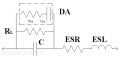
And in capacitors, ESR (Effective Series Resistance) is about restricting AC. Correct?
That seems contradictory.
 

Ian0

Joined Aug 7, 2020
13,131
My understanding is that resistance is about restricting DC, and impedance is about restricting AC. Correct?
And in capacitors, ESR (Effective Series Resistance) is about restricting AC. Correct?
That seems contradictory.
Impedance is the combination of reactance and resistance
( Impedance^2 = reactance^2+resistance^2)
Every impedance has a reactance part and a resistance part.
A perfect capacitor has no resistance, but no capacitor is perfect.
 

Papabravo

Joined Feb 24, 2006
22,082
Not really. Consider all three words of the phrase. By the nature of their construction, capacitors do not have any actual DC resistance because there is no direct DC path for current to flow. There may be a very high resistance leakage path, but that path has little to no effect power dissipation or losses within the capacitors working voltage range.

Consider the meaning of the words effective and resistance. The combination of these two terms refers to an effective loss, that is not frequency dependent. Consider also that impedance is a complex quantity which has both a Real Part and an Imaginary Part. A perfect ideal capacitor would have a zero Real Part. We cannot realize such a component, and thus real capacitors use ESR as an indicator of non-ideality.
 

Thread Starter

johnyradio

Joined Oct 26, 2012
615
effective and resistance. The combination of these two terms refers to an effective loss, that is not frequency dependent
It may mean not frequency dependent, but the combination of effective and resistance doesn't particularly imply not frequency dependent.
 

Ian0

Joined Aug 7, 2020
13,131
It may mean not frequency dependent, but the combination of effective and resistance doesn't particularly imply not frequency dependent.
The word "resistance" itself implies "not frequency dependent", because resistance is independent of frequency. Otherwise, it is reactance.
 

Ya’akov

Joined Jan 27, 2019
10,235
I have found that military training material targeting technicians is an excellent place to get insights into the nature of concepts around practical devices that behave in mysterious ways, including capacitors. This WWII era Navy training film is an excellent introduction to an underlying basis for the observable behavior of capacitors.


MrChips

Joined Oct 2, 2009
34,807
If you want a generalized model, all practical real resistors, inductors and capacitors are a combination of all three, R, L, and C.

We call it impedance, which is the total effect of having both resistance and reactance.

The mathematical equation is

Z = R + jX

where,
R is resistance
X is reactance
Z is impedance
j is the complex operator √-1
 

ronsimpson

Joined Oct 7, 2019
4,691
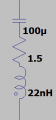
ESR is mostly the lead "resistance" and the resistance of the metal inside the cap. This can be measured at DC if you can get the meter probes inside the capacitor or at the resonant frequency where C&L cross.
ESL is mostly the lead length and length of the metal inside the cap. (wire length makes inductance) This can be seen at and above the resonant frequency.
1759673355501.png
 

wayneh

Joined Sep 9, 2010
18,104
An AC signal sees both an impedance and an ESR when traversing a capacitor. The value of that ESR does not vary with frequency in the way the reactance of an inductor would, but is also not entirely constant over wide frequency ranges and should be specified at a particular frequency. I believe 100kHz is common but you'll see other frequencies used. I suppose you'd want to know the specification at a frequency closest to the intended application, for instance the operating frequency of an SMPS.
 
Top