Facebook
 Google
 GitHub
 Linkedin
I have been doing some calculation on capacitors in different circuits lately and everything has been going fine, but this one got me really stuck. As a result I have been scratching my head on this problem for a couple of days now and need some pointers on how to solve it.
I want to create a function which shows voltage over time for ex. C1.
The initial condition (t=0) are:
V(C1) = 4 V => Q(C1) = 2,72 mC
V(C2) = 0 V
C1 = C2 = 680 microF
R1 = 4,7 Kohm
I have been thinking:
V(C1) - V(R1) - V(C2) = 0
V(C1) - R*dq/dt - dq/C = 0
And this is where I get stuck, Im not really sure how to proceed or even if I'm going in the right direction.
I can solve this if it had been only a capacitor decharging itself or a power supply charging a capacitor.
But when it is two capacitors, the voltage over both of them will alter over time and I cant see a solution for this.
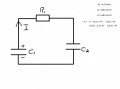
Added a quick drawing for the layout of the circuit.
I want to create a function which shows voltage over time for ex. C1.
The initial condition (t=0) are:
V(C1) = 4 V => Q(C1) = 2,72 mC
V(C2) = 0 V
C1 = C2 = 680 microF
R1 = 4,7 Kohm
I have been thinking:
V(C1) - V(R1) - V(C2) = 0
V(C1) - R*dq/dt - dq/C = 0
And this is where I get stuck, Im not really sure how to proceed or even if I'm going in the right direction.
I can solve this if it had been only a capacitor decharging itself or a power supply charging a capacitor.
But when it is two capacitors, the voltage over both of them will alter over time and I cant see a solution for this.
Added a quick drawing for the layout of the circuit.
Attachments
-
 9.5 KB Views: 46