Capacitively coupled H-bridge?

Thread Starter

wayneh

Joined Sep 9, 2010
18,104
Is there a way to do this, using large (ie, polarized electrolytic) capacitors?

I'm using a half-bridge in my EL project, and I use a big cap there (C6) to limit any DC current through the step-up transformer coil. I'm considering going to a full H-bridge to increase the voltage output but I cannot figure out how to keep using the capacitive coupling. Changing polarity would damage the cap. I keep thinking some arrangement of two caps and diodes will do it but I can't hit on the magic arrangement.
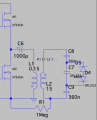
Screen Shot 2019-02-06 at 4.10.42 PM.png
 

Thread Starter

wayneh

Joined Sep 9, 2010
18,104
If you use a full bridge you won't need the capacitor. L1 could connect directly between the two bridge outputs.
Yes, but the capacitor limits the duration of the pulse to a time much shorter than the duration of the square wave drive signal. If I take it out, the current would continue to flow in L1 much longer without any benefit at the output. It would just be wasted. I've determined experimentally that the 1000µF cap gives full brightness of the EL panel and no gain is seen from going up to 6,000µF. Using 470µF causes a very slight but detectable dimming.
 

AlbertHall

Joined Jun 4, 2014
12,625
The fact that a 6-fold increase of capacitance from 1000uF to 6000uF makes no difference suggests to me that the capacitor isn't reducing the pulse width. Have you checked the waveforms with a 'scope?
 

Thread Starter

wayneh

Joined Sep 9, 2010
18,104
The fact that a 6-fold increase of capacitance from 1000uF to 6000uF makes no difference suggests to me that the capacitor isn't reducing the pulse width. Have you checked the waveforms with a 'scope?
No, but LTspice shows a brief peak in current, not a full square wave.
 

AlbertHall

Joined Jun 4, 2014
12,625
If increasing the capacitance makes no difference in the real world but does make a difference in the simulator this would suggest that some part of the simulation does not match the real world.
 

Thread Starter

wayneh

Joined Sep 9, 2010
18,104
If increasing the capacitance makes no difference in the real world but does make a difference in the simulator this would suggest that some part of the simulation does not match the real world.
Well, merely increasing the time that current flows through L1 doesn't change the pulse that appears in L2. That pulse happens on the rising edge across L1 and, once the current quits changing, the pulse in L2 disappears until the falling edge comes along and once again there is a dI/dt.

If it helps, slow it down to a 1 Hz feed. There would be a pulse in L2 when the power is turned on, but nothing would happen for the rest of the second. But the full available current would be flowing if C6 was bypassed.
 
Top