If the blob of solder appears to form a grey wrinkled skin, then the soldering iron is too hot. If the solder melts and forms a tiny little sphere which rolls around on the soldering iron tip, then the tip is dirty.
Waaaaayy too hot for my taste ... I normally soldier things at 550°F, 575°F tops. Otherwise the soldier's flux/rosin dries up too fast. And when it comes to delicate parts, I turn down the heat all the way to 450°F even if it means I have a harder time putting things together. ADC parts are especially sensitive to high soldering temps.
The higher the heat, the rarer the meat. Temp is not nearly as dangerous as the amount of heat transferred to the part. A hot iron 600°F for lead solder and 700°F for lead-free are good. Add an extra 100°F if you are using a very fine conical tip. Once you start melting solder, heat transfer goes way up and a joint can be made in a fraction of a second.
At this point, I suspect the solder or iron. Your heat setting is so high, at least the solder should have melted in your video. I’d try replacing one or the other.
You can also try using steel wool, a scotchbrite pad or even a pink pencil eraser to polish the copper pad and the lead on the resistor. Sometimes, older parts get some fine oxidation and that causes the solder to bead up and not flow well.
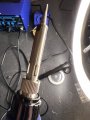
We use soldering irons with temperature contol, not a soldering gun.
Maybe your solder is made for plumbing or is the newer "lead free" that needs a higher temperature.
The video is below. You have to go full screen to lose the pause button overlayed. It depicts me trying to solder a joint. The resistor lead is just under the tip of the soldering iron even though you can't see it initially. Station is set to 750 deg F. I'm heating the joint.
it looks like the handle of your iron is too close to the table. From handle to tip, try angling about 45° so the the chisel tip gets right on the solder pad and resistor lead at the same time. Then gently push the solder onto the point where the iron touches the solder pad and iron tip.
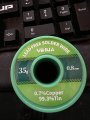
That is almost pure tin and melting point of tin is about 230 degC or 450F. Alloys will have lower melting temperature, exact value depends on material composition.
that specific solder type should have melting point of about 227 degC
480degC sounds excessive and should melt it with ease.
So either the solder is not really what is shown on the label, or soldering iron is not clean, or soldering iron is not working correctly (wrong value or unit displayed). so i would say post info on your actual soldering iron and photo of the actual tip.
maybe some prankster put wrong label on a spool of jewelry wire...
If you try to transport solder via the soldering tip the rosin would have evaporated by the time you get to the joint.
The rosin is an essential part of the soldering process.
Well the 63/37 tin/lead works much better. I changed from chisel tip to conical. I've increased the working temperature to 800 deg F. The solder tends to melt faster & I seem to be able to make more joints. But improvement doesn't mean there is possibly still something wrong. For instance I have to have the iron tip practically on top of the joint and the solder. There is very little room to spare. And, sometimes I think maybe I actually hit the solder with the iron by accident making it appear I am melting the solder from a hot joint but actually melting the solder with the iron tip. If there were more space to tell, I could rule that in or out.
I see a few possibilities: one, proceed and hone the soldering skills. Or, two, return the unit, which is very easy to do, and start fresh on a different station.
Well the 63/37 tin/lead works much better. I changed from chisel tip to conical. I've increased the working temperature to 800 deg F. The solder tends to melt faster & I seem to be able to make more joints. But improvement doesn't mean there is possibly still something wrong. For instance I have to have the iron tip practically on top of the joint and the solder. There is very little room to spare. And, sometimes I think maybe I actually hit the solder with the iron by accident making it appear I am melting the solder from a hot joint but actually melting the solder with the iron tip. If there were more space to tell, I could rule that in or out.
Tun the temp down to 700°F and wipe the dip firmly (with rotation) across a damp sponge each time you lift it out of its holder and after every 10 solder pads if you are doing a bunch.
it should be "right in top" as you say. That's not wrong and should be expected. Also, thinner solder is easier to work with than fat.

 Facebook
 Google
 GitHub
 Linkedin



 Waaaaayy too hot for my taste ... I normally soldier things at 550°F, 575°F tops. Otherwise the soldier's flux/rosin dries up too fast. And when it comes to delicate parts, I turn down the heat all the way to 450°F even if it means I have a harder time putting things together. ADC parts are especially sensitive to high soldering temps.