I use a conical solder tip for through hole soldering too. I use a chisel tip if I have to solder braiding or a large ground plane. I prefer a damp sponge to clean the tip rather than an abrasive scrubber.
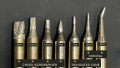
These are the tips I use the most. They are Hakko T8 and T12 tips, so they are—literally—hot swap. This makes changing tips on the fly practical, and it is very useful.
The 1.5mm screwdriver tip is the default, it's a great general purpose option and is usable from relatively large floods and objects (even 18650 batteries) to larger SMD work.
If I am going to be doing more then a couple of joints, or the job requires more thermal mass, the 2.5mm or 5mm tips are used. The 5mm tip does just fine even with the largest floods, it has a lot of capacity.
The 1mm screwdriver is really good for dense boards and general SMD work with components on the larger end. It's also good for surface mount where there is a need for accurate heating (the tip is sideways in the photo so it looks like it could be conical, it's not.)
The 1mm truncated cone tip is my favorite for work under the microscope. It is very accurate, with the section through the cone offering a very small working tip when needed but also a relatively large area when that's called for. It also allows for a very comfortable working angle keeping the iron our of the way and the work visible.
The .8mm conical tips are the extreme opposite of the 5mm chisel. They are very good at getting into tiny spaces and control the amount of heat the component is exposed to. The bent one has really saved the day on occasion when the work was in the middle of a cluster of parts.
The integral heater technology of the Hakko and others (Pace, JBC, etc.) is far superior to the sleeve-over-heater of previous times. I strongly recommend people investigate this. The difference is dramatic with much quicker heating and recovery times, and the ability to remove the hot tip and replace it with something more appropriate while you work.
The cost of such irons can be high—but it doesn't have to be. Open source options like the Pinecil and innovative inexpensive stations like the KSGER (w/ the handle that doesn't have the knurled nut) make it affordable. I have a Hakko FX-88, which is the older technology, and every time I use it I wish it was the other station. It's a very good station, it just can't compete.
When soldering, I poke the solder where the iron and wire (or pad) meet. The solder provides more contact area for heat to flow from the tip to the pad/wire. I prefer to use the leaded rosin-core solder, 60/40 or 63/37 whenever possible.
I'd always used damp sponges as tip cleaners, but then I found that a local supermarket sells real copper (or at least copper alloy) tip cleaners in the cleaning products aisle. Check with a magnet, though; the "copper" scouring pads I found in other stores were all plated steel.
You can put together a T12 style soldering station for around $20 by getting a kit and being creative with the case and power supply. There's also T12 irons with the controller in the handle in the same price range, no assembly required, just plug in a power brick (or battery).
A little solder on the tip before you solder will help bridge the gap between the iron, lead and board. More solder means greater heat mass, more thermal energy transfer. A dry iron just won't do.
If you use sn63/pb37 alloy, you can't make a cold joint. Unlike sn60/pb40 it has no plastic region. It goes from liquid to solid without being susceptible to disruption.
sn60/pb40 has better wetting action so it is good for tinning, for example in a solder pot. sn63/pb37 is much better for hand soldering. Note this assumes that you will not use lead free solder.
There is literally no reason for a hobbyist to use lead free. Wash your hands after handling the solder, don't eat it, and if your room has poor ventilation use a fume absorber (can be had cheap with activated charcoal filters to absorb nasty stuff). You should use one even with lead free solder because of the flux fumes if you solder a lot in a small space.
Soldering is sort of like many skills. Practice and more practice. Find an old scrap board and take components off and put them back. The more you work at it the better you become.
You're only putting a small amount of solder on the tip.
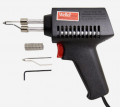
This thread has over 30 posts and you still haven't given us sufficient information to determine why the solder isn't melting. 480F or 480C? What type of solder? Have you ever soldered anything successfully? Are you actually using a soldering gun?
You're only putting a small amount of solder on the tip.
This thread has over 30 posts and you still haven't given us sufficient information to determine why the solder isn't melting. 480F or 480C? What type of solder? Have you ever soldered anything successfully? Are you actually using a soldering gun? View attachment 283376
Ok. using a soldering iron. I found the toggle mode for C/F and I am working in degrees ~750F. I was at480F and bumped i up to 750F. I am using lead-free 0.7% copper, 99.3% Tin. Am cleaning the iron frequently with a brass sponge and tinning the tip at every session. I am using a chisel tip to increase the area of heat transfer. The tip feels warm 3/4" away from hand but nothing exceptional, maybe it is the tip. My setup was a bundled purchase from Amazon. My soldering station is an YiHUA 862BD+. I have soldered years ago, but in hindsight I was creating cold joints, etc.
The video is below. You have to go full screen to lose the pause button overlayed. It depicts me trying to solder a joint. The resistor lead is just under the tip of the soldering iron even though you can't see it initially. Station is set to 750 deg F. I'm heating the joint.
If you are not making the product commercially then 60/40 or 63/37 Tin/Lead.
If you are selling the product, then TSC (Tin Silver Copper) which I think contains about 3% silver.
Lead-free solders don't react well to all types of soldering iron tips. Even the famous Weller TCP tips oxidise badly and become difficult to tin. My Weller WSP80 seems to deal best with lead-free solder, but the similar TN1010 doesn't work as well.
If you're still learning soldering technique, use lead solder until you get proficient.
At this point, I suspect the solder or iron. Your heat setting is so high, at least the solder should have melted in your video. I’d try replacing one or the other.

 Facebook
 Google
 GitHub
 Linkedin