Can't solder DFN 5x6 Package MOSFETs without heat-damaging them

Thread Starter

electromeow

Joined Oct 12, 2021
16
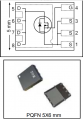
I've had a lot of trouble with DFN5x6 (also known as DFN8, PowerPAK-8 or PowerFLAT5x6-8) packaged MOSFETs. I tried with two different models by different manufacturers, AON6512 and IRFH7440. They were both genuine parts, that I've ordered from LCSC.
But no matter how I tuned the temperature of my hot air station, I couldn't properly solder these power MOSFETs without overheating them. I believe they are overheated, because I also considered the possibility I've been damaging them electrically or due to ESD. I tried without touching them with my hands, only with my tweezers. I tried inspecting the circuit on the oscilloscope, but it looks like there weren't any harmful Vgs or Vds.
I tried different ways to solder: Increasing the heat up and doing the job in a matter of seconds, pre-heating and using the lowest possible temperature to solder the MOSFETs. I've used up nearly 100 AON6512 MOSFETs while trying all those methods. But no luck. My board had 10 of them on it in parallel, and they were distributed to both sides of the PCB: 5 on the top and 5 on the bottom side. Sometimes I could have them soldered without damaging, but then they continued to fail fairly easily when I powered the circuit. They were failing after a few turn-on or turn-off events, although we weren't even turning the motors or when we were turning the motors at very low power.
Let me explain the purpose of all these MOSFETs: They are used to switch the power of a battery-powered vehicle with BLDCs which draw about 150 amps at full load, but 90% of the time we don't use it under full power. So the MOSFETs aren't driven quickly, like in a buck converter or vice versa.
The board includes 8 ESCs and MOSFETs on it, also large copper polygons to carry high currents from the battery to the ESCs and over the MOSFETs. Since there are large polygons on it, they sink a very significant amount of the heat produced by the hot air station, therefore making the reflow process even more difficult.
On our previous boards for the project, we had DPAK MOSFETs, and we were using higher temperatures for soldering. We never minded about damaging them while soldering. We could solder them without any concerns in mind. But we never had issues about soldering them. They used to get them damaged because of the overheating when we were using the board on full power. This year, we planned getting rid of burning MOSFETs under full power, searching for MOSFETs with lower Rds and/or better heat dissipation(low Rthja). As we have seen that most of the high-power low Rds MOSFETs belong to this type of package, we have chosen the footprint for DFN 5x6 MOSFETs. We actually loved the package because of its heat dissipation performance (low Rthja) and we thought, we would be able to run on full power without the need of more expensive and even lower Rds. But I hope I haven't done that choice, because this trouble took me months.
If you have any information on properly soldering these MOSFETs, please help.
Thank you in advance for all the attention and support...
 

ronsimpson

Joined Oct 7, 2019
4,647
Sometimes I use a toaster oven. There are many stories on the internet about how to solder with them. I do it differently. PCB, solder past, transistor, heat full power. Then I watch through the window to see when the solder past turns shiny and flows. Turn off the heat open the door and let it sit for a while. The power transistor is large, and its solder will milt last. The small parts solder down first.
1722447197252.png
I have used the air gun. Take more time, less temperature.

I know people that use a hot plate to heat the entire board, to less than milting point. Then they add more heat to the top side only where the transistor is.

You might have silkscreen holding the part up off the PCB.

Post your schematic and pictures. We might see something you did not.

1722447106947.png
 

MisterBill2

Joined Jan 23, 2018
27,186
It may be that the failure is caused by not getting the bottom area soldered to the heat sink. It is also possible that some designs can not be produced with adequate production yield.
Just because theory tells you that something should work does not mean that it will work. Usually that is because of an unknown variable.
 

narkeleptk

Joined Mar 11, 2019
586
Ive soldered mosfets in this package @ 400-500C & full air speed. Never had any issue with over heating them.

Are you lingering over it for a long time trying to get it lined up? In my case it, I usually tin the pads on pcb with solder (lead or leadfree), apply some flux, set the mosfet on the pads, then apply the air briefly and it pulls itself into place very quickly.
 
I have soldered them (and similar/smaller 3 x 3 mm) with a soldering iron. I make the drain pad big enough to provide some area for the iron tip to heat the pcb pad. And I do not use (or even have) soldering paste. I either coat the MOSFET tab with Kester 44 flux (and apply solder near the iron tip while heating) or pre-tin the drain tab and apply flux to the pcb pad.

One MAJOR variable: Why don't you provide an image of your pcb design in the area of concern, including any vias which may be sinking heat from your pcb pad?

Another MAJOR variable: I use 63/37 tin lead alloy. I am 72 and I have been breathing those lead fumes since I was 13; this has helped to make me as I am!! :D But seriously, if you are using ROHS solder or something else it might make your soldering job much more difficult.

 

Thread Starter

electromeow

Joined Oct 12, 2021
16
One MAJOR variable: Why don't you provide an image of your pcb design in the area of concern, including any vias which may be sinking heat from your pcb pad?

Another MAJOR variable: I use 63/37 tin lead alloy. I am 72 and I have been breathing those lead fumes since I was 13; this has helped to make me as I am!! :D
1722532246432.png
Simply explaining the PCB: You see the 5 MOSFETs in the middle of the image. There are 5 more MOSFETs just under them. The polygon in the middle (the polygon which the tabs of the MOSFETs are buried) is the minus terminal for the device's circuit. The polygon surrounding the polygon in the middle is the plus terminal of the circuit. The battery power is connected via 4 parallelled XT30 connectors, you can see them under the MOSFETs. MOSFETs are simply switching the low side connection from the circuit to battery's minus terminal. There is also a small circuit not shown in the picture, at the side of the board to control the MOSFET gate. It is a very simple circuit to switch on and off the MOSFET's if switch is on and battery isn't under the minimum voltage limit. The other big creatures (U1, U3...) are ESCs for our motors, they are directly soldered to the PCB. It isn't the ideal way to connect the ESCs to the circuit, I'm aware of this. But unless we directly solder them, the ESCs and their wires would create a mess in the tubing where we place the circuits.
There is also another thing at the bottom left side, connecting the battery's plus terminal to the plus side of the rest circuit. It is a power sensor which includes shunt-resistor current sensing. We place another PCB there via castellated holes.

I tried tinning the surface of the pads, then pour some flux on it, place the MOSFETs on the footprints and lastly reflow with hot air. When using this method, I used 63/37 or 60/40 solder wire of a quality brand. But sometimes I tried with a solder paste, which claims to be 63/37, but I'm not sure whether it is or not because it is a chinese thing. I used a so-called no-clean flux most of the time. But it was a very low concentrated flux, I suppose it is flux chemicals dissolved in isopropyl alcohol because it smells so. It is sold in 1 liter bottles, I believe it is made to use in factories.

But the question I've been questioning is, why this happens only with this specific package? I stop heating the board after the solder melts. My solder is 63/37 and it melts 20 degrees celcius below the point where the leadless RoHS compat. solders melt. Then how do the factories using leadless solders can solder these properly, they must use more heat than I use. Is it the problem with the MOSFET itself? If silicon was that sensitive to heat, then why other chips with smaller transistors (like uCs) could withstand higher temperatures for much longer time periods? The other chips have no problem with the soldering temperature, I can desolder and solder them again and again with higher temperatures. Phone repairs desolder and solder phone processors from one phone to the other phone and they don't get damaged although they have smaller and billions of transistors. All the other chips I've had experience with, can withstand higher temperatures easily and I've never had any other chip burnt this easily, most of them burnt after 2-3 solder-desolder cycles. What is the problem with the chips of this package?
 

Veracohr

Joined Jan 3, 2011
783
When you used DPAKs did you have a similar PCB design? Even though you have a large copper area your heat is all concentrated in a small part of it.
 

Thread Starter

electromeow

Joined Oct 12, 2021
16
When you used DPAKs did you have a similar PCB design? Even though you have a large copper area your heat is all concentrated in a small part of it.
Yes after this incident we had to reproduce the PCB with the same design, but changed the MOSFETs to DPAK package, added TVS diode between gate and source to avoid ESD damage.
 

Ian0

Joined Aug 7, 2020
13,097
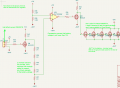
R32=1MΩ is asking for trouble.
There is a large capacitance between gate and drain. With R32=1MΩ, any voltage fluctuation at the drain is fed directly, unattenuated to the gate.
I would never use a MOSFET driven by less than 100Ω.
 

Thread Starter

electromeow

Joined Oct 12, 2021
16
R32=1MΩ is asking for trouble.
There is a large capacitance between gate and drain. With R32=1MΩ, any voltage fluctuation at the drain is fed directly, unattenuated to the gate.
I would never use a MOSFET driven by less than 100Ω.
I preferred larger resistors to minimize the quiescent current when device is turned off. Could you please explain more about that 1MΩ resistor issue?
 

panic mode

Joined Oct 10, 2011
4,866
each gate is basically a capacitor... for AON6512 that is 3.5nF.... and if you have 5 of them in parallel, that would add up to 17.5nF. for IRFH7440 it is 4.7nF per mosfet or 23.5nF for group of five. this means RC time constant on the order of 17-25ms.

when you are turning mosfets on, they gate voltage is rising gradually as the capacitors are charging through 1Mohm resistor. discharge is quicker since this is done through transistor. you need to be aware of charge/discharge time as this affects losses. transistor that turns on/off slowly gets a lot hotter... normally one would see much lower resistor value there. this is normally only the issue if switching is frequent (SMPS, PWM...).
 
Last edited:

panic mode

Joined Oct 10, 2011
4,866
to reduce thermal stress it helps to use some sort of pre heater or hot plate that brings temperature of the board and part to some mid point temperature that is not dangerous. while maintaining that local temperature, soldering pads will be much easier regardless if using regular soldering iron or hot air. this will allow you to get to melting temperature in a much more controlled fashion - specially if multilayer or when copper areas are large.
 
Last edited:

Ian0

Joined Aug 7, 2020
13,097
I preferred larger resistors to minimize the quiescent current when device is turned off. Could you please explain more about that 1MΩ resistor issue?
@panic mode has the first part correct. When the voltage reaches Vgs(th) the transistor starts to turn on. Then we have the Miller effect. Cgd - the gate-drain capacitor- behaves is though it is G times larger than it really is, where G is the voltage gain which is Gfs*Rds. So the time constant is R.Cgs.Gfs.Rds+R.Cgs (R=1M) which might be quite a while, during which time the MOSFET dissipates a quarter of the load power.
Apart from the power dissipation the Miller integrator is quite benign, but add in some inductance - there's always some stray inductance. The 90° phase shift from the Miller integrator becomes 180°, and now we have an oscillator, probably at a very high frequency, and all the time the MOSFET is dissipating perhaps a quarter of the load power. Before long it's had enough. . . .and you need a new MOSFET.
 

ronsimpson

Joined Oct 7, 2019
4,647
each gate is basically a capacitor... for AON6512 that is 3.5nF.... and if you have 5 of them in parallel, that would add up to 17.5nF. for IRFH7440 it is 4.7nF per mosfet or 23.5nF for group of five. this means RC time constant on the order of 17-25ms.
Going back and rereading this. There are 10 MOSFETs in parallel. Five on each side. (34-50mS) The current is 150A. That is only 15A/MOSFET but, that is if all transistors turn on/off at the same G-S voltage. I do not think they will current share well with reduced gate voltage. (when the Gate voltage slowly increases over 40mS) I spent some time looking at "safe operating" conditions and do not know what to say. Maybe panic mode or someone should look at "safe operating area."
 
Top