Maybe you can find a readily made buck-boost module that can do the voltages you want though finding one that goes up to 7A might be difficult.Any other circuit configuration that will work?
3V out from 6V in.how would one do a 3V dropout then?
Exactly the same way, but not quite so accurate.
They way I am analyzing:Exactly the same way, but not quite so accurate.
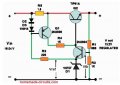
The 2n3904 and 1N757 take the place of the TL431. The TL431 is a much better reference than the 1N757.
It also has a current limit: R4 takes the place of Rb, but is has Q1 in series. If the voltage drop across R5 exceeds the voltage across D2, Q1 is switched off which in turn switches off Q4.
Assume 0.6V for the voltage across a silicon diode, so Q1 base is at Vin-1.3VThey way I am analyzing:
Intially:
D2 and D3 cause Vin-1.7 voltage at base of Q1. Voltage at R5 terminals are: Vin, Vin-1.7. At R4 one end it is vin-1.7+.7.
After that I am lost as to what the voltage is at R4 terminal facing the base?? I am also not sure if Q2 is on or off?
WellAssume 0.6V for the voltage across a silicon diode, so Q1 base is at Vin-1.3V
Voltage across R5 is the current through it multiplied by its resistance.
What do you think it is? Referring to your previous circuit.Well
What exactly is the current thru R5?
What exactly is current thru R4?
If i had to guess R4 20ma and R5 would be 200 mA?? I am not sure you use hfe to calculate based on load current but i am not sure if q2 is on or off initially.What do you think it is? Referring to your previous circuit.
Assume that it is operating as a regulator, and you have a load connected.If i had to guess R4 20ma and R5 would be 200 mA?? I am not sure you use hfe to calculate based on load current but i am not sure if q2 is on or off initially.
Can you help? I just dont know where to begin. Whatever I am thinking and getting stuck at i posted. R4 20ma and R5 would be 200 mA??Assume that it is operating as a regulator, and you have a load connected.
I can help, but you also have to think, because I won't always be here when you get stuck.Can you help? I just dont know where to begin. Whatever I am thinking and getting stuck at i posted. R4 20ma and R5 would be 200 mA??
You implied that you knew how to use LTspice. Why are you asking these basic questions? If you can't figure out how a circuit works using a circuit simulator, you're going to have a hard time with circuits.Well
What exactly is the current thru R5?
What exactly is current thru R4?
In LTSpice can I see initial how it calculating everything? How and where is that file?You implied that you knew how to use LTspice. Why are you asking these basic questions? If you can't figure out how a circuit works using a circuit simulator, you're going to have a hard time with circuits.
Goes thru R5 and then to Q2?? Please helpYou implied that you knew how to use LTspice. Why are you asking these basic questions? If you can't figure out how a circuit works using a circuit simulator, you're going to have a hard time with circuits.
Right, so what is the voltage across R5?Goes thru R5 and then to Q2?? Please help
Why do you keep asking questions LTspice can answer?Goes thru R5 and then to Q2?? Please help
0.7V?Right, so what is the voltage across R5?
I suggest you return to your original two questions. For this I can show you a method to derive an equation from a array of voltage / current values.In LTSpice can I see initial how it calculating everything? How and where is that file?
I am new sorry