Cant figure this circuit out

Thread Starter

hhsting

Joined Apr 25, 2024
395
I have two questions. I am new at this and I read the literature online but i still cant figure out:

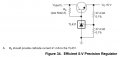
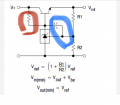
1. How do I calculate voltage drop, current thru and purpose of brown circled resistor in the figure below?

2. How do I calculate voltage drop, current thru and purpose blue circled capacitor in the figure below?
1717803044065.png
 
Last edited by a moderator:

dl324

Joined Mar 30, 2015
18,219
1. How do I calculate voltage drop, current thru and purpose of brown circled resistor in the figure below?
That resistor determines the maximum output current from the pass transistor and also provides the current required by the TL431 (1mA). The regulator needs to be able to sink all of the current in Rb.
1717806891781.png
1717815055581.png
2. How do I calculate voltage drop, current thru and purpose blue circled capacitor in the figure below?
Voltage drop and current aren't important. That cap is used for noise suppression.
 

Ian0

Joined Aug 7, 2020
13,097
1. How do I calculate voltage drop, current thru and purpose of brown circled resistor in the figure below?
Dennis makes it sound like you can use R1 to create an output current limit. You can (sort of), but it won't be very repeatable as it will depend on the battery voltage and the Hfe of the particular transistor that you use, which can vary all over the place.
To calculate Rb, determine how much output current you need.
Divide by the minimum value of Hfe from the transistor datasheet, at the output current. (There should be a graph of collector current vs. Hfe)
Add the 1mA that the TL431 needs.
If the total comes to more than the TL431 can withstand, you need a transistor with more Hfe.
Bearing in mind that the Base voltage is approximately 0.6V above the output voltage. Work out the value of R1 for the lowest possible battery voltage.
2. How do I calculate voltage drop, current thru and purpose blue circled capacitor in the figure below?
The capacitor is not for noise reduction (though it does perform that function) it is there for stability. The TL431 is rather prone to oscillation, and needs some phase shift to keep it stable. Generally 100nF is a good value to choose, but its frequency response is set by 1/(2πRC) where R is the parallel combination of the feedback resistors. Lower values of feedback resistor require higher values for C.
 

Thread Starter

hhsting

Joined Apr 25, 2024
395
Dennis makes it sound like you can use R1 to create an output current limit. You can (sort of), but it won't be very repeatable as it will depend on the battery voltage and the Hfe of the particular transistor that you use, which can vary all over the place.
To calculate Rb, determine how much output current you need.
Divide by the minimum value of Hfe from the transistor datasheet, at the output current. (There should be a graph of collector current vs. Hfe)
Add the 1mA that the TL431 needs.
If the total comes to more than the TL431 can withstand, you need a transistor with more Hfe.
Bearing in mind that the Base voltage is approximately 0.6V above the output voltage. Work out the value of R1 for the lowest possible battery voltage.

The capacitor is not for noise reduction (though it does perform that function) it is there for stability. The TL431 is rather prone to oscillation, and needs some phase shift to keep it stable. Generally 100nF is a good value to choose, but its frequency response is set by 1/(2πRC) where R is the parallel combination of the feedback resistors. Lower values of feedback resistor require higher values for C.
Where does it state in datasheet how much current TL431 can withstand? Also what is the complete equation 1/(2*pie*RC) = ? ?
 

Ian0

Joined Aug 7, 2020
13,097
https://www.onsemi.com/pdf/datasheet/tl431-d.pdf
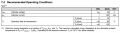
It occurs twice, once in "maximum ratings" and once in "recommended operating conditions" labelled as "cathode current".
In data sheet speak, if you exceed the figure in "recommended operating conditions" it won't work, but if you exceed the figure in "maximum ratings" you will break it.
f=1/(2πRC) is a very widely used equation, which gives the "roll-off" frequency for any place there is an RC network.
it also follows that C=1/(2πfR) and R=1/(2πfC)
 

Thread Starter

hhsting

Joined Apr 25, 2024
395
https://www.onsemi.com/pdf/datasheet/tl431-d.pdf
It occurs twice, once in "maximum ratings" and once in "recommended operating conditions" labelled as "cathode current".
In data sheet speak, if you exceed the figure in "recommended operating conditions" it won't work, but if you exceed the figure in "maximum ratings" you will break it.
f=1/(2πRC) is a very widely used equation, which gives the "roll-off" frequency for any place there is an RC network.
it also follows that C=1/(2πfR) and R=1/(2πfC)
Datasheet says recommended operating conditions of 1ma to 100ma.

So lets say I have output 7A and hfe of 40 then I have 175mA. I can also add 100 ma to that or 80ma why you have added 1 ma?

also if I go with 1 ma then I have 1mA + 175mA = 176 mA.
How does transistor know to abosrb at base 175ma and the diode know absorb 1ma? I.e diode can absorb up to 100ma so how does it know to ansorb only 1mA why not 2ma,…70ma,80ma,90ma…100ma?
 

Ian0

Joined Aug 7, 2020
13,097
The 1mA is the figure from "Minimum cathode current for regulation" on page 3.

So if you want 7A output, and your transistor hfe is 40, then 175mA will go into the transistor's base.
But you want the output voltage to remain constant, even if you disconnect the load.
In that case, the only current flowing will be through R1 and R2, which is about 100uA. The Hfe will probably be higher, but we'll assume it is still 40, so only 2.3uA will go into the transistor's base.
But there is still the same voltage across Rb, so 175mA will still flow through it.

What happens when you remove the load? The transistor would still have enough base current for a 7A load, so the output voltage would rise. That would take the voltage on the TL431's ADJ terminal above its 2.5V reference, and that causes more current to flow through the TL431 until the output voltage is where it should be.
So you will have 175mA through Rb (because the voltage across it hasn't changed), 2.3uA into the transistor base, so 174.998mA though the TL431 - which it won't like at all.
 

dl324

Joined Mar 30, 2015
18,219
How does transistor know to abosrb at base 175ma and the diode know absorb 1ma?
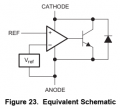
The comparator opamp is what determines how much the TL431 will sink.

You can use a Darlington transistor or MOSFET to avoid issues with the maximum current the TL431 has to sink.

What is the supply voltage and maximum output voltage you require?
 
Last edited:

Thread Starter

hhsting

Joined Apr 25, 2024
395
The comparator opamp is what determines how much the TL431 will sink.

You can use a Darlington transistor or MOSFET to avoid issues with the maximum current the TL431 has to sink.

What is the supply voltage and maximum output voltage you require?
Supply voltage: 3Vdc to 12Vdc
Output voltage: 3Vdc to 7Vdc. Output voltage not exceeding supply voltage of course. So if its 4vdc supply voltage then ouput voltage 3vdc to 4vdc. If supply is 3bdc then output voltage is 3vdc. If supply voltage is 7vdc then output voltage 3vdc to 7vdc. Etc etc
Output current: 100mA to 7A
 
Last edited:

Thread Starter

hhsting

Joined Apr 25, 2024
395
You can't get 3.3-7.0V out with a 3V input.
Yea ofcourse. If you can then You did have new power source! I dont mean that. I mean:


Supply voltage: 3Vdc to 12Vdc
Output voltage: 3Vdc to 7Vdc. Output voltage not exceeding supply voltage of course. So if its 4vdc supply voltage then ouput voltage 3vdc to 4vdc. If supply is 3vdc then output voltage is 3vdc. If supply voltage is 7vdc then output voltage 3vdc to 7vdc. Etc etc
Output current: 100mA to 7A
 

dl324

Joined Mar 30, 2015
18,219
Yea ofcourse. If you can then You did have new power source!
It can be done. Just not with the components you're working with.

I dont mean that. I mean:

Supply voltage: 3Vdc to 12Vdc
Output voltage: 3Vdc to 7Vdc. Output voltage not exceeding supply voltage of course. So if its 4vdc supply voltage then ouput voltage 3vdc to 4vdc. If supply is 3vdc then output voltage is 3vdc. If supply voltage is 7vdc then output voltage 3vdc to 7vdc. Etc etc
Output current: 100mA to 7A
You need to rethink your requirements. You're not going to get 3V out with 3V in. The pass transistor has to have some headroom. Even 4V in would be problematic for 3V out at 7A. The transistor will be in, or near, saturation and current gain will drop off.
 

panic mode

Joined Oct 10, 2011
4,864
That is not how it works.

Voltage regulators have voltage drop and in thus case that voltage drop is larger than Vbe of the transistor. And that us some 0.6-0.7V
In other words if input is 4V, output cannot be more than 3.3V.

In fact that us the cutoff. To get any regulation, you will want voltage drop of at least 1V.
 

Ian0

Joined Aug 7, 2020
13,097
Yea ofcourse. If you can then You did have new power source! I dont mean that. I mean:


Supply voltage: 3Vdc to 12Vdc
Output voltage: 3Vdc to 7Vdc. Output voltage not exceeding supply voltage of course. So if its 4vdc supply voltage then ouput voltage 3vdc to 4vdc. If supply is 3vdc then output voltage is 3vdc. If supply voltage is 7vdc then output voltage 3vdc to 7vdc. Etc etc
Output current: 100mA to 7A
All circuits have their limitations. You have already discovered one of them. Your circuit can't deliver more than 100mA*Hfe.
Also, it doesn't work with less than about 3V from input to output. In other words, it's not a LOW-DROPOUT regulator.
But it is possible to make a low-dropout regulator, just not with the circuit you quoted.
3V out from 3V in is obviously not possible, but 3V out from 3.1V is maybe, just not with that circuit.
 

Thread Starter

hhsting

Joined Apr 25, 2024
395
It can be done. Just not with the components you're working with.


You need to rethink your requirements. You're not going to get 3V out with 3V in. The pass transistor has to have some headroom. Even 4V in would be problematic for 3V out at 7A. The transistor will be in, or near, saturation and current gain will drop off.
Yes of ofcourse let me rethink how about this:


Supply voltage: 3Vdc to 12Vdc

Output voltage: 3Vdc to 7Vdc. Output voltage not exceeding supply voltage of course. So if its 4vdc supply voltage then ouput voltage 3vdc to 4vdc. If supply is 3bdc then output voltage is 3vdc. If supply voltage is 7vdc then output voltage 3vdc to 7vdc. Etc etc

Output current: 100mA to 7A. The output current should not exceed output voltage. Meaning if vout is 3V max output is 3A. 4V out then output is 4A. 7V max output is 7A. Etc etc
 

Ian0

Joined Aug 7, 2020
13,097
There are no "universal" circuits.
You might think op-amps are universal, so why are there so many different op-amps?That's because each type has a speciality. No op-amp is perfect for all applications.
When it comes to power supplies:
The lower the dropout voltage (difference between input and output) the trickier it becomes.
The higher the output current the trickier it becomes.
If you are content with a dropout voltage of 3V, then use a MOSFET and your circuit can easily deliver 7A.
 

Thread Starter

hhsting

Joined Apr 25, 2024
395
There are no "universal" circuits.
You might think op-amps are universal, so why are there so many different op-amps?That's because each type has a speciality. No op-amp is perfect for all applications.
When it comes to power supplies:
The lower the dropout voltage (difference between input and output) the trickier it becomes.
The higher the output current the trickier it becomes.
If you are content with a dropout voltage of 3V, then use a MOSFET and your circuit can easily deliver 7A.
If you see post #16 then i rethought about it and changed requirements. I am curios about your MOSFET circuit how it works and it drawbacks and looks like?
 

Ian0

Joined Aug 7, 2020
13,097
If you see post #16 then i rethought about it and changed requirements. I am curios about your MOSFET circuit how it works and it drawbacks and looks like?
But you are still aiming for a dropout voltage of zero. That circuit doesn't do zero drop-out.

You can replace the transistor with a MOSFET. It will then need no gate current, so the output current is only limited by the MOSFET itself.
However, the minimum dropout is equivalent to Vgs of the MOSFET for the output current required, and that is going to be higher than it is for a bipolar transistor.
 

Thread Starter

hhsting

Joined Apr 25, 2024
395
But you are still aiming for a dropout voltage of zero. That circuit doesn't do zero drop-out.

You can replace the transistor with a MOSFET. It will then need no gate current, so the output current is only limited by the MOSFET itself.
However, the minimum dropout is equivalent to Vgs of the MOSFET for the output current required, and that is going to be higher than it is for a bipolar transistor.
How i am aiming for dropout voltage of zero? Also i dont understand your mosfet circuit exactly how it works?
 
Top