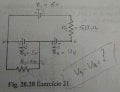
I realized that a second after i posted ahahah, but thanks anyway, could you help me with the second one ? I know about Kirchhoff Laws, but i don't know where to point the currents and the loops
I realized that a second after i posted ahahah, but thanks anyway, could you help me with the second one ? I know about Kirchhoff Laws, but i don't know where to point the currents and the loops
Your first problem is that you are not supposed to use both of them at the same time. You are supposed to use only one of the two. So. Which one are you using?
this is a homework section, you need to do all work (or at least attempt to do so) and then you will receive feedback if you are doing it wrong and where.
if you need help with Fig2, here it is: label your currents and indicate directions. only then it makes sense to tackle equations.
If you guys did not understand, that is the problem.. the exercise has no current directions. I managed to do it by guessing the direction of the current based on the voltages of each battery. Sorry for that, i thought someone would come and help to get through it, like shteii01 did, i appreciate his help, really. Shteii01 how would you do it ? Its interesting to see different ways, or maybe the same one with a different name.. In the way i was taught, we apply KCL at a reference node to find a relationship between the currents, then we use the KVL around the loops to find more equations, bringing both these laws together we find the variables we are lookin for. Show me your way, please?
that is part of solving problem - guessing current directions (or picking them arbitrarily), then writing equations and finally solving the equations. if the initially assigned current direction was wrong you will get negative result (but correct magnitude).
If you guys did not understand, that is the problem.. the exercise has no current directions. I managed to do it by guessing the direction of the current based on the voltages of each battery. Sorry for that, i thought someone would come and help to get through it, like shteii01 did, i appreciate his help, really. Shteii01 how would you do it ? Its interesting to see different ways, or maybe the same one with a different name.. In the way i was taught, we apply KCL at a reference node to find a relationship between the currents, then we use the KVL around the loops to find more equations, bringing both these laws together we find the variables we are lookin for. Show me your way, please?
It is you who fail to understand.
When you do KCL, there are one or two assumptions that YOU make before you start doing the math.
When you do KVL, there are one or two assumptions that YOU make before you start doing the math.
The fact that you don't know that you have to make assumptions... tells me that you need to go back to the textbook and read how to do KCL and KVL.
I don't see why you need to make so many assumptions when using both of the laws... by applying KCL first, we assume the current directions and then get the maximum number of equations we can find( using KVL), as they are linear equations, they are easily solvable. If you could demonstrate what you're saying in the exercise above i would be very happy.
does not work that way, YOU need to show YOUR effort first and so far you have nothing.
just follow suggestions and mark the currents then write equations the way you know them...
I don't see why you need to make so many assumptions when using both of the laws... by applying KCL first, we assume the current directions and then get the maximum number of equations we can find( using KVL), as they are linear equations, they are easily solvable. If you could demonstrate what you're saying in the exercise above i would be very happy.
reversing battery would ruin the problem. you mean your solution used opposite direction for I1? that is fine (any direction is ok as long as it is MARKED....).
so what did you get?

 Facebook
 Google
 GitHub
 Linkedin