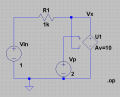
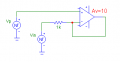
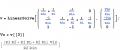
Afterthought, adding the drop of R1 from the other source.I don't know where the ±1V is coming from???
I was trying to make a full node equation and it cancelled itself out, should have stopped there.But, as I'm sure you've noted already, the other source and the resistor (as long as it is nonzero) have no effect on Vx.
Yep, been there done that.I was trying to make a full node equation and it cancelled itself out, should have stopped there.![]()
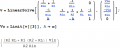
I think, the wanted "trick" could be the following:![]()
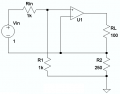
But I want to ask you is there any easier way to find solution for this circuit?
Maybe you know some trick that we can use here to speed up finding a solution?
You show an expression for Hf(Vout=0) = R1/(R1+Rin+Rp) - [-Rp/(R1+Rin+Rp)]I think, the wanted "trick" could be the following:
The closed-loop gain of an idealized opamp (Aol infinite) with feedback can be expressed as Acl=Hf/Hr
with Hf=(Vp-Vn)/Vin for Vout=0
and Hr=(Vp-Vn)/Vout for Vin=0.
Thus, the whole calculation is split into two separate steps which consists of two voltage divider ratios only.
Example: Setting R2||RL=Rp we have
Hf(Vout=0)=(Vp/Vin)-(Vn/Vin)=R1/(R1+Rin+Rp) - [-Rp/(R1+Rin+Rp)] .
OK - may be. No problem - this solution just came into my mind.All this doesn't look much simpler (or speedier, as Jony130 asked for) than the matrix solution.
The matrix solution I gave seems to me to be the most simple. I did the second half of your method, calculating Hr(Vin=0), and it involves an expression similar in complexity to the first half, requiring a fair amount of algebra to get the final result.OK - may be. No problem - this solution just came into my mind.
As you know - each circuit can be analyzed following different approaches.
Everybody has its own preference.
Do YOU have a way which is simpler (speedier)?
The method a person has decided is the "best" might not be the most simple or speedy. A person might choose a method that leads to more algebra because they are familiar and practiced with it, thereby making fewer errors, and that would probably be their preference.I think, only after collecting and comparing different methods for analyzing a particular circuit one can decide which way is the "best". And, most probably, different people will come to different preferences, don`t you think so?
Yes - this is exactly what I wanted to say.A person might choose a method that leads to more algebra because they are familiar and practiced with it, thereby making fewer errors, and that would probably be their preference.
If you read what Jony130 said in post #11, he gave a new circuit in this thread because he was unable to start a new thread. The original title for the thread doesn't apply to the new circuit he gave in post #11; he was able to solve the circuit he gave in post #11, but he wanted an easier and speedier method.Yes - this is exactly what I wanted to say.
By the way - I didn`t intend to argue against your method.
The title of this thread is "can we solve the circuit?"
And - as an answer to the OP`s problem - I have mentioned one of different methods how to "solve the circuit" . That`s all. Perhaps it could help.
LvW
| Thread starter | Similar threads | Forum | Replies | Date |
|---|---|---|---|---|
| G | Help me! I need to solve this circuit | Homework Help | 10 | |
| H | How to solve this circuit | General Electronics Chat | 36 | |
|
|
I couldnt solve this qn can someone help me out | Homework Help | 10 | |
| K | How can we solve this circuit ? | Homework Help | 7 | |
| L | How can i solve this circuit using nodal analysis? | Homework Help | 1 |