Can we solve this circuit

Thread Starter

Jony130

Joined Feb 17, 2009
5,600
Hi,
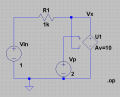
Here is a circuit that I can not solve.


How we can use a nodal analysis to solve for Vx?

(Vin - Vx)/R1 - ?? = 0

I think that I have some kind of blackout today.
 

Attachments

WBahn

Joined Mar 31, 2012
33,196
Is there a particular reason you want to use nodal analysis on this problem? Remember, nodal analysis is just KCL, so in general you want to avoid nodal analysis when there are voltage sources for which you will have to get currents for. Problems like this are much better dealt with using mesh current analysis.
 

Thread Starter

Jony130

Joined Feb 17, 2009
5,600
I prefer nodal analysis. But yes you are right I can also use mesh current analysis.

Vin - I*R1 - Vx = 0

and

Vx = Av*(Vp - Vx) ; I = (Vin - Vx)/R1

so

Vx = (Av*Vp)/(Av+1)

THX
 

thatoneguy

Joined Feb 19, 2009
6,359
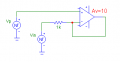
I don't see a simple equation for a node, since the node voltage is dependent on the node voltage (feedback).

Ignoring the left side:
Vx=10(2-Vx)

Vx/10 = 2-Vx

Vx=20-10Vx

11Vx=20

Vx=20/11

Vx= 1.818 ±1V and resistor and direction of current.
 

WBahn

Joined Mar 31, 2012
33,196
If you only want Vx, that is quite trivial:

Vx = Av(Vp-Vx)

Vx = Vp[Av/(Av+1)]

For Av=10 and Vp=2V, this is

Vx = 2V(10/11) = 1.818V

Done.

I don't know where the ±1V is coming from???
 

WBahn

Joined Mar 31, 2012
33,196
But, as I'm sure you've noted already, the other source and the resistor (as long as it is nonzero) have no effect on Vx.
 

Thread Starter

Jony130

Joined Feb 17, 2009
5,600
Hi, I don't know why but I'm unable to start new thread. So I decided to post my question here.

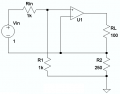
I have this simple op amp based circuit


And I try to find Vo voltage.

So I write this equations for Vn node

(Vout - Vn)/RL = Vn/R2 + ((Vn + Vin) - Vp)/Rin

And for Vp node

((Vn + Vin) - Vp)/Rin = Vp/R1

And after many attempts I finally find the solution

Vo = Vin * ((R2 RL + R1 (R2 + RL)))/(R2 Rin)

and

Io = Vin/Rin (1 + R1/R2)

But I want to ask you is there any easier way to find solution for this circuit?
Maybe you know some trick that we can use here to speed up finding a solution?
 

Attachments

The Electrician

Joined Oct 9, 2007
2,986
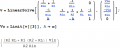
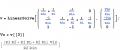
Convert Rin and Vin to a Norton equivalent current source of value Vin/Rin with Rin now connected between the plus and minus inputs of the input. Let V1 be the plus input, V2 be the minus input, and V3 be the opamp output, Vo.

Then:


I left the opamp open loop gain, A, as a finite quantity to deal with the case where an opamp isn't ideal; real opamps, in other words. If only the ideal case solution is wanted, the matrix can be modified slightly and the limit operation eliminated:


You can't get much easier or speedier than that!
 

Attachments

Last edited:

Thread Starter

Jony130

Joined Feb 17, 2009
5,600
ThxThe Electrician, As always you show a matrix, but to be honest I'm not so confident with this type of a matrix. I always have problems with it. The only matrix that I can create is "Jacob Shekel matrix".
 

LvW

Joined Jun 13, 2013
2,037


But I want to ask you is there any easier way to find solution for this circuit?
Maybe you know some trick that we can use here to speed up finding a solution?
I think, the wanted "trick" could be the following:

The closed-loop gain of an idealized opamp (Aol infinite) with feedback can be expressed as Acl=Hf/Hr
with Hf=(Vp-Vn)/Vin for Vout=0
and Hr=(Vp-Vn)/Vout for Vin=0.

Thus, the whole calculation is split into two separate steps which consists of two voltage divider ratios only.

Example: Setting R2||RL=Rp we have
Hf(Vout=0)=(Vp/Vin)-(Vn/Vin)=R1/(R1+Rin+Rp) - [-Rp/(R1+Rin+Rp)] .
 

The Electrician

Joined Oct 9, 2007
2,986
I think, the wanted "trick" could be the following:

The closed-loop gain of an idealized opamp (Aol infinite) with feedback can be expressed as Acl=Hf/Hr
with Hf=(Vp-Vn)/Vin for Vout=0
and Hr=(Vp-Vn)/Vout for Vin=0.

Thus, the whole calculation is split into two separate steps which consists of two voltage divider ratios only.

Example: Setting R2||RL=Rp we have
Hf(Vout=0)=(Vp/Vin)-(Vn/Vin)=R1/(R1+Rin+Rp) - [-Rp/(R1+Rin+Rp)] .
You show an expression for Hf(Vout=0) = R1/(R1+Rin+Rp) - [-Rp/(R1+Rin+Rp)]

Next, an expression is needed for Hr(Vin=0) which will be similarly complicated, and the final result will be the quotient Hf/Hr.

All this doesn't look much simpler (or speedier, as Jony130 asked for) than the matrix solution.
 

LvW

Joined Jun 13, 2013
2,037
All this doesn't look much simpler (or speedier, as Jony130 asked for) than the matrix solution.
OK - may be. No problem - this solution just came into my mind.
As you know - each circuit can be analyzed following different approaches.
Everybody has its own preference.
Do YOU have a way which is simpler (speedier)?

I think, only after collecting and comparing different methods for analyzing a particular circuit one can decide which way is the "best". And, most probably, different people will come to different preferences, don`t you think so?
 
Last edited:

The Electrician

Joined Oct 9, 2007
2,986
OK - may be. No problem - this solution just came into my mind.
As you know - each circuit can be analyzed following different approaches.
Everybody has its own preference.
Do YOU have a way which is simpler (speedier)?
The matrix solution I gave seems to me to be the most simple. I did the second half of your method, calculating Hr(Vin=0), and it involves an expression similar in complexity to the first half, requiring a fair amount of algebra to get the final result.

I used a computer to solve the matrix system which means not having to do the algebra by hand. But I also used the computer to manipulate the expressions involved in your method and it was still more involved. I had to type in the somewhat complicated Hf and Hr expressions before the computer could simplify them, which took more time and effort than typing in the matrix. The elements of the matrix are very simple, not at all complicated expressions.

I don't think there is what I would call a really simple solution; it's a somewhat complicated circuit.

I think, only after collecting and comparing different methods for analyzing a particular circuit one can decide which way is the "best". And, most probably, different people will come to different preferences, don`t you think so?
The method a person has decided is the "best" might not be the most simple or speedy. A person might choose a method that leads to more algebra because they are familiar and practiced with it, thereby making fewer errors, and that would probably be their preference.

Jony130 wanted a speedy method. The elements of the matrix are all very simple and quick to write without errors, which makes it a speedy method.
 

LvW

Joined Jun 13, 2013
2,037
A person might choose a method that leads to more algebra because they are familiar and practiced with it, thereby making fewer errors, and that would probably be their preference.
Yes - this is exactly what I wanted to say.

By the way - I didn`t intend to argue against your method.
The title of this thread is "can we solve the circuit?"
And - as an answer to the OP`s problem - I have mentioned one of different methods how to "solve the circuit" . That`s all. Perhaps it could help.

LvW
 

The Electrician

Joined Oct 9, 2007
2,986
Yes - this is exactly what I wanted to say.

By the way - I didn`t intend to argue against your method.
The title of this thread is "can we solve the circuit?"
And - as an answer to the OP`s problem - I have mentioned one of different methods how to "solve the circuit" . That`s all. Perhaps it could help.

LvW
If you read what Jony130 said in post #11, he gave a new circuit in this thread because he was unable to start a new thread. The original title for the thread doesn't apply to the new circuit he gave in post #11; he was able to solve the circuit he gave in post #11, but he wanted an easier and speedier method.

I didn't think you were arguing against my method, but Jony130 wasn't asking for just any method that could solve the circuit, even though that's the original title for the thread. The reason I was critical of your method is because it didn't seem to be easier and speedier, which is what Jony130 was asking for; perhaps you overlooked this request of his in post #11.
 
Last edited:
Top