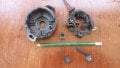
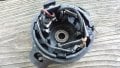
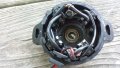
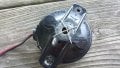
Can someone identify this Briggs-Straton electric motor?

Thread Starter

sdowney717

Joined Jul 18, 2012
804
I had to repair the brushes.
The 2 brushes on the DC - side, their wires pulled out - broke loose of the brushes to make intermittent connection, so motor was stalling and starting constantly while running. I thought at first get new brushes, but impossible, no ID on motor.

So to fix brushes, i cleaned out the hole in the brush where the copper lead goes.
I took solder wick twice the length needed, bent in middle and placed bent end in the hole.
I then took Q-tip cotton and rammed small pieces in the hole to wedge the copper braid tight pack in the brush.
Reused the silicon tubing insulation and attached braid ends to inside lug with solder.
Anyway, I got a low ohm connection to the brush and the motor works again.

I have an album of pictures here.
https://picasaweb.google.com/105248...horMotorJune202015?authuser=0&feat=directlink

The motor powers an anchor line (rope) drum winch with lots of gears. Winch is powered by AC 120v rectified to DC by a full wave bridge rectifier.
So the motor is DC.
Other than the brush issue, the motor is in great shape.


 

tcmtech

Joined Nov 4, 2013
2,867
Those carbon brushes can take some pretty serious heat without damage so if it was me I would just heat them up with a big soldering gun or small torch and remelt the solder back into them.
 

Thread Starter

sdowney717

Joined Jul 18, 2012
804
I have read solder shrinks. On another forum was told soldering into brushes wont last.
So far it is working ok packed with the cotton.
Using the braid seems good to me, very flexible, conforms well to the brush hole.

The braid is meant to suck absorb solder. So it is good to have it loose so the brush can easily move. If it gets soldered at the brush it will make a hard spot.
 

ian field

Joined Oct 27, 2012
6,536
Why not just replace the brushes? While the OEM type brushes may be obsolete or unobtainable, motor brushes on a whole are not. http://store.eurtonelectric.com/brushes.aspx And this is just one place selling them online. Very few if any company makes their own brushes for their motors, they use an off the shelf design/size.
Had the brushes fail on a motorcycle starter motor a while back, there was quite a long delivery time on the order so I raided my assorted salvaged brushes tin. Prettymuch used up most of them by the time I successfully filed a set down to fit and actually have the result work properly - but it can be do able.

Funnily enough - the genuine parts are still in my spares box, as I finally got a set of filed brushes to work - and they still are.
 

MaxHeadRoom

Joined Jul 18, 2013
30,569
Starter motor brushes are very high in copper content, especially series field type due to the very high current.
Softer high carbon will wear that much faster.
Max.
 

Thread Starter

sdowney717

Joined Jul 18, 2012
804
20180705_152850.jpg

20180705_152900.jpg
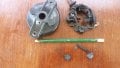
Well, I am back. The motor has failed, same issue, wire leads have burnt out of 2 brushes.
So I really need new brushes.
And the end cap bearing spun in the bakelite, it got stuck on the motor shaft. I can epoxy it maybe with JB weld.
 
Last edited by a moderator:

Thread Starter

sdowney717

Joined Jul 18, 2012
804
Why not just replace the brushes? While the OEM type brushes may be obsolete or unobtainable, motor brushes on a whole are not. http://store.eurtonelectric.com/brushes.aspx And this is just one place selling them online. Very few if any company makes their own brushes for their motors, they use an off the shelf design/size.
I just emailed them and asked if they have something.
Sent him pics and size.

Brushes are a little over 1/8" width, 1/2" tall, 1/2 " depth.
They also have a spring holder formed into their back end.

I think I found them, they are calling them Briggs and stratton starter motor brushes.
Mine are connected in pairs and look just like this here.
http://store.eurtonelectric.com/hitachibrush99-006-1-2.aspx
 
Last edited:

Thread Starter

sdowney717

Joined Jul 18, 2012
804
Ok, looking at my brush holder, it can be modified to use a wider brush.
Where the brush wire enters is narrow for the wire, but immediately after opens up much wider than the 0.15 " brush.
The holder itself can take a wider brush, the end cap has a groove formed by a raised edge that this narrow brush slides on which could be ground lower.

What happens if you use a wider brush?, it will be wider than the commutator segments.
What happens if the brush is shorter?
What happens if the brush is not black carbon, but that other black silver slippery brush, like you see in low voltage DC motors?

I would like to use a bigger brush, if it is more robust than what I have, will a wider brush run cooler?
 

Thread Starter

sdowney717

Joined Jul 18, 2012
804
I bought 2 different kits, 391705 which includes a base plate, might be useful and has slightly different wire ends for the ground brushes.
https://www.ebay.com/itm/OEM-Briggs...e=STRK:MEBIDX:IT&_trksid=p2057872.m2749.l2649

Not this one, but shows picture and has the brush holder which looks just like mine but a little different where brushes sit as far as the size.
The phenolic brown bottom plate might be good to keep space brushes higher and also less heat going into the end cap bakelite.

https://www.ebay.com/itm/Genuine-Br...794391&hash=item282805e411:g:6voAAOSw5cNYasbR
Other kit fits a huge number of starters. amd may have a longer field brush wire. They listed the brush sizes which gave me some confidence

https://www.ebay.com/itm/New-Starte...e=STRK:MEBIDX:IT&_trksid=p2057872.m2749.l2649

Used On:
Briggs & Stratton (1996-1998) , Cub Cadet (1972-1993) , Scotts (2002-2008) , Toro (1977-1998)
Replaces:
Briggs & Stratton Engines 395538
Unit Nos:
Briggs & Stratton Engines 393499, 394805, 394807, 394808, 394943, 395537, 396306, 491308, 497453, 498149, 690658; John Deere LG497453
Lester Nos:
5742, 5743, 5745, 5746, 5910, 5933
For :
Briggs & Stratton Small Engine Starters
Dimensions:
Fld. Brush: 6mm T x 9.5mm W x 12.5mm L x 113mm LL w/ 1/4-20 Stud
Grd. Brush: 6mm T x 9.5mm W x 12.5mm L x 43mm L
Bushing: 12.58mm ID x 18.23mm OD x 12.74 L
Bushing: 9.54mm ID x 14.35mm OD x 9.51mm L w/ Shoulder
 
Looks like your doing well. I had to replace the brushes on a blower motor on an 82 Toyota. The vacuum cleaner store had lots to choose from.
I actually shimmed one side of the brush holder and filed brushes to fit.

With a lot of stuff, you just have part numbers and no sizes.

"O-rings" drive you nuts. The hardware store uses ID/OD; the real numbers are called dash numbers and your faucet or power tool has part numbers.
 

Thread Starter

sdowney717

Joined Jul 18, 2012
804
Someone please explain to me what the company did that made this electric anchor winch to run on DC using 120vac power?
They seem to have taken a 12vdc Briggs starting motor, (or something like it).
Used a full wave bridge rectifier.
Fed 120vac into the rectifier.
Used the DC output of the rectifier and powered the motor.

Now wont that way overspeed the motor?? And overheat the motor??
I measured about 105vdc on the output pins of the rectifier.

Looking at pictures of Briggs starter motors, there many fewer commutator segments than on the winch motor, I count 24 commutator bars on the winch motor.

The motor drives multiple gears and the final winch drum runs slow. You wrap a rope around the drum and it pulls up the anchor, and it is very powerful.
 
Last edited:

Thread Starter

sdowney717

Joined Jul 18, 2012
804
Looks like your doing well. I had to replace the brushes on a blower motor on an 82 Toyota. The vacuum cleaner store had lots to choose from.
I actually shimmed one side of the brush holder and filed brushes to fit.

With a lot of stuff, you just have part numbers and no sizes.

"O-rings" drive you nuts. The hardware store uses ID/OD; the real numbers are called dash numbers and your faucet or power tool has part numbers.
I know what you mean, it is a crap shoot sometimes making things work, especially older things where the manufacturer has abandoned the device.

If that phenolic spacer fits under my brush holder and the slightly wider brushes make this motor function, I will buy the proper brush holder ( one of those ebay listings shows it ) for spares. Fixing this winch is a lot cheaper than buying a new one.
 
Last edited:

Thread Starter

sdowney717

Joined Jul 18, 2012
804
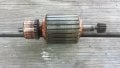
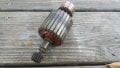
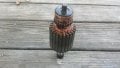
Here are 3 pics of armature. Where this differs from a 12vdc starter armature, is the greater number of commutator segments, the threaded rod with screwed on gear.
A starter armature has the same diameter commutator as this one here.

What determines the voltage a motor is made for?
20180706_092934.jpg
 

Attachments

shortbus

Joined Sep 30, 2009
10,050
Someone please explain to me what the company did that made this electric anchor winch to run on DC using 120vac power?
They seem to have taken a 12vdc Briggs starting motor, (or something like it).
Used a full wave bridge rectifier.
Fed 120vac into the rectifier.
Used the DC output of the rectifier and powered the motor.

Now wont that way overspeed the motor?? And overheat the motor??
I measured about 105vdc on the output pins of the rectifier.
Do you have a snowblower that has plug in electric start? They do the same thing with them, a 12V starter motor running on full bridge rectified 120V.
 

Thread Starter

sdowney717

Joined Jul 18, 2012
804
Do you have a snowblower that has plug in electric start? They do the same thing with them, a 12V starter motor running on full bridge rectified 120V.
Does that make it spin much faster and make more heat and power?
The bridge rectifier is a square metal encased device with central hole for attachment, so the electric DC power it can make is limited. much less than a starting battery. Might be 10 amps. One big advantage of higher voltage, the power cables can be very small. If it was a typical 12vdc anchor windless, the cables might need to be 2/0 to keep voltage drop to a minimum, and it sucks a lot of 12vdc current. And a seperate winch battery might be needed near the anchor locker. For me, I just run a 16 gauge extension cord from a closeby 120vac outlet up to the winch inside the bilge with 120vac..

Another clue about the armature being different than a high current 12vdc starter armature, the windings uses a much finer wire and lots more coils. This design was never meant to function as a starter motor, but it is similar. I hope those new brushes work ok. They are probably metallic carbon and I read they are used up to 72 vdc. So I really don't know how the new wider and different composition brushes will affect the running. Wider brushes will affect the commutation period. Going from 0.15 to .25 inch in width. Any thoughts?
http://www.eeeguide.com/commutation/
 
Last edited:

Thread Starter

sdowney717

Joined Jul 18, 2012
804
I took my ohm meter and measured the armature. Viewing the brush holder, at 90* the power comes in and exits to the ground brushes.
2 field brushes are 180* apart as are 2 ground brushes . Measuring at 90* across the commutator, I get around 11-12 ohm
If I short multiple segments using the probe, the lowest reading is 9.8 ohms. 2 bars joined power in, 2 bars out ground. So it seems there is a slight drop in resistance, but not a short by using a wider brush.

Directly adjacent bars read 2.8 ohms. Every bar is connected to all other bars. Highest ohms at 180* apart is 14 ohms.
Measuring ohms bringing probes closer to each other, ohms steadily drop till the lowest reading is bars next to each other.

I got the impression brushes actually short the commutator as the motor turns reading the linked web page on commutation, meaning wider brushes would present a serious problem with brush arcing, but it seems like that cant happen with this armature. Am I way off base here?

I ordered the ebay brushes to save some cash, but the other narrower brushes linked to earlier are exact replacements. I guess I can see if it runs ok, not drawing a lot of current. Maybe let it run a while then open it up to see how the commutator looks. With this motor, you can not view the brushes as it runs.

Found this about DC commutation, it all gets complex.
https://circuitglobe.com/what-is-commutation-or-commutation-in-dc-machine.html

I also found out, I loosened the rubber boot around the 2 power wires and when it is slid back, I can observe for abnormal brush sparking inside.
 
Last edited:

Thread Starter

sdowney717

Joined Jul 18, 2012
804
20180710_063434.jpg 20180710_063447.jpg 20180710_063456.jpg

It works, got all parts in mail. I used both brush kits field wires, they were longer. The new brushes are wider (0.25" versus 0.15") and brush wires twice the diameter

Clipped off the stud.
Connected wires by crimping yellow ring lugs using a vice grip.
There was room to keep the brush leads on seperate lugs on one side so did that. Had to bend lugs to 90* angle to fit on several.
To make space for the brushes, removed the guides on bakelite cap that guided the thinner OEM brush. Snapped of with pliers, and ground smooth with dremel.

The kit for these has longer field wires, so it is better to use.
Unit Nos: Briggs & Stratton Engines 393499, 394805, 394807, 394808, 394943, 395537, 396306, 491308, 497453, 498149, 690658; John Deere LG497453

The other kit, 391705, the phenolic spacer is an exact fit, so the old kits, 394747, that include a brush holder would fit this starter.
https://www.ebay.com/itm/Genuine-Br...794391&hash=item282805e411:g:6voAAOSw5cNYasbR

Even though I put it together exactly as original, the polarity of the wires is reversed, but it may have always been that way.
Other thing, a little sparking at first and then went away. The motor felt loose before running, afterward much tighter. Took it apart and it is the brushes wore in making better contact, so must be brush friction only.

The brushes, they allowed no possible way I saw to assemble the armature. I drilled four 1.05 mm holes right at the outer edge and used U bent paper clips to hold the brushes back so it could slide together.

Link to it running. For the test, I pulled back the rubber boot to see into the commutator. It was glued to the wires, so had to use a tiny screwdriver to free both wires from the rubber. I am not going to reglue, it is still tight fit. My 5 year old grandson is impressed!
https://photos.app.goo.gl/vV5w4CneSweuow4GA
(have to click when you get there to see and hear vid)

So wider brushes did not negatively affect commutation. Which sort of makes sense.
As the armature coils turn in the magnetic field, before they connect to the brushes, an EMF is generated that is the reverse polarity of power entering brushes. So a wider brush shorts that back EMF quicker, so must mean less EMF being generated before brush connects to the bar. This wider brush always connects 2 bars simultaneously. Which maybe allows the motor to draw more current, perhaps the motor has more power now.
Any thoughts on this?

I put probes on the rectifier DC out.
not running read 90 vdc
running reads 145 vdc.
 
Last edited:
Top