Is that to disable it if it's battery powered and the battery becomes discharged?
Do you want to just disable the output, or cutoff power to the whole circuit?
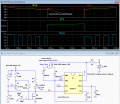
Here's the 555 circuit with a voltage cutoff circuit
It uses the TL431 programmable shunt regulator as a comparator with a built-in accurate voltage reference, to pull the 555 RST input low, which stops the output oscillation when the battery drops below the set voltage.
When the TL431 Ref voltage drops below 2.5V, as determined by the U4/R3 voltage divider ratio, it stops conducting and its cathode voltage goes high, causing MOSFET M1 to turn on, pulling the RST signal low.
This also turns on the D3 LED low-voltage indicator.
R4 provides some hysteresis so the circuit doesn't oscillate at the set point.
The simulation shows the RST line (yellow trace) going low at 9.8V (red trace), which can be adjusted by pot U4.
LED D3 indicates the Low Battery condition (green trace).
That's an odd statement. Don't believe all you read.
Most semiconductor devices are readily damaged by an over voltage so I don't see anything special about the TL431 in that regard.
The TL431 is rated at 37V max cathode to anode and it can't be readily overvolted in this circuit.
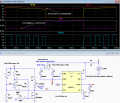
When the voltage is high, the TL431 is full on and has only a couple volts across it, with most of the voltage being dropped across R3 (see V(k), purple trace below)
What do you think would generate an overvoltage?
Edit: I just noticed a problem with your adaption of the circuit.
The RST signal voltage should go no higher than the 555 supply voltage.
So solve that, connect the LED resistor (only) to the the 555 +5V supply instead of the battery voltage.
But what's the purpose of the 5V regulator?
You can run the 555 circuit directly from the battery voltage.
I don't see why that would need a TVS on the gate. It only sees voltage from the 555 output.
You seem to be somewhat obsessed with transient voltages. Have you had a problem with them in the past?
I'm confused.
Is the transformer used to charge the battery?
The transformer can cause a transient voltage on the primary due to the primary magnetizing inductance if the primary is disconnected, but nothing significant if the secondary is disconnected, since that doesn't interrupt the magnetizing current.
Okay.
But that's only connected to the output MOSFET drain.
If have the MOSFET source ground directly connected to the power supply ground with good capacitive decoupling (say 100μF electrolytic in parallel with 100nF ceramic) between the HEI supply pin and the MOSFET source pin, you shouldn't have a problem.

 Facebook
 Google
 GitHub
 Linkedin