can current limit diode supply current to low impedance load

DickCappels

Joined Aug 21, 2008
10,661
If it is a current source diode it can drive current into a dead short of a load, the impedance of which is limited by the voltage compliance of the diode and its power supply.

It is a great way to delver current to the load and whether there are better ways, we need to know the circuits constraints -compliance voltage, its power supply, the amount of current desired, and anything else like required accuracy and physical restraints that come fo mind.
 

crutschow

Joined Mar 14, 2008
38,536
I thought that constant current diode would do it since it shows a built in mostfet which looks way more efficient than that LM317.
There's no difference in efficiency.
Any linear method (diode, resistor, voltage regulator) to limit the current has the same efficiency.

If you want higher efficiency, then you need to use a switching regulator configured in a constant-current mode.
 

panic mode

Joined Oct 10, 2011
5,011
one can create constand current source using LM317. What exactly is constant DC current to primary of a transformer supposed to accomplish?
you still did not explain what the application is and why are you concerned with limiting current. Transformer is an inductive load. DC current limit is reached in steady state. Should not wait for that....
 

AlbertHall

Joined Jun 4, 2014
12,628
If I vary the Vgs to 4.3v then the current peaks to ~3amps and no current limiting is needed but the transistor dissipates ~15watts. But with 4.3Vgs the turn on time is much sharper and 15watts for a different parts isnt too much heat.

Can MOSFETS be safely used were switching loss is high without damage to the part?
Note that if you set Vgs to get a specific current it will increase significantly as the FET heats up.
 

AlbertHall

Joined Jun 4, 2014
12,628
When the drain current is limited by Vgs then the drain current increases with temperature. From the example below, with Vgs at 4V the drain current is 10A at 100C, but only 4A at 25C.
 

crutschow

Joined Mar 14, 2008
38,536
If you are trying to step up a voltage you don't use a current-limiter as that kills the efficiency.
And the circuit you show is not how you use a transformer to step up a voltage.
If you tell us what the requirements are for what you are trying to accomplish, not what you are trying to do, we can better help.
 

Plamen

Joined Mar 29, 2015
111
Can this https://www.mouser.com/ProductDetail/511-STEF033APUR work current limiter for a load thats practically a short circuit?

Is there a better way to supply a set current to the load?
Petkan:
There are may ways to skin a cat. For starters if the current is modest (say below 50 mA) it could be done in analog terms by using a common 3 terminal voltage regulator as current source. Apply the input voltage to Vin, connect a a current defining resistor between Vout and GND pins and wire the load from the GND pin to the actual GND. Ther are dedicated constant current sources like LT3080. With higher load current we prefer switching mode approach. There are ready made CV/CC (Constnant Voltage/Constant Current) modules on Aliexpress. The most flexible are Buck-Boost ones, as they can deliver the desired voltage with the desired current limit over a wide range of input voltages (below or above the desired output).
 

crutschow

Joined Mar 14, 2008
38,536
Typically a resistor is used to limit the current to the desired value in an ignition coil.
Is there some reason you do not want to use that?

If not a simple 2-transistor current limiter should work (below), but it will have the same dissipation as a resistor and the MOSFET will need to be on a heatsink.
The current is approximately 0.65V/Rs.
The value of Rs could be switched to change the limit.

upload_2019-3-1_13-39-21.png


Note that, for the real circuit, you will likely need a voltage clamp (Zener or TVS diode) from the transistor drain to source so the voltage spike when the secondary is open doesn't zap the transistor.
 

crutschow

Joined Mar 14, 2008
38,536
You can minimize the dissipation by reducing the ON time of the MOSFET to the minimum needed for the current to reach the maximum value due to the primary inductance.
Thus the MOSFET OFF can be longer than the ON time.
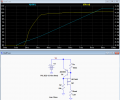
With a primary inductance of 430μH and a series resistance of 4Ω to limit the current to 3A. the charge time-constant is 430μH/4Ω = 108μs, thus to charge to 5 time-constants, requires about 0.5ms. (See sim below).
View attachment 171268
At 125Hz, that's a duty-cycle of about 6% ON.
That reduces the average resistor power dissipation to about 1.5W (due to the high peak power you would want to use a 5-10W resistor).
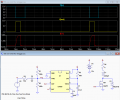
This could be done with a 555 timer configured as a triggered 1-shot with a 0.5ms on-time, for example.

Edit: Below is the LTspice simulation of a 555 circuit.

upload_2019-3-1_16-11-59.png
 
Last edited:

crutschow

Joined Mar 14, 2008
38,536
Would the snubber diode limit the high voltage output?
Yes.
You can't put just a diode across the coil as that will indeed kill the output voltage.
You only do that when you need to suppress the inductive kick from a solenoid or relay coil.
Your application requires a Zener from the MOSFET drain to source, as I showed in my sim, with Zener voltage of about 75% of the MOSFETs voltage rating.
The maximum output voltage will then be the Zener voltage times the coil turns ratio.
 
Last edited:
Top