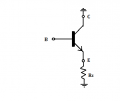
Calculte amplification and emitter current

Thread Starter

J_Rod

Joined Nov 4, 2014
109
common-collector problem.png
Hi there,
In this common-collector configuration I need to calculate voltage gain and emitter current. Full problem statement:
"An input voltage of 2 V RMS is applied (measured from base to ground) to the circuit. Assuming that the emitter voltage follows the base voltage exactly and that VBE RMS = 0.1 V, calculate the circuit voltage amplification (Av = Vo/Vi) and emitter current for RE = 1k ohm."

My results:
Vi = VB = 2 V RMS (measured from node B and GND)
Vo = VRE (measured from node E with reference GND)
IE = IB +IC
Using Kirchhoff's Voltage Loop,
-2V +0.1V +VRE = 0
VRE = 1.9V RMS
IE = VRE/RE = 1.9V /1k ohm = 1.9 mA
then the gain is
Av = Vo/Vi = 1.9V /2V = 0.95

My question is does this working make sense? The gain is near unity which is consistent with the common-collector configuration (http://www.allaboutcircuits.com/textbook/semiconductors/chpt-4/common-collector-amplifier/ ). I think that is what they mean when it says the emitter voltage follows the base voltage exactly. Also, is there any way to calculate IB and IC from the given information?
Thank you!
 
Last edited:

#12

Joined Nov 30, 2010
18,224
The idea that you have a transistor with a grounded collector (no voltage supply) opens up the idea that the base-collector junction can become forward biased. Base current can escape in both directions! Please tell me this is just an agreement between you and your teacher. That would make a lot of doubts go away.
 

Jony130

Joined Feb 17, 2009
5,598
Why your collector is short to ground? Or maybe this is a "small-signal" schematic ?
Also, is there any way to calculate IB and IC from the given information?
Do you know the relations between Ib, Ic and Ie in bipolar transistors ??
 
Last edited:

Thread Starter

J_Rod

Joined Nov 4, 2014
109
The idea that you have a transistor with a grounded collector (no voltage supply) opens up the idea that the base-collector junction can become forward biased. Base current can escape in both directions! Please tell me this is just an agreement between you and your teacher. That would make a lot of doubts go away.
Hmm, does that mean the input current splits to nodes C and E? In other words, IC is negative. I don't know what you mean by agreement, but we haven't done any problems like this in class.
 

Thread Starter

J_Rod

Joined Nov 4, 2014
109
Why your collector is short to ground? Or maybe this is a "small-signal" schematic ?

Do you know the relations between Ib, Ic and Ie in bipolar transistors ??
I'm not sure why it's grounded, but this the full circuit diagram for the problem. In the common-collector configuration, node C is at ground potential, and the input to node B has one leg at ground and the other at 2V RMS, so they share a common point.

For the BJT, IE = IB +IC. IB is usually in micron scales and IE and IB usually around milliamperes.
 

Jony130

Joined Feb 17, 2009
5,598
I'm not sure why it's grounded, but this the full circuit diagram for the problem. In the common-collector configuration, node C is at ground potential, and the input to node B has one leg at ground and the other at 2V RMS, so they share a common point.
So, as I suspected this is just a "AC" ground. The collector is not "physically connected" to GND. So no current will flow through the base-collector junction.
For the BJT, IE = IB +IC. IB is usually in micron scales and IE and IB usually around milliamperes.
And Ic is equal to what ??
 

Thread Starter

J_Rod

Joined Nov 4, 2014
109
So, as I suspected this is just a "AC" ground. The collector is not "physically connected" to GND. So no current will flow through the base-collector junction.

And Ic is equal to what ??
IC = 0 since there is no current through base to collector. Then IE = IB.

What does AC ground mean, though?
 

Jony130

Joined Feb 17, 2009
5,598
IC = 0 since there is no current through base to collector. Then IE = IB.
No, wrong. I was asking for general relation between Ib and Ic. Ic = Ib*β and Ie = Ib + Ic = Ib + Ib*β = Ib*(β + 1).
And now if you know Ie you can easily find Ib and Ic.
What does AC ground mean, though?
This circuit cannot work without properly selected operating point for the transistor. This means that DC current must flow first. Transistor must work in active region. Because only if transistor is properly biased in the active region, then when we give a AC signal at the input of the transistor then it will be able to amplify it.
And his ground symbol on your diagram represent AC ground (small-signal model). This ground is a reference point for the AC signal, because the ideal DC voltage source has 0Ω internal resistance. And that's why AC-signals are short by DC voltage source. But I suspect that you do not understand the difference between DC-analysis and AC-analysis (small-signal).
 

JSCV

Joined Oct 3, 2015
23
''and the input to node B has one leg at ground and the other at 2V RMS, so they share a common point. "

What do try to tell here ? Do you mean the BASE (node B) is connected to both ground and 2V RMS ?
 

Thread Starter

J_Rod

Joined Nov 4, 2014
109
I need to know either IC and IE or IB and IE to find the other current.

There is no DC input to this circuit. The diodes will conduct when the AC input has portions which will turn them "on." And no, we haven't done AC analysis of the BJT in class as I have said.
 

Thread Starter

J_Rod

Joined Nov 4, 2014
109
''and the input to node B has one leg at ground and the other at 2V RMS, so they share a common point. "

What do try to tell here ? Do you mean the BASE (node B) is connected to both ground and 2V RMS ?
A sinusoid connects from B to GND and the collector (C) connects to GND.
 

Jony130

Joined Feb 17, 2009
5,598
I need to know either IC and IE or IB and IE to find the other current.
So now you do not know Ie ??
There is no DC input to this circuit. The diodes will conduct when the AC input has portions which will turn them "on." And no, we haven't done AC analysis of the BJT in class as I have said.
Well if this is the case I must say that I don't understand the point of this exercise. In this situation BJT will not work as a transistor but just like a two separate diodes.
The B-E junction will conduct only for positive half cycle of a input signal. We have the same situation for B-C junction. This "diode" will short and clamp the positive half cycle. And for negative half cycle both diodes are off.
 

Thread Starter

J_Rod

Joined Nov 4, 2014
109
So now you do not know Ie ??

Well if this is the case I must say that I don't understand the point of this exercise. In this situation BJT will not work as a transistor but just like a two separate diodes.
The B-E junction will conduct only for positive half cycle of a input signal. We have the same situation for B-C junction. This "diode" will short and clamp the positive half cycle. And for negative half cycle both diodes are off.
I calculated IE in my first post. I am not sure what IB or IC are. Beta is just a change of variables dependent on IB and IC.

You're not the only one who doesn't understand this exercise! If this circuit acts like a clamper as you say, the output will have an an average DC value, but the input has an average DC value of 0.
 

dannyf

Joined Sep 13, 2015
2,197
"An input voltage of 2 V RMS is applied (measured from base to ground) is applied to the circuit. Assuming that the emitter voltage follows the base voltage exactly and that VBE RMS = 0.1 V, calculate the circuit voltage amplification (Av = Vo/Vi) and emitter current for RE = 1k ohm."
The question is faulty, and easy if you ignore its fundamental fault.

Assuming that the circuit works, the first part of the question is easy: Av=Vo/Vi = 1, as it indicates that the emitter / output voltage follows the base / input voltage.

But the input signal is an ac signal (2 Vrms). and the circuit needs a DC bias to work (assuming that C is tied to a positive voltage source). What you get is a pulsed DC on the emitter, with the last 0.1v chop'd off.
 

WBahn

Joined Mar 31, 2012
32,872
I suspect that this might be yet another case of an instructor dreaming up an exercise that they themselves don't understand. Giving the benefit of the doubt, it's also possible that they have the right ideas in mind and are just doing a very bad job of conveying them.

It appears that they are mixing the hell out of large signal (DC bias) and small signal (AC operation) concepts.

But the more I look at the information in the question the more I suspect that the person that wrote it doesn't know what they heck they are talking about.
 

Thread Starter

J_Rod

Joined Nov 4, 2014
109
I suspect that this might be yet another case of an instructor dreaming up an exercise that they themselves don't understand. Giving the benefit of the doubt, it's also possible that they have the right ideas in mind and are just doing a very bad job of conveying them.

It appears that they are mixing the hell out of large signal (DC bias) and small signal (AC operation) concepts.

But the more I look at the information in the question the more I suspect that the person that wrote it doesn't know what they heck they are talking about.
This is from a well-known textbook, and I don't think I copied the problem down incorrectly. I'll have to ask the professor about it.
 

Thread Starter

J_Rod

Joined Nov 4, 2014
109
The question is faulty, and easy if you ignore its fundamental fault.

Assuming that the circuit works, the first part of the question is easy: Av=Vo/Vi = 1, as it indicates that the emitter / output voltage follows the base / input voltage.

But the input signal is an ac signal (2 Vrms). and the circuit needs a DC bias to work (assuming that C is tied to a positive voltage source). What you get is a pulsed DC on the emitter, with the last 0.1v chop'd off.
Does that mean the GND symbol is actually a positive DC value which turns "on" the transistor? Is that what is meant by AC ground? Then I suppose the current IE = 2V RMS /1k ohm = 2 mA RMS
 

WBahn

Joined Mar 31, 2012
32,872
The notion of DC and AC ground is actually a bit of shorthand related to looking at the total solution as being the superposition of two solutions, namely the DC steady state solution and the solution that, when added to that DC steady state solution, yields the total solution (or an acceptably close estimate of it). Since that second solution is not DC, we call it the AC solution. If we then look at the equation that makes up the AC solution and construct a circuit that would yield that equation, we see that any node that was connected to a DC voltage supply is now at ground. This shouldn't come as a surprise because what do you do when you use superposition in a linear circuit? You zero out all of the voltage supplies except the one you are interested in and so any node that was connected to one of the supplies that, in turn, was connected to ground (common) is now also at ground potential. Hence, any node in the actual circuit that is at a fixed DC voltage behaves as a "ground" for the AC portion of the analysis.
 

WBahn

Joined Mar 31, 2012
32,872
This is from a well-known textbook, and I don't think I copied the problem down incorrectly. I'll have to ask the professor about it.
What text? If I have it (or if the library has it) I'd be interested in taking a closer look. Sometimes the author establishes some conventions that need to be applied when considering the problems they present. But, sometimes even well-known textbooks have serious shortcomings.
 

Thread Starter

J_Rod

Joined Nov 4, 2014
109
What text? If I have it (or if the library has it) I'd be interested in taking a closer look. Sometimes the author establishes some conventions that need to be applied when considering the problems they present. But, sometimes even well-known textbooks have serious shortcomings.
The textbook is Electronic Devices and Circuit Theory 11 ed. by Boylestad and Nashelsky. The problem is ch.3 #26 and the circuit is FIG. 3.21 pg 143.
 
Top