There are those who say that hiss is caused by high resistance, and those who say that hiss is caused by high capacitance. Resistors do not have leakage. Capacitors can. I vote capacitors as the source of hiss.
Are you referring to a particular audio amp, or just audio amps in general?
Capacitors do not generate noise, only resistance and active devices do.
In an audio amp, the most likely source of noise is an active device at the front end, unless there are some very high value resistors in the audio path.
Are you referring to a particular audio amp, or just audio amps in general?
Capacitors do not generate noise, only resistance and active devices do.
In an audio amp, the most likely source of noise is an active device at the front end, unless there are some very high value resistors in the audio path.
You got it backwards.
My personal experience, similar to Crutschow snd others, is that both resistors and semiconductors are responsible for the white noise, which is heard as a hiss.
A defective capacitor causes a popcorn or crackling noise, when the dielectric is breaking down. Never will a capacitor create white noise.
Think semiconductors first, resistors second, capacitors last. An individual transistor has a performance parameter called its noise figure. Also, there's a reason why so many white and pink noise generator circuits use a transistor as the noise source.
Certainly the comments are correct, in that components do generate noise from current passing thru. (That does not mean that I can explain it or even fully understand it.) BUT certainly I have seen it and heard it. BUT the noise is created by the current flow, not the resistance itself. Likewise, capacitor noise is created by charge movement.
The really bad news is that electronic circuits with no current flow or charge movement are seldom doing anything useful.
Certainly the comments are correct, in that components do generate noise from current passing thru. (That does not mean that I can explain it or even fully understand it.) BUT certainly I have seen it and heard it. BUT the noise is created by the current flow, not the resistance itself. Likewise, capacitor noise is created by charge movement.
The really bad news is that electronic circuits with no current flow or charge movement are seldom doing anything useful.
Certainly the comments are correct, in that components do generate noise from current passing thru. (That does not mean that I can explain it or even fully understand it.) BUT certainly I have seen it and heard it. BUT the noise is created by the current flow, not the resistance itself. Likewise, capacitor noise is created by charge movement.
The really bad news is that electronic circuits with no current flow or charge movement are seldom doing anything useful.
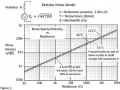
I am not sure what point you are trying to make but since resistor self-noise is proportional to resistance, for any given circuit the noise will be inversely proportional to current. Resistor noise is thermal in nature, so the proportionality to voltage drop makes sense.
Don't understand that statement.
How is thermal noise related to voltage drop?
As I recall, carbon composition resistors can have a small noise component proportional to the current through them (perhaps similar to shot noise), in addition to their normal thermal noise.
Since they are seldom used anymore, that's now rather a moot point.
Don't understand that statement.
How is thermal noise related to voltage drop?
As I recall, carbon composition resistors can have a small noise component proportional to the current through them (perhaps similar to shot noise), in addition to their normal thermal noise.
Since they are seldom used anymore, that's now rather a moot point.
In resistors Johnson Noise (thermal noise) is proportional to resistance, voltage drop is proportional to resistance. Voltage drop is not the cause of the noise, it is just inextricably coupled to it.
In resistors Johnson Noise (thermal noise) is proportional to resistance, voltage drop is proportional to resistance. Voltage drop is not the cause of the noise, it is just inextricably coupled to it.
OK.
But that, to me, is a somewhat confusing statement.
To be clear, voltage drop also varies with current through an ideal resistor, but the noise voltage doesn't.
Voltage drop due to current and voltage noise are both due to resistance, but that's there only relationship.
You can thus still have the noise with no current and thus no voltage drop.
OK.
But that, to me, is a somewhat confusing statement.
To be clear, voltage drop also varies with current through an ideal resistor, but the noise voltage doesn't.
Voltage drop due to current and voltage noise are both due to resistance, but that's there only relationship.
You can thus still have the noise with no current and thus no voltage drop.

 Facebook
 Google
 GitHub
 Linkedin