Filtered signal amplification problem

Thread Starter

yungeeboi

Joined May 31, 2025
1
Hi everyone. I've designed a circuit for small amplitude signal processing (amplitude = 1 mV). As for active filtering stages I use 2nd order LPF (fc = 20Hz), 2nd order HPF (fc=4Hz) and twin-t notch filter (50Hz). After that goes amplification stage (op amp with potentiometer as a negative feedback), offset control and output buffer stage. As for power supplies, I use 3.7V battery and 7660 voltage converter for negative supply. I don't use decoupling on power rails (can it be the thing?)
I have a problem with amplification stage. When I try to increase the gain, I start to see slow oscillations (somewhere in between of 20-40Hz) instead of a signal.
How can I deal with those oscillations? Should I use a buffer between filtering and amplification stages?
I've already implemented a capacitor in parallel with negative feedback resistor, but It doesn't have the desired effect.

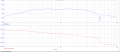
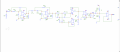
I've attached Bode plot and the circuit.
Thanks in advance!
 

Attachments

KeithWalker

Joined Jul 10, 2017
3,603
Hi everyone. I've designed a circuit for small amplitude signal processing (amplitude = 1 mV). As for active filtering stages I use 2nd order LPF (fc = 20Hz), 2nd order HPF (fc=4Hz) and twin-t notch filter (50Hz). After that goes amplification stage (op amp with potentiometer as a negative feedback), offset control and output buffer stage. As for power supplies, I use 3.7V battery and 7660 voltage converter for negative supply. I don't use decoupling on power rails (can it be the thing?)
YES It can be the thing!
 

MisterBill2

Joined Jan 23, 2018
27,186
Without adequate capacitors on the power supply circuits there is coupling between stages, and in an amplifier circuit with gain that will result in oscillation. That is certain, not just a guess. That amplifier has quite a bit of gain and so certainly the coupling of the stages will produce an oscillation at one or more frequencies.
 

Pyrex

Joined Feb 16, 2022
501
Decoupling capacitors is a mandatory for such high gain circuits . Moreover, each opamp should be fitted with its own capacitors. In some complicated cases both voltages should be laid thru resistors (20-50 ohm ) for the first opamp. Common point of two capacitors to be tied together and tied to the GND point of the second opamp
 

MisterBill2

Joined Jan 23, 2018
27,186
In addition to the good advice already given, the actual physical arrangement of the power supply connections matters.
The system circuit is composed of the signal path conductors, the common "ground" path conductor, and the power supply conductors. Unwanted coupling can be caused by the voltage developed by the currents passing thru the impedance of shared conductors. That is the mechanism that causes the dreaded "ground loops", that are sometimes a problem.
That is not quite the same as power feed coupling, which bypass capacitors usually reduce or prevent completely. "Loop" coupling is a physical arrangement thing much more than a circuit design fault, and so it is less likely to be obvious on a circuit schematic view. It is one of the reasons that printed circuit designing requires more than just understanding and using the layout software.
 
Last edited:
Decoupling needs to be used, 100%. Depending on the actual gain (on schematic shown it doesn't look very high), other reasons to see noise in this range could be related to large capacitors in filter circuits. If they are ceramic they can act as microphones. Try knocking on the PCB when gain is high, you'll see pretty big amplitude of the sound they capture.
If confirmed - the only solution would be to use film capacitors instead of ceramics.
Try adding the amplifier stage at the input to reduce the gain on the final stage.
 

MisterBill2

Joined Jan 23, 2018
27,186
yungeeboi said:


I don't use decoupling on power rails (can it be the thing?)

And why would you not do the standard and very important thing that all circuits require?
The only times where you can get away without any decoupling capacitors is when both the source impedance and the connection impedance are both zero. This is often the case in simple circuit simulator programs, seldom the case in the real world. It may also work sometimes in circuits with low gain.
 

schmitt trigger

Joined Jul 12, 2010
2,027
Also, the voltage divider R12 and R13, where you add a DC bias, you require to decouple that also.
To do so, split R12 into 100k and 300k, with the 100k on top (to V+). Then at the junction of the 100k and 300k, add a 0.1uF to ground. The bottom of the 300k connects to the signal node and R13.
 

MisterBill2

Joined Jan 23, 2018
27,186
Also, the voltage divider R12 and R13, where you add a DC bias, you require to decouple that also.
To do so, split R12 into 100k and 300k, with the 100k on top (to V+). Then at the junction of the 100k and 300k, add a 0.1uF to ground. The bottom of the 300k connects to the signal node and R13.
That advice is correct, but complicated. Why not feed the signal into the inverting input and add a feedback resistor to give the desired gain??
 
Top