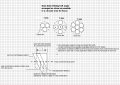
caclulating the angle of Multi IR LED arrangment

Thread Starter

longpole001

Joined Sep 16, 2014
62
Hi guys ,
just want to check on how to calculate the combined illumination angle for when IR leds are combined for adding a lens FL calculations

if i have say 3 led with a 10deg half angle arranged close as possible together , would the emitted beam be consider a single light source and be at 10deg or each led added together to be a total of 30deg half angle

cheers
 

Thread Starter

longpole001

Joined Sep 16, 2014
62
i want to extend a 38khz ir signal some 150meter with say 3 or 5 extra LEDs in series that are 10deg half type , this will requires some optics on the tx side and maybe on the RX side

The optimal lens will make use of as much of the IR emission as possible. If the half-intensity emission angle as the usable shape of the IR beam between the focal length and lens diameter for a specific IR LED.

The minimum lens diameter D is given by D ≥ 2 F tan(θ), where F is the focal length and θ is the half-intensity angle from the axis. For example, for the Vishay TSAL-6100's 10° half intensity angle, the lens diameter should be no less than 0.35 times the focal length, or the focal length should be no more than 2.8 times the diameter

However if placing 3 leds of 10deg in close to each other is considered still 10deg for the lens calculation or is it now 30deg half , or another calculation for the half -intensity ???


a
 

kubeek

Joined Sep 20, 2005
5,796
However if placing 3 leds of 10deg in close to each other is considered still 10deg for the lens calculation or is it now 30deg half , or another calculation for the half -intensity ???
Imagine the cone of light coming from each LED. Does the cone angle change when you pleace more LEDs next to each other? No it does not, unless each LED is pointing in different direction.

But since the LEDs are further apart, I would add the diameter of the space they are in to the required diameter of the lens.

(Or buy normal leds and see where and how the light goes ;) )
 

Thread Starter

longpole001

Joined Sep 16, 2014
62
your correct in that the cone angle does not change , but as there is separation of 5mm between each led the combined focal point does
as factor of the light angle

so to calculate the lens focus Length and thereby the diameter of the lens for the combined light source of 2, or 3 leds in an overall dia of 10mm when arranged in a circular position
, each led source point is 5mm separation ,
I would think this changes the combined focal point of the sources by the distance of seperation x half angle value of each led to caclulate where they overlap

the overlap point is where the focal point of the lens need to be for the max light out
led seperation distance x half angle value = offset
the offset value added to the position lens focal distance when positioning the lens ???

also as half of the angel overlap of 2or 3 led at 10deg at the combined focal point is now a total 20deg half angle for the combined leds ???

as as such changed the focal length and thus the diameter of the lens required for the combined led output would be caclulated ona 20deg angle becuase of the seperation ???
 

DickCappels

Joined Aug 21, 2008
10,661
Try three visible LEDs with the same radiation angle. If all three are mounted on the same plane (pointed the same way) you don't have to get the LED cluster very far away from a screen or wall to see that the three beams nicely merge into a single spot. At some distance from your cluster of three 10° LEDs you will see the spot on a screen correlates to a single 10° beam.
 

Thread Starter

longpole001

Joined Sep 16, 2014
62
well the suck and see appoche may end up being the start point to play and find out ,
but without a good expectation of the optics design math and consideration of the distance for overlap of the multi led arrangement its going to not work very well for an incorrectly selected lens based on a guess

what math equation may work out the distance where 3, 5, 7 leds of 10deg each , arranged in close arrangement as possible , would be combined overlap distance for all light.

at that combined point i would be very surprised for mulli led arrangement not to have a total wider half angle, at the combined focus point due to the separation of each led in the array, as there is no way it would remain at the original 10deg as there little chance that it overlaps exactly for each led in the array at the combination point

what is the math to work out this wider half angle due to mulli led overlap based on led separation distance and the number led in the array
 
Top