Building a sensitive pickup

joeyd999

Joined Jun 6, 2011
6,297
The most "useful" (or ideal) output I could wish for would be a waveform such as the one shown above, but with a rail-to-rail voltage (from 0 to 3.6V) with the lowest possible voltage as the input signal. In the sim above, a 100 µV sinewave is being used as the input of a single stage circuit ... in a letter to Santa Claus I'd ask for a rail to rail output when the input signal is 1 µV
I've not followed this thread, but if I understand your requirements correctly, how about either a log amp, or an AGC, for the front end, followed by some filtering and a comparator?
 

MrChips

Joined Oct 2, 2009
34,817
the distance between the sensor and the PCB is only a couple of inches btw. And shielding (and twisting) the cable is perfectly doable. Shielding the PCB itself is a different matter, but I'll take your advice into account.
A couple of inches is way too long where SNR is concerned.
The trend today in signal processing is to skip the amplifier altogether. Digitize the signal directly right at the sensor with a 24-bit ADC. 24 bits represent 16,777,216 steps. Thus for 2.5 V full-scale, one step is about 0.15 μV.

Even after degrading the ADC to 20 bits ENOB, one step is about 2.4 μV.
 

Thread Starter

cmartinez

Joined Jan 17, 2007
8,763
Lots of ideas here. I'll have to give proper consideration to each of them.

Many thanks to all for your involvement.
 

Thread Starter

cmartinez

Joined Jan 17, 2007
8,763
Starting with the idea of modeling a guitar pickup makes sense but it just occurred to me that the signal also resembles what you'd get from a low-output moving coil (LOMC) phono cartridge. Maybe there's something to be learned by looking into that application.

For example here's a DIY project to build a pre-amp for that kind of cartridge.
https://diyaudioprojects.com/Chip/Opamp-Phono-Preamp/
Excellent suggestion, Wayneh ... I'll look into it. Many thanks.
 

schmitt trigger

Joined Jul 12, 2010
2,090
@cmartinez ;
As you can already see, there are literally dozens of ways to skin a cat. Like absolutely everything else in engineering, there is the art and science of the tradeoffs between performance, complexity, cost and other parameters.
I have avoided jumping into this meleé and further confuse the discussion.
Therefore my two yen;
You’ll have to start choosing at least a pair of the many proposed solutions and actually order components and build them. Evaluate that those solutions meet your expectations and requirements which, BTW, include cost and power consumption.
I know it is a lot of work, but remember Edison’s famous saying: success is 1% inspiration and 99% perspiration.
 

Ian0

Joined Aug 7, 2020
13,132
I agree with @schmitt trigger . It's definitely time to get something built. There's only a limited amount that SPICE can tell you until you can give it accurate information on signal levels.
I'd suggest that the first thing you do is build a linear amplifier with known gain and frequency response. Then you will be able to determine exactly what magnitude and frequency your input signal really is.
 

Thread Starter

cmartinez

Joined Jan 17, 2007
8,763
You’ll have to start choosing at least a pair of the many proposed solutions and actually order components and build them. Evaluate that those solutions meet your expectations and requirements which, BTW, include cost and power consumption.
I know it is a lot of work, but remember Edison’s famous saying: success is 1% inspiration and 99% perspiration.
Thanks ST, that is exactly what I've been doing. I've been fabricating fixtures and adapters that will let me test different configurations of pickups (varying in magnet and wire sizes and number of turns) using at least three different OpAmps in a highly tweakable and patchable PCB. ... And like you've just said, it's a lot of hard work, and it's also the only way to get to where I want to go.

It'll be at least another week until a few more parts that I've ordered arrive and the necessary gizmos have been built and the pertinent tests have been performed. I'll get back here and report my results as soon as all of that happens. Thanks everyone for your contributions.
 
Last edited:

Thread Starter

cmartinez

Joined Jan 17, 2007
8,763
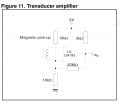
The necessary parts to build the op-amp circuit we've been talking about arrive today. But in the meantime, I decided to build a circuit based on a comparator. I found this in the LM193 datasheet:

Pickup & Comparator.jpg

I have a few LM331 comparators laying around and so I improvised and built the circuit from scratch.

The thing is picking up EMI from all over the place! ... if I stand near it in certain positions it goes berserk!, but if I move a little to the left or the right it suddenly quiets down. And it doesn't matter if I use a battery or a power supply. Although it does react to a metal being shaken close to it. Funny enough, if I remove the 10k resistors (and the 20M, which is for hysteresis) its behavior improves significantly. But it is not as nearly as sensitive as it is compared to the EMI being picked. Is there a way to filter or cancel that?
 

Thread Starter

cmartinez

Joined Jan 17, 2007
8,763
UPDATE: Apparently, much of the EMI being received was from the scope's probe itself, which I had attached to the comparator's output and its clip to ground. The circuit is almost usable, but it lacks the sensitivity I need.
 

schmitt trigger

Joined Jul 12, 2010
2,090
I haven't read the whole thread, therefore I ignore whether you have actually shown your magnetic pickup's actual physical assembly.
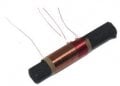
Seems to me that you DO require a pickup with significant directionality, which will gather the faint signals while rejecting the all of the stray fields. Think of something similar to those old AM radio ferrite antennas.
I also haven't read your whole thread to determine the actual frequency range of your signals of interest. Again, following the same idea, you could try to bandpass-tune that "antenna" to reject signals outside that range.

Just sayin'
AM-radio-ferrite-rod-antenna-coil.jpg
 

Thread Starter

cmartinez

Joined Jan 17, 2007
8,763
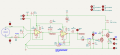
So far, so good ... The PCB's have finally arrived, and I've just tested the first stage of the circuit shown below (with my scope connected to pin #2 of J3). And it's working beautifully, giving a nice, clean signal! This thing is detecting the presence of a 4x10mm magnet up to 8 inches away! ... I'm using the TP5591, btw. The use of a battery to power up the circuit is a must. Otherwise my crappy power supply will induce a horrible amount of noise. Tomorrow I'll be testing it using the real scenario with the second stage enabled ... see what happens. Wish me luck!

1772575828724.png
 

Thread Starter

cmartinez

Joined Jan 17, 2007
8,763
UPDATE. I have enabled the second op-amp, and the circuit did increase its sensitivity, albeit at the cost of introducing a noticeable amount of noise. Next step is to verify if its output can be used as it is, or if the pickup needs shielding, or if the idea and general setup is useful at all. I'm optimistic enough to go through with all the necessary tests and experiments. But I'm also staying objective and ready to move on and change my approach if this thing doesn't meet requirements.
 
Top