Still waiting on parts to finish this design/build but in the meantime, I found these small linear PSUs on eBay. https://www.ebay.com/itm/Continuous...Power-Supply-DIY-Kit-Transformer/293513256925 View attachment 220123
Price is about the cost of the transformer alone. Did make 2 modifications. Added an inline fuse to the power cord and a multiturn POT for easier voltage adjustment. One is spot on voltage with my bench meter and the other is 0.1V low. They max out @ 15.5V. Still need to tape up the line in wires where I couldn't shrink wrap to protect them.View attachment 220125
Exactly! Not fully shown is the black jumper I made between the +&- which has an alligator clip on it. I like to use red for the +V and yellow for -V. No idea what the VA rating is of the XFMRs but should be good for a 100mA+ split voltage supply.
IF you can believe the listing. Marking on the transformer mostly in chinese. It does show 110V 50hZ and a diagram of the secondary being 12-0-12, which it isn't. It has a single coil/2 wire input and a single coil/2 wire output. I already burned up/shorted a larger 115/230/12-0-12 5VA XFMR rated for 180mA by putting a 100mA load resistor on both the + & - sides. Turns out the 180mA was total, not per coil it seems. The limiting factor is most likely the XFMR here which could easily be upgraded if needed. But, hey, it's cheap, works, and Op Amps typically only need <10mA supply current. That's all I'm trying to do here is supply the Op-Amp itself and free up my bench PSUs for the circuit supply requirements.
Yeah, I failed to mention that part. If you burn them out maybe you can replace them with a proper center tapped one. It should be fine for simple circuits. Maybe you should put in an inline fuse. I’ve shorted things out while testing. Opamp circuits have a way of growing.
I did, and I use a 1/2A 5x20mm glass cartridge. Sometimes I don't get my thinking cap on straight so I keep plenty of fuses on hand. I also have the power strip switch handy in case the circuit on the secondary starts giving off smoke signals and the fuse doesn't go. That's 60W on the primary and with 12V on the seconday the fuse won't go until it hits 5A on the secondary side of the XFMR so... I might even have to buy some lower-rated fuses if I can find them.
Yes, these do, but the one I am building will only have 1 voltage adjusting pot. Right now, across the 5-18V range, I am getting a 0.4V difference between +&-. So I still have some tweaking to do on it once I get it built on perfboard. Right now it is only breadboarded and still waiting on a few better parts for it.
Yes, that circuit is actually from one of the manufacturer's PDF. Yes I started with the XFMR he recommended and it failed when I put a 100mA load on each side of it so I upgraded to the 2000 mA model. Which is overkill and I have another 180mA on order. The XFMR cost is more than the 2 kits from eBay but it is a good learning experience... So, as soon as the parts I have on order are delivered I will finish the perfboard layout and start the soldering. I would still like to narrow the 0.4V differential voltage issue.
The label on the transformer (image in post #59) indicates that it is center-tapped, but the ebay listing image shows otherwise. I'm guessing it's just mislabeled?
This circuit is not quite the "standard" approach. A small drawback is that the output tracking will drift a small amount because each regulator chip has its own reference voltage that can wander independently of the other. More on that in the next post.
Yes, the label is bogus. You can't see the secondary wires as I have them tucked out of the way under the board but there are only 2 wires. Single primary and secondary windings. I put a 2kΩ resistor across both in series @ 15V and get 14.7 mA and the voltages drop by 0.2V so there is not a lot of VA available from the XFMRs but enough for an Op-Amp.
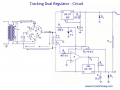
Here is a variation of post #21. The positive supply is the controlled output, and the negative supply tracks it as an inverting power amplifier. This eliminates the problem of the two regulator's references not being equal or temperature-tracking.
Because negative regulator U3 is acting as nothing more than a power transistor, it can be replaced with a PNP power darlington transistor.
NOTE: This is not my schematic. I grabbed it off the innergoogle to illustrate the concept.
1. GND is the positive rail for the opamp. This could be a problem, depending on the opamp's input common mode voltage range. A common fix is a 3 to 5 V zener supply off of C1.
2. There is no output filtering for the positive supply.
3. There is no reverse-polarity protection anywhere.
@AnalogKid One of the problems I ran into was matching up the regulators as the VI curves were apparently slightly different for each one. Luckily I had bought the regulators in lots of 10 so I was able to get a better match although not perfect. Or it may be the resistors in the circuit not perfectly matched although even @ 1% I tried to get them as close as I could. The voltage difference is 0.4V but it is linear across the ~5-18V range. Without the matching, the V differential varied across the output V range.
That is why the vast majority of dual-tracking circuits use approximately the same topology, one that has everything referenced to one reference instead of two.
@AnalogKid I like it. Why so much capacitance before the regulators? I breadboarded with 1000uF on each leg and was going to use 2200uF on the perfboard? I also like the secondary fusing and have started considering doing that also. Instead of the coarse and fine pots, I use a multiturn as the standard single turn is way too touchy. Something to consider... Also, since using perfboard, I am using the LM3XXTs. You left off the typical diode protection and smoothing tantalum caps after the regulators?

 Facebook
 Google
 GitHub
 Linkedin