Buck converter based LED power supply

Thread Starter

tom66

Joined May 9, 2009
2,595
How would an IRF9530 work for the P fet? It's overkill at the 14A rated current, but it's the only one I have around.
 

Wendy

Joined Mar 24, 2008
23,798
That's what I was talking about when I was referring to in post 113.

However, it doesn't sound like a logic level MOSFET. This is a requirement if you're using a various of mine and Wookie's schematic. Logic level MOSFETs can be a pain to acquire, thought you can mail order them easily enough.
 

Wendy

Joined Mar 24, 2008
23,798
Dagnabit!

I've just spend over 5 hours looking for problems. One was easy, solder wasn't bridging between a wire and the pad.

The second was a stone female dog, I drew the wrong colors on R4 and R5. The schematic is correct, but when I build it wanna guess what cue I used? My breadboard is getting mighty ugly.

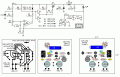
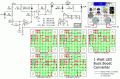
I have corrected the drawings, both of them. Here they are.


Remember, use M/S Paint to print out the PCB to get it to the correct size.

.
 

Attachments

Last edited:

Wendy

Joined Mar 24, 2008
23,798
Can you point us to the datasheet? Truth to tell, I'm not as familiar with MOSFETs as I would like, so I'd like Wookie's input

If it is local (and I need a new MOSFET) I might use it. You can get them in very small packages, sort of a modified SMT layout. My parts stock is coming along nicely, but it seems every new project needs something.

If mine works it will be listed as not critical, other than logic level. :D

It's 4:15AM here, I want to get a 1.2KΩ ½W resistor, so I'm going back to bed. One of things I miss as I get older is the ability to sleep the full night.
 

Thread Starter

tom66

Joined May 9, 2009
2,595
Can you point us to the datasheet? Truth to tell, I'm not as familiar with MOSFETs as I would like, so I'd like Wookie's input

If it is local (and I need a new MOSFET) I might use it. You can get them in very small packages, sort of a modified SMT layout. My parts stock is coming along nicely, but it seems every new project needs something.

If mine works it will be listed as not critical, other than logic level. :D

It's 4:15AM here, I want to get a 1.2KΩ ½W resistor, so I'm going back to bed. One of things I miss as I get older is the ability to sleep the full night.
Here's the datasheet:

http://www.datasheetcatalog.com/datasheets_pdf/2/S/J/3/2SJ380.shtml

It's a 12A, 100V device with an Rds(on) of 0.15 ohms, which is miles better than the other device, but I'm unsure on the other parameters, like gate charge. I'll wait for SgtWookie's input on this.

Unfortunately you'll probably only be able to get it in a special order from Digikey or Newark.
 

SgtWookie

Joined Jul 17, 2007
22,230
Bill,
You have the schematic labeled as a "Buck Boost" type; but it is simply a "buck" type. The input voltage must be higher than the LED's Vf @ rated current, or it won't work. A "buck boost" type would work over a wider range of voltages.

I don't know why you changed the Zener to a 1N4733? It won't work properly, as that Zener needs 49mA current to regulate, which the comparator simply can't do, and even if it could, it would be wasteful.

Even the 1N751 I used is pushing it, as that one needs 20mA to regulate.

Tom,
The Vdss rating on that MOSFET is a bit high (100v) which makes the Qg (total gate charge) rather high (48nC) for the Rds(on) (0.15). You really want a lower Rds(on) and lower Qg; about the only way you can accomplish that is to go for a much lower Vdss rating.

The higher the voltage rating, the thicker the channel has to be, which increases Rds(on). In order to bring Rds(on) down, they have to increase the surface area of the drain and source, which increases the gate charge.
 
Last edited:

Thread Starter

tom66

Joined May 9, 2009
2,595
Tom,
The Vdss rating on that MOSFET is a bit high (100v) which makes the Qg (total gate charge) rather high (48nC) for the Rds(on) (0.15). You really want a lower Rds(on) and lower Qg; about the only way you can accomplish that is to go for a much lower Vdss rating.

The higher the voltage rating, the thicker the channel has to be, which increases Rds(on). In order to bring Rds(on) down, they have to increase the surface area of the drain and source, which increases the gate charge.
Yeah, I suspected that. Unfortunately it's one of the few P channel logic-level FET's in a TO-220 package.

I'm thinking, will the increased gate change decrease efficiency even though the Rds(on) is lower? Will it present a significant problem for 1W LEDs? For higher power LEDs and the corresponding fets, a little boost circuit to generate 10-15V could be run off the main oscillator, if there is one.

Okay, here's another one with less than half the gate charge: http://search.digikey.com/scripts/DkSearch/dksus.dll?Detail&name=869-1054-ND. Would this one work?
 
Last edited:

SgtWookie

Joined Jul 17, 2007
22,230
Yeah, I suspected that. Unfortunately it's one of the few P channel logic-level FET's in a TO-220 package.
What's the matter with the SOIC-8 or TO-252 packages?

Folks are going to have to get used to making circuit boards for their projects, as TO-220 packages are getting to be much less popular; manufacturers like using SMT packages nowadays.

I'm thinking, will the increased gate charge decrease efficiency even though the Rds(on) is lower? Will it present a significant problem for 1W LEDs?
It takes time to charge/discharge the gate of a MOSFET. They act more or less like capacitors. The higher the gate charge requirement, the more current you need to charge/discharge them in a reasonable amount of time.

While the MOSFET is in transition from ON to OFF or vice versa, it's in a partially conductive state; this results in high power dissipation in the MOSFET itself.

It'll help you a lot if you read through this page:
http://www.mcmanis.com/chuck/robotics/projects/esc2/FET-power.html

For higher power LEDs and the corresponding fets, a little boost circuit to generate 10-15V could be run off the main oscillator, if there is one.
I'm not following you here. I don't think I've posted any boost or buck-boost type circuits in this thread so far; only buck-type circuits.

Okay, here's another one with less than half the gate charge: http://search.digikey.com/scripts/DkSearch/dksus.dll?Detail&name=869-1054-ND. Would this one work?
That has less than 1/2 the gate charge of the previous MOSFET you found.

If you'd be more flexible on the package, you'd have a lot more choices.
 

Thread Starter

tom66

Joined May 9, 2009
2,595
I'd be happy to move to SMT... but it is considerably more difficult to solder compared to through hole. I'm designing an SMT version soon, so I might use a surface mount fet.

The boost circuit I'm talking about is a simple implementation of a charge pump. My first circuit had an oscillator, but the new circuit doesn't, so it wouldn't work. But, on circuits with an oscillator, it can be used to boost Vcc by 2x-3x, and a zener can be used to limit the voltage.

I understand how when a MOSFET transitions between on and off it dissipates heat; what I don't understand is to what point will this present a problem? That is, will the fet I selected handle it? I'm asking you, because I don't know much about this. I'm more experienced with the simpler BJTs. I'll check out that link.
 

SgtWookie

Joined Jul 17, 2007
22,230
I'd be happy to move to SMT... but it is considerably more difficult to solder compared to through hole.
Not necessarily. Once you start designing boards with SMT devices, you'll like the fact that you don't need so many holes through the board. The smaller IC's do take a bit of getting used to, but once you get "over the learning curve", you'll appreciate the additional flexibility.

I'm designing an SMT version soon, so I might use a surface mount fet.
Go for it. :) Keep in mind that heat dissipation will be via the traces; so using nice fat traces will keep things cool.

The boost circuit I'm talking about is a simple implementation of a charge pump. My first circuit had an oscillator, but the new circuit doesn't, so it wouldn't work. But, on circuits with an oscillator, it can be used to boost Vcc by 2x-3x, and a zener can be used to limit the voltage.
Well, inductorless charge pump circuits are usually only good for up to around 150mA. That might be OK for a few low-power LEDs, but not really practical for higher power LEDs.

I understand how when a MOSFET transitions between on and off it dissipates heat; what I don't understand is to what point will this present a problem? That is, will the fet I selected handle it? I'm asking you, because I don't know much about this. I'm more experienced with the simpler BJTs. I'll check out that link.
Checking out the link will help you understand it a great deal better.

Keep in mind the simple emitter-follower driver circuits we're using are only good for around 100mA or so current. I was trying to avoid gate driver ICs, which do a great job, but are rather expensive compared to a couple of common transistors.

Meantime, check out this MOSFET:
http://search.digikey.com/scripts/DkSearch/dksus.dll?Detail&name=FDD6685CT-ND
It's in a D-Pak package; basically a surface mount version of a TO-252. Very compact, and really not that bad to solder; just tin the board beforehand.
 
Last edited:

Thread Starter

tom66

Joined May 9, 2009
2,595
Not necessarily. Once you start designing boards with SMT devices, you'll like the fact that you don't need so many holes through the board. The smaller IC's do take a bit of getting used to, but once you get "over the learning curve", you'll appreciate the additional flexibility.

Go for it. :) Keep in mind that heat dissipation will be via the traces; so using nice fat traces will keep things cool.
I'm also designing Super OSD with surface mount components so experience is useful!

Well, inductorless charge pump circuits are usually only good for up to around 150mA. That might be OK for a few low-power LEDs, but not really practical for higher power LEDs.
No, I think you're misunderstanding me. The charge pump is for the fet's gate, not the LEDs.

Checking out the link will help you understand it a great deal better.

Keep in mind the simple emitter-follower driver circuits we're using are only good for around 100mA or so current. I was trying to avoid gate driver ICs, which do a great job, but are rather expensive compared to a couple of common transistors.
Well, not really. http://www.microchip.com/ParamChartSearch/chart.aspx?branchID=9010&mid=11&lang=en&pageId=79

Microchip has some for 40 cents each, not that much more expensive given you eliminate two resistors, a zener and two transistors, and this will probably work better (efficiency wise.)

Meantime, check out this MOSFET:
http://search.digikey.com/scripts/DkSearch/dksus.dll?Detail&name=FDD6685CT-ND
It's in a D-Pak package; basically a surface mount version of a TO-252. Very compact, and really not that bad to solder; just tin the board beforehand.
Thanks, I'll have a look. But the Qg is virtually the same as the one I originally suggested?
 

Wendy

Joined Mar 24, 2008
23,798
That same package style also has a through hole form, I've used it for logic nMOSFETs. They keep the leads long and straight.
 

SgtWookie

Joined Jul 17, 2007
22,230
No, I think you're misunderstanding me. The charge pump is for the fet's gate, not the LEDs.
Ahh, ok. You didn't explain that part.

Well, not really. http://www.microchip.com/ParamChartSearch/chart.aspx?branchID=9010&mid=11&lang=en&pageId=79

Microchip has some for 40 cents each, not that much more expensive given you eliminate two resistors, a zener and two transistors, and this will probably work better (efficiency wise.)
Don't forget that you'll need caps across the gate driver IC - and transistors & resistors can be purchased practically dirt cheap.

Thanks, I'll have a look. But the Qg is virtually the same as the one I originally suggested?
Look at the Rds(on) vs Qg.

Also, since the leads are shorter, less opportunity for the gate to "ring".
 

Wendy

Joined Mar 24, 2008
23,798
Using the filters on the various vendors (Mouser in this case), how do you establish what is logic level? They don't actually have a filter for that.

The nearest parameter I could find was "Gate to Source Breakdown Voltages", which for this p channel MOSFET was "-16V or 5V". The part number had an L in the name (IPP100P03P3L-04), but there is no filter for that.
 
Last edited:

Wendy

Joined Mar 24, 2008
23,798
I'm going to have to order some MOSFETs. I saw about 3 seconds of conversion (input 300ma, output 900ma) before the FET started smoking quite vigorously. This with a dead short (an ammeter) on the output.

One option to try it out for the short term is a conventional pMOSFET, and use 11V for the power supply. This will allow checkout of other parameters.
 

Thread Starter

tom66

Joined May 9, 2009
2,595
As I thought would happen. You can get a little heatsink for TO-92 packages. You could also try making one, just make sure you have good thermal contact.
 
Top