Buck-Boost Converter Simulation

Thread Starter

everibarra

Joined Nov 8, 2013
6
Hello everyone,
I am currently working on a buck-boost converter for a solar cell while trying to vary the output voltage by switching the input signals' duty-ratio.

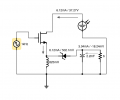
I uploaded a picture of the simulated schematic using ICircuits.

The offset of the pulse input is set in order to keep the transistor in saturation mode (ON) . Also I understand that the voltage across the inductor (VL) should equal (Vin), and as you guys can see, the voltage decreases all the way down to milivolts for some reason.

Why is this happening? Should the transistor be switching functionality ? If so, would a simple pulse between -5V and 5V work?

NOTE: Solar Panel MAX open circuit voltage : 38V , MAX open circuit current: 9A
 

Attachments

Alec_t

Joined Sep 17, 2013
15,119
Isn't your PFET upside down?
What output voltage are you expecting with the component values shown?
What gate voltage are you applying?
What is the zener voltage?
 

Thread Starter

everibarra

Joined Nov 8, 2013
6
It's an NMOSFET.
I'm simulating with a solar cell with a MAX open circuit voltage of 38 V , so I am expecting something around that value.
Gate Voltage applied is a signal input voltage, more specifically an square voltage signal from 1V to 5V (Threshold voltage of transistor is 1V)
Zener Voltage at 5mA is 5.6V
 

crutschow

Joined Mar 14, 2008
38,506
The transistor is used as a source-follower so the inductor voltage will never be more than 5V minus the transistor gate threshold voltage.

Your circuit is unlikely to do what you want without significant design changes.

What is the purpose of the zener diode?
 

Thread Starter

everibarra

Joined Nov 8, 2013
6
I got this Buck-Boost Converter design from a book called "Power Electronics" by Ned Mohan.

From what I read, the zener diode will allow the inductors' current to flow when the transistor is turned off.
 

crutschow

Joined Mar 14, 2008
38,506
I got this Buck-Boost Converter design from a book called "Power Electronics" by Ned Mohan.

From what I read, the zener diode will allow the inductors' current to flow when the transistor is turned off.
Is that the exact circuit Ned showed in the book? It doesn't appear to work properly as shown.

For best efficiency you either want a PMOSFET for the switch or use a bootstrap driver for the NMOSFET so that the full solar cell voltage appears across the inductor when the MOSFET is ON. Any voltage drop across the MOSFET reduces efficiency.

And I realize the diode is not a zener, it's a Schottky diode.
 

Thread Starter

everibarra

Joined Nov 8, 2013
6
Can you talk more about the bootstrap driver? Can you and would you please provide a schematic of the driver ? I would really appreciate
 

Thread Starter

everibarra

Joined Nov 8, 2013
6
So I have to rely on ICs ... I have no way of simulating the circuit with the program I originally used? The only way to simulate is to get the actual bootstrap driver and test the actual circuit?
 

crutschow

Joined Mar 14, 2008
38,506
So I have to rely on ICs ... I have no way of simulating the circuit with the program I originally used? The only way to simulate is to get the actual bootstrap driver and test the actual circuit?
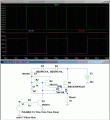
Below is the simulation of a discrete bootstrap circuit in LTspice.

Due to the high supply voltage D3 and D4 are 10V zeners added to keep the peak MOSFET Vgs ON voltage below 20V. It could be one 20V zener but I didn't have that in my model library. Those aren't needed if the supply voltage is below 20V.

The transistors are just representative ones in my library. They can be any similar devices that meet the circuit voltage and current requirements.

Rload would be the inductor in your circuit.

Bootstrap Driver.gif
 

Thread Starter

everibarra

Joined Nov 8, 2013
6
So I tried your circuit Alec_t, it is pretty much working as a follower for me... Not boosting nor bucking. Did it work for you? Please let me know if it did!
Either way thank you very much for your help.
 

Alec_t

Joined Sep 17, 2013
15,119
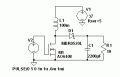
It worked much as you found. All I did was vary your circuit by changing the FET round. A proper buck/boost circuit would be more complex.
 
Top