Brushless generator rotation direction

MisterBill2

Joined Jan 23, 2018
27,567
Those were the REALLY OLD tractors. No doubt about that. But right now I am wondering why no other comments about a toothed belt drive scheme. Cheaper and easier than gears, much quieter than roller chain or even than the silent chain types, far more efficient than V-belts. Also more easily implemented than other schemes, except for a standard PTO and universals drive. It may possibly be that adapting the generator to an automotive engine could still be the simplest way to go. But it will need to be an older engine with a carburetor fuel system, since the current systems are probably not going to be willing to function without a complete array of vehicle safety and emissions modules connected.
 

Thread Starter

strantor

Joined Oct 3, 2010
6,875
Those were the REALLY OLD tractors. No doubt about that. But right now I am wondering why no other comments about a toothed belt drive scheme. Cheaper and easier than gears, much quieter than roller chain or even than the silent chain types, far more efficient than V-belts. Also more easily implemented than other schemes, except for a standard PTO and universals drive. It may possibly be that adapting the generator to an automotive engine could still be the simplest way to go. But it will need to be an older engine with a carburetor fuel system, since the current systems are probably not going to be willing to function without a complete array of vehicle safety and emissions modules connected.
Sorry, I haven't commented on the toothed belt for a couple of reasons. #1 I think it deserves a more thorough investigation and a more informed response, but I've been extremely busy with work. #2 I'm also discussing this project on a machining forums and a tractor forum, and I lose track of what's been discussed where. I thought I had at least acknowledged your suggestion but that probably someone else, somewhere else.

The problem that I run into with arriving at a spec for the toothed belt solution is two-fold.
#1. Toothed belt applications, or at least the way belt MFGs approach them, seem to be catered toward OEM applications and OEM support. If I were an OEM designing a generator for mass production, I would call Gates or Continental and give them the specs and they would crunch the numbers for me and suggested components. But just little 'ol me, they probably wouldn't have time for, and they don't publish as much information for me to crunch the numbers myself, like they do for v-belts.
#2. They do publish some info, and what I've gleaned from it, is that (there are many many styles) there two main categories of belt styles: those meant for low power/high precision (affordable) and those meant for high power/lower (but still high) precision (very expensive). I need the second kind. I can't seem to find the needed pulleys on Ebay for a reasonable price. The first kind of pulleys on Ebay abound. But not the second kind. The second kind is very expensive when purchased through motion control distributors. They are probably out there much cheaper, like for motorcycle drive pulleys and engine timing pulleys, etc.

Chances are, a belt from a 2005 Kawasaki snowmobile would work with a 1998 Harley Davidson cruiser rear wheel pulley and a 2010 Toyota Tundra crankshaft pulley to give me the correct ratio and power transmittal rating at a very reasonable cost, but these components aren't listed as "GT3 80 tooth pulley 5mm pitch 40mm width," they're listed as "1998 Harley Davidson cruiser rear wheel pulley." In order to find a winning combination I would need to research a lot of different vehicle applications and find out what styles they use, and what parts to look for. At some point the cost breakdown of all the research points to just going with the gears I've already spec'd. The gears should cost me <$400 to implement so I think I might be already at that point.

That being said, if you know a lot about these belts and you'd like to do some quick digging and show me just how much harder I'm making this than it needs to be, I am happy to watch and listen.
 

shortbus

Joined Sep 30, 2009
10,050
Actually the tooth belt would be much easier to do than gears.

The gears to last and run quiet, need to be contained and run in oil. The center to center distance and end plates of the gear case have to be made to keep those distances and support the bearings.

A toothed belt is not near as touchy with center to center distances. The bearings are about the same. But there is no oil needed so the sides of the gear case can be made from sheet metal. The belt will be quietest of all.

And there is another idea if doing it from scratch, a multiple row roller chain. It uses some of both of the other ideas, it needs to run in oil, and needs to have stout end plates in the gear case to support the bearings. And noise is about like gears. Many years ago I helped a friend build a modified pulling tractor, a Cockshut with 2 460 Lincoln engines. We used double row chain to link the engines together.

May be this will help you with the toothed belt drive end, something to read with some tech stuff in it.
 

Attachments

Tonyr1084

Joined Sep 24, 2015
9,744
I was just about to mention the noise you'd have with gears, but I see Shortbus beat me to it. I'm in complete agreement with him on that.

On a different note, snowmobiles use a variable transmission configuration. First, let me say that I know NOTHING about snowmobiles or their transmissions. I don't know how many horse power they are able to cope with, but it may be worth a look. I don't know that this would solve your problem, but since brainstorming has been used for many years to solve problems, I thought I'd just throw that out there. Like I say, it may work, it might not.
 

MisterBill2

Joined Jan 23, 2018
27,567
Sorry, I haven't commented on the toothed belt for a couple of reasons. #1 I think it deserves a more thorough investigation and a more informed response, but I've been extremely busy with work. #2 I'm also discussing this project on a machining forums and a tractor forum, and I lose track of what's been discussed where. I thought I had at least acknowledged your suggestion but that probably someone else, somewhere else.

The problem that I run into with arriving at a spec for the toothed belt solution is two-fold.
#1. Toothed belt applications, or at least the way belt MFGs approach them, seem to be catered toward OEM applications and OEM support. If I were an OEM designing a generator for mass production, I would call Gates or Continental and give them the specs and they would crunch the numbers for me and suggested components. But just little 'ol me, they probably wouldn't have time for, and they don't publish as much information for me to crunch the numbers myself, like they do for v-belts.
#2. They do publish some info, and what I've gleaned from it, is that (there are many many styles) there two main categories of belt styles: those meant for low power/high precision (affordable) and those meant for high power/lower (but still high) precision (very expensive). I need the second kind. I can't seem to find the needed pulleys on Ebay for a reasonable price. The first kind of pulleys on Ebay abound. But not the second kind. The second kind is very expensive when purchased through motion control distributors. They are probably out there much cheaper, like for motorcycle drive pulleys and engine timing pulleys, etc.

Chances are, a belt from a 2005 Kawasaki snowmobile would work with a 1998 Harley Davidson cruiser rear wheel pulley and a 2010 Toyota Tundra crankshaft pulley to give me the correct ratio and power transmittal rating at a very reasonable cost, but these components aren't listed as "GT3 80 tooth pulley 5mm pitch 40mm width," they're listed as "1998 Harley Davidson cruiser rear wheel pulley." In order to find a winning combination I would need to research a lot of different vehicle applications and find out what styles they use, and what parts to look for. At some point the cost breakdown of all the research points to just going with the gears I've already spec'd. The gears should cost me <$400 to implement so I think I might be already at that point.

That being said, if you know a lot about these belts and you'd like to do some quick digging and show me just how much harder I'm making this than it needs to be, I am happy to watch and listen.
I studied application notes for toothed belts and used them in a project that shipped about 15 years ago. In that application they worked very well. I have also gone through various applications briefs from some of the manufacturers. But I also see pictures in the write-ups about dragsters and how the toothed belt is the only smart choice to drive that big blower on top of the engine. And it seems that at the high speeds that the blowers turn they do take a whole lot of horsepower, so they are in the correct power range. So it may be that the suppliers for dragster parts would be able to sell exactly what you need, since every blower runs at a step-up RPM from the crankshaft drive. But I am not into building or racing cars, only looking at them as objects of technical beauty, so I am not much help there, other than mentioning that the center to center spacing is much more forgiving than for gears.
 

shortbus

Joined Sep 30, 2009
10,050
On a different note, snowmobiles use a variable transmission configuration.
But those are like all transmissions in vehicles, they are a gear down not gear up like he needs. Also they use a wide shallow V belt, or did , but could be like tractors, changed over time. Those belts had groves in them, on the inside, but just to make them flex over small diameter pulleys.
 

MisterBill2

Joined Jan 23, 2018
27,567
But those are like all transmissions in vehicles, they are a gear down not gear up like he needs. Also they use a wide shallow V belt, or did , but could be like tractors, changed over time. Those belts had groves in them, on the inside, but just to make them flex over small diameter pulleys.
That is exactly why I did not suggest a snowmobile drive. In addition, they are only intended to start from serious reduction and go towards a 1:1 ratio. Possibly a six-inch wide flatbelt, which would give the option of a gentle startup. I am not sure about the belt life in that application, but flatbelts are even more forgiving than toothed belts. AND flatbelt pulleys may be available used, in farm country. Check with the Grange for any body who has old stuff.
 

Tonyr1084

Joined Sep 24, 2015
9,744
Snowmobile transmissions. Learned something. But what I was thinking of would be driving the driven gear. Same as when you push start a car in first gear. The engine spins a whole lot while the tires don't spin much at all. Of course, the purpose in a "first gear" is to give the engine the torque advantage over the wheels, then shift into higher and higher gears until you reach 1 to 1 or overdrive. Just like a 2:1 transformer, if you turned it around it becomes a 1:2 transformer. (somewhat so anyways - not recommended) If you connect the PTO to what would be the track-belt and spin it at (oh, lets say) 100 RPM, the other end of the transmission would spin at (again, making up numbers) 500 RPM. That's what I was thinking of when I recommended the snowmobile transmission. But since others know more about snowmobiles than I do - and they recommend going a different route - what I said is negated. But that's OK. If you don't learn something when the opportunity presents itself then - - - .
 

MisterBill2

Joined Jan 23, 2018
27,567
Snowmobile transmissions. Learned something. But what I was thinking of would be driving the driven gear. Same as when you push start a car in first gear. The engine spins a whole lot while the tires don't spin much at all. Of course, the purpose in a "first gear" is to give the engine the torque advantage over the wheels, then shift into higher and higher gears until you reach 1 to 1 or overdrive. Just like a 2:1 transformer, if you turned it around it becomes a 1:2 transformer. (somewhat so anyways - not recommended) If you connect the PTO to what would be the track-belt and spin it at (oh, lets say) 100 RPM, the other end of the transmission would spin at (again, making up numbers) 500 RPM. That's what I was thinking of when I recommended the snowmobile transmission. But since others know more about snowmobiles than I do - and they recommend going a different route - what I said is negated. But that's OK. If you don't learn something when the opportunity presents itself then - - - .
On a snowmobile drive, and any other using the dual flange pulleys, the input speed is driving an arrangement to close the gap, while the output is spring loaded, with torque having an effect also. So you can't push start a snowmobile. the drive only goes one way. BUT on an older combine there is often a "Variator" to set the ground speed by adjusting a set of pulleys from one larger to the other larger. But that is not a system to hold a constant speed, because the belt wears and changes things.
The toothed belt system used on the faster funny cars and rail jobs is far closer to what is required.
 

shortbus

Joined Sep 30, 2009
10,050
Snowmobile transmissions. Learned something. But what I was thinking of would be driving the driven gear.
The snowmobile "transmission" is a centrifugal clutch, the speed of the motor makes the drive pully expand and contract. And the driven pulley is just spring loaded to keep up with the drive pulley size. Similar to an automatic transmission. they can't be 'back driven' to work the other way.

https://adventure.howstuffworks.com/outdoor-activities/snow-sports/snowmobile1.htm
 

shortbus

Joined Sep 30, 2009
10,050
Just wanted to show you how they work, cause you said you never messed with them. They are pretty simple but the good ones can handle more than 100 HP.
 

shortbus

Joined Sep 30, 2009
10,050
Dragster blower belts have been mentioned a few times in this thread. Just want to clear something up on them. Most of the blower belts aren't what would be used for doing this type of work, driving any thing like this. A blower belt is more old school type of toothed belt, a Gilmer belt. A modern drive belt has a different tooth profile and is much quieter and can handle more power, they are called a HTP belt. The gilmer belt has a more rectangular tooth and the the HTP belt has a sine wave shaped tooth. The gilmer is used on blowers more due to tradition than any thing else.
 

Thread Starter

strantor

Joined Oct 3, 2010
6,875
I looked into blower belts and pulleys. They don't make them in the tooth count range I need. Also the pulleys are typically a billet aluminum "cup" whose walls don't look even 1/4" thick. I'm thinking just because an engine makes 1200hp, doesn't mean the blower is handling anywhere near that. Not sure how much it actually handles, but comparable industrial pulleys with published power handling capacity are solid steel.
 

Thread Starter

strantor

Joined Oct 3, 2010
6,875
A snowmobile transmission being a CVT, I don't think is suitable because I need fixed output speed. A snowmobile transmission would probably slow down as it gets loaded up.
 

Thread Starter

strantor

Joined Oct 3, 2010
6,875
One crazy idea I've been kicking around is a capstan drive. Basically a round belt, wrapped 1.5 times around each pulley, with the pulleys being simple round shapes with a concave surface like a bollard or capstan. Much higher traction against the pulleys, but surely less efficient as the belt would have to slide laterally a little bit each revolution. It's probably dumb. Otherwise someone else would be doing it.
 

MisterBill2

Joined Jan 23, 2018
27,567
I looked into blower belts and pulleys. They don't make them in the tooth count range I need. Also the pulleys are typically a billet aluminum "cup" whose walls don't look even 1/4" thick. I'm thinking just because an engine makes 1200hp, doesn't mean the blower is handling anywhere near that. Not sure how much it actually handles, but comparable industrial pulleys with published power handling capacity are solid steel.
At 12,000 to 15,000 RPM the blower is taking about 100HP. OK, so while the HP range mat be correct the RPM range was way off. Sorry about that. Thinking back about a flatbelt, possibly a wider one, say 6 inches, carefully spliced, with a 4 inch small pulley and a ten inch big pulley, might even be in the ball park And with flat belts you could gradually engage the load, making startup a lot nicer. The concept may be worth the time to investigate it.
 

Tonyr1084

Joined Sep 24, 2015
9,744
One crazy idea I've been kicking around is a capstan drive. Basically a round belt, wrapped 1.5 times around each pulley, with the pulleys being simple round shapes with a concave surface like a bollard or capstan. Much higher traction against the pulleys, but surely less efficient as the belt would have to slide laterally a little bit each revolution. It's probably dumb. Otherwise someone else would be doing it.
The amount of force or adhesion needed to turn the pulley would preclude the lateral sliding action you speak of. In all likelihood the belt would tend to climb over itself, thus stretching itself, thus loosening or breaking either the belt or the mounts holding the equipment.

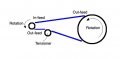
A belt works best when it is pulling. What I mean is that on the side the pulley is pulling (force) against is what gives the greatest amount of work being done. Back when I was a kid we had a lawn mower that engaged by applying a small amount of tension to the belt on the out-feed side of the pulley. Tension increased on the in-feed side forcing the cutters and the wheels to drive. I later used the same setup to build and drive a go-cart. The clutch was a pedal that applied this pressure to the out-feed roller and drove the cart forward. I had two different ratio pulley sets that I could switch between with the movement of a lever that changed which pulley set engaged.

The point is that you don't need a tight belt configuration. All you need is a way of applying enough pressure to the belt to cause a standard V belt to engage. Give me a few minutes and I'll see if I can come up with a rough drawing of what I'm talking about.
 

Tonyr1084

Joined Sep 24, 2015
9,744
The small pulley (in this case) represents my 4 HP Briggs & Scrapiron motor and the large pulley represents the drive axel. The tensioner swings into and away from the belt applying enough pressure for the large pulley out-feed side and the in-feed side of the small pulley to provide plenty of friction to pull the wheels into motion. As the tensioner swings away the belt slackens and slips, thus, not driving the go-cart. On my go-cart, the driver had to hold the clutch pedal down in order to drive. Safety "Dead-man" arrangement. You couldn't accidentally drive the cart without someone to step on the clutch pedal. Anyway, the drawing below describes what I'm thinking - as opposed to your 1 1/2 wrap solution.

Pulley.jpg
 
Top