Brushless generator rotation direction

Thread Starter

strantor

Joined Oct 3, 2010
6,875
I have a Caterpillar SR4B 275kW generator head that I want to couple to my tractor's PTO. I have to gear it up to achieve 1800 generator RPM from 540 PTO RPM. The tractor's PTO spins clockwise as viewed from the back of the tractor. The original Caterpillar diesel engine spins CCW as viewed from the flywheel. So to make it spin the original direction, I would need to reverse rotation. The simplest gearing (two gears) would do that. However I'm evaluating potential lower cost options and maybe I could do it with a belt/belts. Then the generator would be spinning "backwards." The question is, does this matter? Does the generator care? I can't seem to find the answer in Caterpillar's documentation, I guess because it isn't a FAQ. These are designed for direct coupling to Caterpillar engines, which only turn one way.

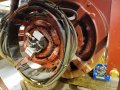
I know that brushed generators can be rotation sensitive, as the brushes are aligned for optimal performance in one direction, but this? It's self excited (see attachment). There's a separate (smaller) section of rotor & armature that inductively transfer field power into the main rotor section, where it's turned into DC by a rectifier spinning at 1800 rpm (see pic attached). I don't see how it could matter which way it spins. Unless maybe there is a squirrel cage with a specific twist or offset or something optimized for CCW rotation.

Anybody know the answer? If not, maybe you can answer this at least... is there any risk of damaging it by spinning it backwards? If it doesn't work, will it simply not work? Or will it be destructive?
 

Attachments

Tonyr1084

Joined Sep 24, 2015
9,744
If your generator produces DC then direction matters. If producing AC, rotational direction does not matter.

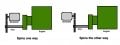
Assume you have a DC generator that spins (oh, lets say) clockwise but the PTO spins counter-clockwise. If you mount the generator directly to the end of the PTO then it will be spinning backwards. Two possible solutions: Reverse the wiring. OR - well, lets say this >> is the generator and this << is the PTO. Placing the generator directly to the PTO would look like this below:
(generator) >><< (PTO). If that's backwards then put the generator in this configuration (below)
<< (generator)
<< (PTO)
with a belt driving the generator using the correctly sized pulleys to get the desired RPM.

But if it's producing AC then rotational direction does not matter.
 

MisterBill2

Joined Jan 23, 2018
27,358
The main consideration in many applications of alternators is the fan for the cooling air..
But in this instance the solution is not complex, just run the shaft past the generator and then drive it with the generator shaft facing away from the PTO.You need to use a belt anyway, this just makes the shaft longer. The whole assembly can still be supported by the drawbar. The added advantage is that the belt is farther away from the PTO shaft, in case the seal leaks a bit.
 

MisterBill2

Joined Jan 23, 2018
27,358
Yes, if you were using a flatbelt drive, but a 275KW generator at 1800RPM will not be using that. Thus I suggest that reversing the direction that the shaft points is a simple work around . One consideration is that 275KW is almost 100 HP, and so this will not be a trivial connection. In fact it may be more than the PTO can deliver. I know that PTO drives have limits. A generator that large would be too big to just hang on the back, anyway. And the drive will need to be either a toothed belt or a multi-strand chain, if the intention is to use the generator anywhere close to it's rated output. I have a 5.5KW generator and that takes an 11 HP engine, so a 275 KW will take a lot more.

I would suggest instead using an automotive V8 engine to drive it directly. 1800 RPM or even 3600 is in the easy range for one of those engines. And they are often available cheap on wrecked cars. I bought one for $100 a few years back, drove it home and pulled the engine and then sold the car for scrap for $20.
 

MisterBill2

Joined Jan 23, 2018
27,358
TONY!! THANKS for producing the drawing of what I was describing. You got it exactly right. And once again I am suggesting that the TS check to make sure that the PTO is able to deliver the needed horsepower, the torque level to spin that alternator at the needed speed under load. Also, the belt or chain will not be a simple thing at that power level. Caterpillar does not do small stuff, it appears.
 

bwilliams60

Joined Nov 18, 2012
1,450
On a brushless alternator, why would it not have an output when driven in the opposite direction? It is still a magnet inducing voltage into a stator winding. The resultant output from the stator should be 180 degrees opposite that of the original direction.
If you want to keep it simple, mount a marine alternator on it. They travel in the opposite direction by design. Just a thought. And cooling fans are correct orientation on the, which is very important.
 

Thread Starter

strantor

Joined Oct 3, 2010
6,875
I have no intention of delivering anywhere near 275kW with this generator. Me and my 15 closest neighbors wouldn't even draw that much together. (BTW 275kW is closer to 400hp). My tractor is rated 40bhp, 32 PTO HP, and I plan to upgrade to 55HP sometime before I die, so I'm designing around that number. My first idea was roller chain, and after much research I crossed it off the list. Big Chains (and I'd need a big one, and more than one of them in parallel, even for 55HP) do not like to go around little pulleys*. So achieving the 1:3.333 speed increase in a single stage would require one sprocket the size of a car wheel and another the size of a wagon wheel, which is prohibitively expensive. Which means doing it in two stages, which doubles the number of sprockets and chains, adds a shaft which adds bearings which adds fabrication and/or machining, and all that adds up to a price tag that's just silly.

*before you say "yehbut... what about motorcycles with chains?".... I don't know. Motorcycle MFGs don't publish whitepapers on their chains; ANSI Roller Chain MFGs do. And what they say, is "strantor, don't use chains." Plus motorcycles run much higher RPM and much lower torque than this application.

V-Belts are also problematic at these high power levels. Just for 55hp, I would need a minimum of 4 of the most expensive special v-belts, or 6 to 8 ordinary v-belts in parallel to satisfy this application. This is coming from V-belt MFG whitepapers and verified with MFG belt calculator apps. I only continue to entertain the idea because I can occasionally find the pulleys on Ebay for a fraction of what they should cost. The problem is finding the mate pulley which gives the proper ratio, also at fractional cost. There are several pulley/belt combos that would work, and I've had some success finding some pieces of some of the puzzles, but never failing, there is no complete puzzle.

I can get a set of hefty spur gears brand new from a place called American Metric, for about $250. According the the gear power calculator on rushgears.com, this gear combo should be good for 70hp. It's the most bang for the buck so far as complete solutions go. But I can't stop myself being enticed by $900 pulleys selling for $90 on ebay.

The V-belt solution would be optimal if the pulleys could be found, because they could be used as a clutch to gently/gradually engage the spinning PTO to the stationary generator with an adjustable tensioner device. The rotor has a huge amount of inertia and the PTO clutch is not a manual clutch that you can feather to get the generator up to speed. It's either on or off, from an electrical switch. I think throwing that clutch closed with the PTO coupled directly to the generator would stall the engine or damage something. They make adjustable slip clutches for PTO so I have options, but I still don't like the idea.
 

Thread Starter

strantor

Joined Oct 3, 2010
6,875
I would suggest instead using an automotive V8 engine to drive it directly. 1800 RPM or even 3600 is in the easy range for one of those engines. And they are often available cheap on wrecked cars. I bought one for $100 a few years back, drove it home and pulled the engine and then sold the car for scrap for $20.
This is phase 2 of the project. Or actually should be considered a separate project. I have two of these Cat generator heads. I was looking for 20-30kW PTO generator and came across these for sale. An asset liquidator on Ebay got ahold of a defunct Caterpillar Oilfiled service shop and was selling these as "for parts/used/unknown condition." They are clearly refurbished by the extinct company. Since the seller is within driving distance I went there and looked at all he had. He let me remove panels and inspect and perform megger checks. I tried to contain my glee as I offered, and he accepted, a price for over half a megawatt of Caterpillar power that was lower than the cost of a single 20kW PTO generator.

So for this first one I want to make a PTO generator, because it's the simplest. I already have a spinning shaft at my disposal that I don't have to go out and buy and rebuild and hack and tinker with. This tractor has digital PTO speed regulation like a cruise control. I can dial in a precise speed set setpoint and save it to the tractor's memory. Then next time I just push a button, and without me touching the throttle, the engine goes right to the stored speed.

But in the scenario where I need a generator to power my home (a hurricane) I might need the tractor for other things, like removing fallen branches or recovering flooded vehicles. So I would like to have a standalone generator and that's the long term goal. I have a 1997 Jeep XJ which has been wrecked but should still run. I'm thinking I can rip the back seats out and replace them with a generator head. Just Cut a hole in the floorboard and shove the generator head in through the back hatch, uncouple the driveshaft from the rear diff and pass it up through the new floorboard hole, and couple to the generator head. It's an automatic transmission so I'm hopeful that the transmission and cruise control will do their thing, and let the jeep sit in 4th gear sipping gas until someone turns on the dryer or A/C, and then it will drop a gear or two to meet demand. It can sit in the driveway (smashed end facing away from the road) near the corner where the service entrance is, and just look like a jeep in the driveway.

I can't find any videos of anyone having done what I describe using an automatic transmission so I assume that means it won't work, but I think it's worth a try.
 

Thread Starter

strantor

Joined Oct 3, 2010
6,875
Not that it really matters but for the sake of clarity, I was mistaken about the power rating. They're 210kW, not 275. Not sure why that number changed in my memory. Someone must have unauthorized access, changing values in my registers.
 

DNA Robotics

Joined Jun 13, 2014
670
Can you attach a drive shaft to the front of the crankshaft? I did that once to drive a mower deck. Your generator could be mounted stationary and just drive up to it when needed. Use a drive shaft with a spline so alignment and distance aren't critical.
 

shortbus

Joined Sep 30, 2009
10,050
Just because the generator(alternator really) has an output rating of "X", that doesn't mean it takes that amount of power in put to drive it when it isn't feeding the "X" amount out. Like all things electrical wouldn't an alternator only use/output what is needed at that moment in time?

As to speed input on this, if it was originally driven by a diesel engine, why do you think it needs to be either geared up or down when driven by the tractor PTO? Most of the alternators I've seen over the years, they used them at work when the substations were down for maintenance, Were direct coupled to the flywheel of the engine, and the engine RPM was set and governed to make the output frequency correct.
 

MisterBill2

Joined Jan 23, 2018
27,358
For the speed increaser please investigate TOOTHED belts, which are also used to drive the blowers on dragster engines, amongst other applications demanding lots of power. And the solution to the clutch issue would be to first start and warm the engine and then shut it off and engage the alternator drive, and then start the engine. A fully warmed engine should catch instantly and thus not be a problem. AND toothed belts are far more forgiving than gears. And you would have a 4 inch pulley and a 12 inch pulley, far cheaper than the gears.

And for the comment about direction: It is all about the cooling air, not the power generation, just like using an automotive alternator.
 

Thread Starter

strantor

Joined Oct 3, 2010
6,875
As to speed input on this, if it was originally driven by a diesel engine, why do you think it needs to be either geared up or down when driven by the tractor PTO? Most of the alternators I've seen over the years, they used them at work when the substations were down for maintenance, Were direct coupled to the flywheel of the engine, and the engine RPM was set and governed to make the output frequency correct.
It is technically an alternator, I don't mind people calling it that because that's what it is. But I choose to call it a generator because when you say "alternator" people think of an automotive alternator, which produces the proper output with a wide range of input RPM. This is a 4 pole AC machine and it needs to spin 1800 rpm to generate 60hz output.

The tractor's maximum PTO output speed is 540RPM. Therefore it needs to be geared up.
 

MisterBill2

Joined Jan 23, 2018
27,358
OK, and I understand about the calling it a generator, since indeed most alternators are in cars and deliver DC, even though they generate AC. So nomenclature can be confusing, big time. And even at 210 KW, I presumed that the potential load could approach that level, so that the input power would also be quite large. That was my incorrect assumption.
It seems that you certainly did get a great deal on them.
My great deal was a fairly new tri-fueld generator set, 5500 watts, which the owner, I am sure, sold because the task of plumbing an adequate gas line to it was quite daunting. I have found the same reality, and so it is taking a lot of thinking as to just how to do it. My problem is that the natural gas delivery line comes to the front of the house while I want the generator system behind the house, out of sight and sound. And piping through the basement would be a large task with rigid pipe, and copper tube of the proper size would be very expensive. Plastic tubing is only allowed outside, and installing that will mean a lot of trenching, since it is not allowed to be exposed above ground. Running it from a propane tank costs more than running it on gasoline, at 4 hours at full output on a tank at $20 per fill. Natural gas and propane offer the real benefits of not deteriorating during storage, which is why I would prefer them. It seems that nothing is simple.
 
Top