Brushless generator rotation direction

MisterBill2

Joined Jan 23, 2018
27,563
The small pulley (in this case) represents my 4 HP Briggs & Scrapiron motor and the large pulley represents the drive axel. The tensioner swings into and away from the belt applying enough pressure for the large pulley out-feed side and the in-feed side of the small pulley to provide plenty of friction to pull the wheels into motion. As the tensioner swings away the belt slackens and slips, thus, not driving the go-cart. On my go-cart, the driver had to hold the clutch pedal down in order to drive. Safety "Dead-man" arrangement. You couldn't accidentally drive the cart without someone to step on the clutch pedal. Anyway, the drawing below describes what I'm thinking - as opposed to your 1 1/2 wrap solution.

View attachment 168573
Tony, thanks for drawing what I was hoping to be describing in post#38. Flat belts instead of V belts but that is the concept. I once owned a motorbike with that arrangement, except that the engine used a V belt to drive a sprocket that drove the chain to the rear wheel. No racing starts unless one wanted to buy a new replacement belt, but once rolling all was well. I believe that it was a REO brand engine.
 

shortbus

Joined Sep 30, 2009
10,050
A belt works best when it is pulling. What I mean is that on the side the pulley is pulling (force) against is what gives the greatest amount of work being done.
That is another benefit of chains or belts over gears. Gears shaft mountings need to be much more robust than belt or chains. The gear teeth generate much more force trying to move themselves apart than a belt does trying to pull itself together. The wedge effect is the difference.
 

shortbus

Joined Sep 30, 2009
10,050
They don't make them in the tooth count range I need. Also the pulleys are typically a billet aluminum "cup" whose walls don't look even 1/4" thick.
Those "aluminum cups" aren't just billet, but aluminum forgings. They then get hard anodized. And pound for pound are stronger than steel. Cant' recall ever seeing any steel HPT pulleys ,but that doesn't mean they don't exist. And the Gilmer/blower belt is not what your after, you want the HPT belts. Did you read the PDF I posted? The HPT system of belts is used on many small center distance applications, like in air boat drives and light aircraft propeller drives, so they are available.

One crazy idea I've been kicking around is a capstan drive.
How would you keep the force on that? Capstans work by one end of the wrap being pulled on , let up that pressure and they slip.
 

shortbus

Joined Sep 30, 2009
10,050
@strantor,Had a chance to look and HPT belts, commonly go down to 60 tooth size.

Also to get a bigger speed without using outlandish size (read expensive) pulleys, you can do like they do with gears in the same situation. Have a compound drive, where there are two steps in the gearing with a jack shaft type compound pulley and two belts.
 

Thread Starter

strantor

Joined Oct 3, 2010
6,875
For tidy sum of $75, I've obtained from a '60s model International Scout: Borg Warner T90AA 3spd manual transmission, Dana 20 transfer case, front driveshaft, flywheel, and clutch (not the clutch disk itself, but the other part). Everything works and my plan is find a clutch disk for it and use it as my speed increasing gearbox. Complete story with pictures here.
 

shortbus

Joined Sep 30, 2009
10,050
Everything works and my plan is find a clutch disk for it and use it as my speed increasing gearbox
How are you going to hook the output shaft to the clutch? You have to remember that the transmission, as it comes from the factory, is a speed reducing element. So the output shaft needs to become the new input and vice versa.
 

MisterBill2

Joined Jan 23, 2018
27,563
How are you going to hook the output shaft to the clutch? You have to remember that the transmission, as it comes from the factory, is a speed reducing element. So the output shaft needs to become the new input and vice versa.
The engine side input shaft is a spline that the flywheel and friction plate assembly slide on to, so it should not be any challenge at all. The trans output shaft is a spline that the yoke for the drive shaft slides over, that will not be a problem either. having a universal joint for the input will allow a bit of angle as an option, or possible use the whole drive shaft and put the rear differential yoke onto the PTO shaft using a standard PTO U-joint
 

Thread Starter

strantor

Joined Oct 3, 2010
6,875
I will abandon the use of terms "input" and "output" in reference to the transmission as it will get too confusing. I will refer instead to "engine end" aka "generator end" and "driveshaft end" aka "PTO end."

On the driveshaft/PTO end, there is 1.375" 6-spline shaft which is the same exact spline as my tractor PTO. all I need to connect it to the tractor is an ordinary PTO shaft like what comes with a tiller (which I'm probably about to buy, so no shaft purchase required).

The engine/generator end is a little more involved. I need to mount the old engine flywheel to the end of my generator shaft. This will require me to machine an adapter which emulates the dimensions of a 1968 Scout crankshaft. I have the capacity to do that and it shouldn't be too hard. The hard part will be getting the shaft of the generator/ engine end of the transmission perfectly aligned with the shaft of the generator (and keeping it there). I'll probably have to fabricate a bellhousing adapter which allows the transmission to bolt onto my generator the same way it would bolt onto a 1968 Scout engine.
 

MisterBill2

Joined Jan 23, 2018
27,563
Do you really need the flywheel? That will add quite a load to the generator bearing, and the balance will have to be very good to avoid nasty vibration problems. OR, do you want the clutch function? I suggest instead taking the center of the clutch plate, the portion with the spline, and making an adapter to the generator shaft from that piece. Adapting to the flywheel would be a much greater challenge, I am thinking.
OR, you may be able to find a 3-piece coupling that offers sections to match both the spline side and the generator shaft size. Then the only challenge will be alignment.
 

Thread Starter

strantor

Joined Oct 3, 2010
6,875
Do you really need the flywheel? That will add quite a load to the generator bearing, and the balance will have to be very good to avoid nasty vibration problems. OR, do you want the clutch function? I suggest instead taking the center of the clutch plate, the portion with the spline, and making an adapter to the generator shaft from that piece. Adapting to the flywheel would be a much greater challenge, I am thinking.
OR, you may be able to find a 3-piece coupling that offers sections to match both the spline side and the generator shaft size. Then the only challenge will be alignment.
Yes I want to use the clutch, that's why I'm going with the flywheel. The additional mass of the flywheel (est. 30lbs) should be pretty insignificant in comparison to the existing mass of the generator rotor (est. 600-800lbs).
 

MisterBill2

Joined Jan 23, 2018
27,563
Yes I want to use the clutch, that's why I'm going with the flywheel. The additional mass of the flywheel (est. 30lbs) should be pretty insignificant in comparison to the existing mass of the generator rotor (est. 600-800lbs).
OK, now it all makes sense. I had lost track of the size of the generator, thinking about those that I can lift without needing a sturdy chainfall. And now I recall that the PTO does not have a clutch, but that it is gear-shifted to be either off or on. So yes, a clutch is certainly needed. Pardon my losing track of things.
 

shortbus

Joined Sep 30, 2009
10,050
Are you going to add a second bearing to support the old output shaft that is now going to be your input to the transmission? The original input was supported at 3 places, pilot bearing(bushing), input ball bearing and the pilot needle bearings in the gear train. Using a cantilevered driveshaft from the tractor to the tranny, it needs support.
 

MisterBill2

Joined Jan 23, 2018
27,563
Are you going to add a second bearing to support the old output shaft that is now going to be your input to the transmission? The original input was supported at 3 places, pilot bearing(bushing), input ball bearing and the pilot needle bearings in the gear train. Using a cantilevered driveshaft from the tractor to the tranny, it needs support.
The shaft from the PTO to the trans has a universal joint at each end. They ALWAYS do. It is a long way from a cantilever. Those U-joints can handle more angle than automotive ones. And the end with the clutch is also supported by the alternator shaft. Keep in mind that it is the bell housing end driving that huge alternator.
 

Thread Starter

strantor

Joined Oct 3, 2010
6,875
Are you going to add a second bearing to support the old output shaft that is now going to be your input to the transmission? The original input was supported at 3 places, pilot bearing(bushing), input ball bearing and the pilot needle bearings in the gear train. Using a cantilevered driveshaft from the tractor to the tranny, it needs support.
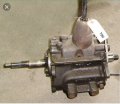
Here's an ordinary 2wd T90 transmission (bellhousing removed):
Screenshot_20190219-174458_Google.jpg
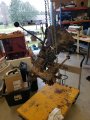
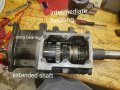
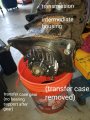
Mine is the 4wd version of the T90 transmission which has an extended shaft on the driveshaft/PTO end, which passes through an intermediate housing before ending with a gear inside the transfer case.

20190216_113853.jpg

20190219_180007.jpg

20190219_181336.jpg
This intermediate housing contains an additional bearing near the end of the shaft, right before the transfer case gear. The fact that the transfer case does not have any bearing to support the very end of the shaft, indicates to me that the bearing in the intermediate housing is sufficient to handle normal side-loads. The fact that this gear is a helical gear, indicates to me that it is also designed with resistance to axial loading. I suspect it will be fine coupled to a PTO shaft, but I'm open to opposing theories.
 

MisterBill2

Joined Jan 23, 2018
27,563
It is a relief to see that the bell housing is a separate piece.On the Mopar automatics it is integral with the main casting and so a lot less flexible. What you have there is a thing that you can work with.. And you may choose to utilize a hydraulic clutch release setup.
 

MisterBill2

Joined Jan 23, 2018
27,563
It is a relief to see that the bell housing is a separate piece.On the Mopar automatics it is integral with the main casting and so a lot less flexible. What you have there is a thing that you can work with.. And you may choose to utilize a hydraulic clutch release setup.
Is it possible that the bearing is on the other part that engages that straight-tooth segment? I am guessing that it was an FWD setup that could be engaged and disengaged, although I don't see that lever in the picture.
 

Thread Starter

strantor

Joined Oct 3, 2010
6,875
Is it possible that the bearing is on the other part that engages that straight-tooth segment? I am guessing that it was an FWD setup that could be engaged and disengaged, although I don't see that lever in the picture.
It is a RWD normally, with 4WD selectable by one lever, and 4WD HI/LO selectable from the other lever.
The helical portion of the gear is used (I believe) during 4WD HI (1:1 transfer case ratio) and the straight-toothed portion (I believe) is engaged during 4WD LO (2:1 transfer case ratio).
I have read on the internet that this Dana 20 transfer case can be easily made to have a 4th operating mode (FWD) simply by removing some pin or block (I can't remember exactly and not really curious) from the transfer case.
But in any case, there is most definitely at least one (probably two) approved operating mode where that straight toothed portion is not engaged with anything and all the side load from the gearing is handled by the bearings in the transmission and intermediate housing.
 
Last edited:
Top