Brushed DC Motor Insulation strength for PWM Control

Thread Starter

Brass Cat

Joined Jan 17, 2025
9
Considering using PWM control on 90v and 180v DC motors. 3/4, 1, 1 1/2 HP rating. Some are older.
They are not labeled as for PWM, nor Phase control. USA made dc motors.
(1) Is it just known these motors designed for phase control without Phase or SCR on label ?
(yes, I know about ASSUME) so I ask.
(2) What insulation class would be suitable for PWM ? Frequency range ?
(3) Powering from 120 / 240v AC, what would be best range of voltage to drive PWM
controller for 90v and 180v motor ?

Thanks for your response, Stan
 

LowQCab

Joined Nov 6, 2012
5,101
PWM, and "SCR", are not the same thing.

An SCR "Light-Bulb-Dimmer" Circuit operates at Mains Frequency and just chops-up the AC Waveform,
and results in, at most, 50% Power delivered to the Motor.

A Triac Chopper can deliver full Power, but is still rather crude.
Both configurations really NEED a Choke to work smoothly.

PWM is completely different, and generally more refined.
PWM Rectifies and Filters the AC into smooth DC, and then chops it at a much higher Frequency.
The Frequency selected can be above the range of hearing,
so it is usually way, way more quiet than a Triac system operating at 60Hz Mains-Frequency.

Triacs and SCRs are infamous for creating Electrical-Noise, ( Hash ), PWM systems not so much,
and the Higher-Frequency of the PWM is easier to Filter-out.

How You go about this depends on your priorities, your wallet, and your experience.

A Triac followed by a big Choke is the easiest and cheapest way to do it, but I hate doing it that way.
A PWM system may cost ~3 to ~10 times as much,
but is far more refined, and includes smooth Braking and Reversing.
Only the most dedicated Hobbyists will go for a PWM system
because it can be substantially more complex than a simple Triac and a Choke.

The ultimate cost will be determined by the Horsepower of the Motor(s).
.
.
.
 

Thread Starter

Brass Cat

Joined Jan 17, 2025
9
Thanks for the responses. I am sorry if I did not frame my questions carefully.
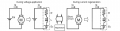
I am familiar about what phase control and PWM control are. With phase control, the firing angle is when the scr or ? (other devices that are turned on, delivering a higher voltage to the motor (dc brush). This causes current to increase as allowed by the inductance of the armature. As the driving (AC) voltage to the back emf voltage of the motor (rotating) decreases to equal the motor's terminal voltage (Consider R and L affects), the current levels out and begins to decrease as the AC applied continues to decrease. It may extinguish at zero current, until another ac half cycle. Firing angle determine the voltage/ current applied to the motor, hence its speed. I am assuming many of the DC brushed motors, US made, 1/2 to 1 1/2 hp, PM or older shunt, were made for the type of control. OK. for 90v and 180v dc brushed motors is that basically true ?

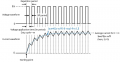
PWM control is different. Voltage / current are applied by rectangular chopping. The duty cycle, D, determines the power delivered. 100% on time delivered the full supply voltage to the PWM controller, What ever D is, that fraction of the supply voltage is what is delivered to the motor, when running steady state. OK.

I submit phase control is easier on the dc motor. the number of voltage spikes it gets hit with are 2 per a full cycle of the supply voltage AC. Lets take 240V rms AC. It peaks at 339V. Rarely is it going to get hit with that. Especially a motor in variable speed service. PWM is not like that. Lets say 20Khz frequency. So the armature gets hit (20000/120 = )166 times with more that 339v, perhaps 395. Even when the motor is running at 20% speed, armature at 48v ! That's hitting it a lot harder.

So I go back to my original questions in opening post. I have project with unique control requirements. Considering using PWM control but wanted some idea of pwm on motors as I described. Not Treadmill Motors. I am aware of the electrical noise generated by these two controller types, there noise characteristics are very different.

Thanks for the input. Any answers most appreciated.
 

LowQCab

Joined Nov 6, 2012
5,101
I'm going blind trying to make sense out of your Post.
Brushed-DC-Motors, and any type of Control topology are just not that complicated.

Any Controller running at 50 or 60Hz is going to be much harder, mechanically,
on the Motor than a high-Frequency-PWM-Controller.
The lower-Frequency makes heavy-parts buzz and vibrate, but they normally survive without problems.
This is the only factor that will have any effect on supposed "insulation-strength".
Over-loading the Motor may cause the Insulation to break-down because of excessive Heat.
Over-Temperature can be caused by repeated starts and stops under full power.


If You have actual, verifiable, concerns that are NOT based in "speculation" about how this all works
then You should go with high-Frequency-PWM, otherwise, You can use either method.

The following questions ALL MUST be answered before any meaningful suggestions can be made.

Please state why You need to control the Torque-Output of your Motor(s).

Do You need accurate RPM-Control of your Motor(s) ?

Please give a detailed description of the Load that the Motor(s) will be driving.

How long will the Motor(s) normally run ?, Minutes or Hours ?

Is excessive Audible-Motor-Noise a problem for your application ? ( Humming, Buzzing ).
Is a quiet running Motor desired in your application ?

Do You want Motor-Braking ? ( almost instant-Stop ) ?

Do You need Motor-Reverse-Run capabilities ?

Do You want a programmable, smooth, "Ramp-up" and "Ramp-Down" of Motor-Speed ?
.
.
.
 

nsaspook

Joined Aug 27, 2009
16,250
Thanks for the responses. I am sorry if I did not frame my questions carefully.
I am familiar about what phase control and PWM control are. With phase control, the firing angle is when the scr or ? (other devices that are turned on, delivering a higher voltage to the motor (dc brush). This causes current to increase as allowed by the inductance of the armature. As the driving (AC) voltage to the back emf voltage of the motor (rotating) decreases to equal the motor's terminal voltage (Consider R and L affects), the current levels out and begins to decrease as the AC applied continues to decrease. It may extinguish at zero current, until another ac half cycle. Firing angle determine the voltage/ current applied to the motor, hence its speed. I am assuming many of the DC brushed motors, US made, 1/2 to 1 1/2 hp, PM or older shunt, were made for the type of control. OK. for 90v and 180v dc brushed motors is that basically true ?

PWM control is different. Voltage / current are applied by rectangular chopping. The duty cycle, D, determines the power delivered. 100% on time delivered the full supply voltage to the PWM controller, What ever D is, that fraction of the supply voltage is what is delivered to the motor, when running steady state. OK.

I submit phase control is easier on the dc motor. the number of voltage spikes it gets hit with are 2 per a full cycle of the supply voltage AC. Lets take 240V rms AC. It peaks at 339V. Rarely is it going to get hit with that. Especially a motor in variable speed service. PWM is not like that. Lets say 20Khz frequency. So the armature gets hit (20000/120 = )166 times with more that 339v, perhaps 395. Even when the motor is running at 20% speed, armature at 48v ! That's hitting it a lot harder.

So I go back to my original questions in opening post. I have project with unique control requirements. Considering using PWM control but wanted some idea of pwm on motors as I described. Not Treadmill Motors. I am aware of the electrical noise generated by these two controller types, there noise characteristics are very different.

Thanks for the input. Any answers most appreciated.
PWM is a method (with the proper filtering circuits) of providing variable, smooth and steady DC power. With properly designed PWM filter, the DC motor should never see the PWM carrier frequency.
https://www.bodine-electric.com/?ac...ols/filtered-pwm-dc-basic-speed-control/0791/

Even if you don't have the filter, the motor inductance RL circuit and mass inertia will integrate the carrier frequency changes into a much smoother equivalent DC ripple.
https://www.portescap.com/en/newsroom/whitepapers/2022/03/controlling-brushed-dc-motors-using-pwm
 
Last edited:

Thread Starter

Brass Cat

Joined Jan 17, 2025
9
Hello LoQCab, Thanks for the detailed response. I do not want you to go blind. Sorry
what I wrote could do that. Do I write incorrectly in describing phase control and PWM?
I hope I am not getting hung up on terminology. Here I have answered your questions.
When I use the word motor I am referring to DC brushed PM or shunt US made motors
1/2 to 1 1/2 hp range,.

I have read somewhere, I believe on this forum, where on older installation of a several HP
DC motor (yes, an exception) was upgraded from pure (sort of) dc power to phase control, motor overheated. Higher stress. Smaller gauge wire. Straight DC is got to be the easiest. Better power
factor that perfect AC loading. With phase control, current being (can be) discontinuous, I^2 R heating comes into effect. Prompts me to ask, are 90V and 180v motors designed for phase control.
This goes back at least to the Monarch Lathe 10EE (1950's) . It used thyratrons to implement
phase control at 5hp. That's the tube equivalent to the SCR.


The following questions ALL MUST be answered before any meaningful suggestions can be made.

Please state why You need to control the Torque-Output of your Motor(s).

If I implied that, it was by mistake. With voltage control, the motor will deliver torque (draw current) to maintain
speed, as DC brushed motors do. But max current (limiting is required).
This is outside the questions I asked.


> Do You need accurate RPM-Control of your Motor(s) ?


Define accuracy. Nothing like 1%, but 10%. I will provide tach with display. Want to control over a range
of speed. Somewhere from 4 to 1 or better. I realize the HP delivered will decrease as speed decreases.
Max deliverable torque will be fairly constant.

> Please give a detailed description of the Load that the Motor(s) will be driving.


Motor will be driving lathe and also milling machine. This includes interrupted cuts and continuous
cuts, so from pulsating load to smooth load.

> How long will the Motor(s) normally run ?, Minutes or Hours ?


Varies, sometimes minutes or for hours.

> Is excessive Audible-Motor-Noise a problem for your application ? ( Humming, Buzzing ).


It could be, more for others. The machining itself is noisy. I don't hear well above 2.5 khz.

> Is a quiet running Motor desired in your application ?

If I achieve it easy, then uses. I am concerning with conducted and radiated RFI, especially from PWM.
Yes, filtering can really reduce it a lot. I would thing that with the added inductor and cap or even more
filtering I would actually have a switching converter, like a buck. Then yes, I can deliver much cleaner dc to
the motor


Do You want Motor-Braking ? ( almost instant-Stop ) ?


Some of the lathes have threaded spindles, so to much deceleration will cause the chuck to spin
off, not nice.


Do You need Motor-Reverse-Run capabilities ?


Reverse operation is desired in some instances. If it is a screw on chuck, then very
slow acceleration and limited "slow" speed, like repositioning for threading. Braking
in reverse and can be quick. If other work mounting, like collets or other non-screw
on, then same acceleration and braking either direction.


Do You want a programmable, smooth, "Ramp-up" and "Ramp-Down" of Motor-Speed ?


Yes, as described above.

Hello nsaspook,

In the motor control books I have, PWM is shown as applied to the motor itself. The motor
armature itself receives the pulses. The armature inductance itself integrates the current.
I guess we are stumbling on terminology. What you describe to be is a buck converter. Yes
it can be filtered well. Your reference article shows they use PWM as can implement filtering
to the output. They also state properly designed.

PWM is a method (with the proper filtering circuits) of providing variable, smooth and steady DC power. With properly designed PWM filter, the DC motor should never see the PWM carrier frequency.

Even if you don't have the filter, the motor inductance RL circuit and mass inertia will integrate the carrier frequency changes into a much smoother equivalent DC ripple.


If I tried to feed 1000w of 5 Mhz. square wave into a 1 1/2 hp motor, it would not like it all all. The eddy current effects : The RL circuit will overheat. There is a range of frequencies that will work.

Quoted from Portescap:

One trade-off of using PWM with a motor is the appearance of eddy current losses in the rotor windings due to the continuous PWM switching, which in general, is not present in the case of a linear power source. However, with a proper design of PWM, the eddy current effects can be minimized, allowing the motors to be optimally driven.

Portescap brushed DC motors offer very low inertia and low inductance. This enables use of the motor in an application where dynamic behavior and fast responses are desired. The use of PWM enables current control in the windings. Hence, the output torque, which is linearly proportional to the average winding current, can be correctly controlled; thanks to our coreless design.

Unlike a pure resistive load, for a DC motor, the resistance, inductance and back EMF on the rotor windings are
deciding factors for optimizing PWM frequency and duty cycle.

So, sure have not meant anyone to go blind. Please don't. I try to write clearly, I will try harder.

Stan.
 

nsaspook

Joined Aug 27, 2009
16,250
...
If I tried to feed 1000w of 5 Mhz. square wave into a 1 1/2 hp motor, it would not like it all all. The eddy current effects : The RL circuit will overheat. There is a range of frequencies that will work.
...
No kidding. You can always come up with some strange, contrived example that no sane power engineer would do. Proper design of PWM means sensible examples too.

We use PWM control of brushed DC servo motors for precision control of semiconductor wafer handlers that have run for decades.

https://techweb.rohm.com/product/motor/brushed-motor/328/
Driving Brushed DC Motors Using PWM Output: Principles of PWM Driving

1737229113201.png
1737229128516.png
 
Last edited:

Thread Starter

Brass Cat

Joined Jan 17, 2025
9
Nsaspook, Thanks for the reply. It is a nice cut and paste. The PWM is as I described, using the motor itself to
moderate the current flow. No post PWM filter.
I asked: (2) What insulation class would be suitable for PWM ? Frequency range ?

Your answer
:
Even if you don't have the filter, the motor inductance RL circuit and mass inertia will integrate the carrier frequency changes into a much smoother equivalent DC ripple.

No need to be upset about this. Even the prior article YOU linked warns against too
high of chopping frequency. Did you read all of it ? Where would you put the upper
safe limit of chopping frequency ? That question was in my original post.
Still NO ANSWER.


LowQCab

Joined Nov 6, 2012
5,101
===================================================================
Please state why You need to control the Torque-Output of your Motor(s).

With voltage control, the motor will deliver torque (draw current) to maintain speed ...............

This is an incorrect concept.
Delivering more Torque to maintain speed requires
Electronic-RPM-Feedback to the Motor-Controller to maintain a set-speed.

The Motor should not be heavily-Loaded at Low-RPMs, this is guaranteed to over-heat the Motor.
The general RPM-Range should be adjusted with Gear or Belt/Pulley Ratio changes.

RPM Control of the Motor CAN NOT completely replaced having to make Drive-Ratio changes.

A good rule of thumb is to never run the Motor at
less than half of it's rated RPM except with very light Loads.

But of course, You could double or triple the Horsepower of the Motor
that is normally required by the Machine, and
ONLY THEN can You expect to get away with running
very low RPMs with a heavy-Load without burning-up the Motor.

A variable Speed Motor WILL NOT completely replace a Gear/Belt Transmission adjustment.

===================================================================

I'll be back later to address all of the other comments,
I have to go run an errand right now.
.
.
.
 

Thread Starter

Brass Cat

Joined Jan 17, 2025
9
LowQcab wrote: Over-loading the Motor may cause the Insulation to break-down because of excessive Heat.
Over-Temperature can be caused by repeated starts and stops under full power.


Well wording. I agree with those two statements completely.

I find the second article nsaspook referenced has some great information regard the effect
PWM can have on the motor. The last point on motor life needs me to study more. This is a clip
from that article:

MOTOR LIFE CONSIDERATIONS

In brushed DC motors, the dominant failure mode is the brushed commutation. During the lifetime of the motor, the brushes, either carbon-graphite or precious metal, are spring loaded and mechanically coupled with the collector segments to charge the coils. Hence, the brush wear is a function of mechanical friction when the brushes slide over the collector segments and electro-erosion caused by electrical discharges at the time of commutation.

When using PWM drives to run the motor at various speed and load points, the estimation of motor life becomes a complex combination of various factors driving its wear properties. These factors can be:

i. Higher current density in the commutation because of reduced efficiency, high mechanical friction, insufficient lubrication or current recirculation.

ii. High electro-erosion during the current spikes when using PWM sources.

iii. Elevated working temperature of the motor due to environmental conditions or high power density of the motor which reduces the lubrication quality.

Depending on the application and type of source used to power the motor, the life expectancy may depend on one or more of the factors described above.

For motor designs where the load point requires the motor to run at moderate torque and speed, no axial and radial loads acting on the shaft and in a moderate temperature range (typically <60º C), the wear is generally dominated by electro-erosion. Then the motor life is inversely proportional to the inductance and square of the current:

Formula 12
 

Thread Starter

Brass Cat

Joined Jan 17, 2025
9
Thanks LowQcarb. Thanks for the replay.
That motor is 1 1/2 hp, overpowered. 1/2 hp is enough. Wont always be at full load.
Controller will have compensation for current draw, to compensate IR loss.
 

LowQCab

Joined Nov 6, 2012
5,101
An over-sized Motor is always a good plan if You have room for it.
.
"" Controller will have compensation for current draw, to compensate IR loss ""
I have no idea what this statement is supposed to mean.

A PWM-Controller does not cause any of the 3 problems listed above,
but a Triac-Controller, without appropriate Choke-Filters, "might" cause the first 2 of those types of problems.

There is a possibility that the person writing about these supposed problems doesn't
know the difference between a PWM-Controller, and a bare-bones Triac-Controller.

A PWM-Controller puts-out virtually perfect DC-Power as far as the Motor can tell,
A cheap Triac-Controller may put-out al sorts of garbage and just "call it" DC-Power.


I will continue to answer the previous long list of responses.
It may take a while.
.
.
.
 
Last edited:

MisterBill2

Joined Jan 23, 2018
27,180
What I do not understand at all is how the switching off and on, not feeding a filter, which would make it a switcher power supply, but switching the motor feed voltage on and off at some higher, although on some motors still very audible, frequency does not produce any inductive spike, while switching on and off a electromagnetic relay coil DEMANDS a diode to clamp that terrible high voltage spike. And that same logic demands diodes to protect against spikes when relays control a motor. But now in a higher powered motor switching the power on and off very sharply using fast mosfets, no spikes are produced. Have half of the laws of electromagnetic induction been suspended??? Is it the non-existent high voltage spikes that have been punching holes in the non-inverter rated motor windings???
The fact is that unfortunately, the very high rate of change of the current in PWM controlled motors does, unfortunately, create some voltage spikes due to that large L di/dt product as the switch off rate is quite fast. Meaning di/dt is rather large.
No, I am not going to present a math proof or list the papers that derive the details.
 
Last edited:

MaxHeadRoom

Joined Jul 18, 2013
30,559
> Do You need accurate RPM-Control of your Motor(s) ?

Define accuracy. Nothing like 1%, but 10%. I will provide tach with display. Want to control over a range
of speed. Somewhere from 4 to 1 or better. I realize the HP delivered will decrease as speed decreases.
Max deliverable torque will be fairly constant.

> Please give a detailed description of the Load that the Motor(s) will be driving.

Motor will be driving lathe and also milling machine. This includes interrupted cuts and continuous
cuts, so from pulsating load to smooth load.
Sounds like you are doing some kind of CNC??
Maching is either done with some kind of programable control (e.g. CNC) or manually, either way close control is required, simple automatic control is not acceptable,
In the case of CNC, satisfactory control results requires some kind of closed loop control.
BTW, rarely are motors manufactured specifically for a particular method of control, Modern construction and materials in construction do not require it either.
And yes, I remember thyratron control! o_O
 

Thread Starter

Brass Cat

Joined Jan 17, 2025
9
MaxHeadRoom, well hello. This motor discussion is for spindle motor. I am not doing cnc. These are manual lathe and milling machines. If I remember reading your posts, you tend to prefer analog power vs switching.

Got to operate a Monarch 10EE lathe, what a machine, they went from Ward/leonard drive to phase switching using two c16J thyratrons. Motor was 240v @ 5HP if I recall, not 180V. All speed control via potentiometer which included field weakening at the higher speeds. Only gearing was a back gear. It could turn 4000 rpm, smoothly.
 

MaxHeadRoom

Joined Jul 18, 2013
30,559
I have done quite a few retro fits now and have never considered any kind of PWM consideration on any make/model of DC or BLDC motor I have used. and never seen any problems?
The nature of the type of wire insulation combined with high grade PM field sources prevents most quality concerns related to applied power IMO.
If you are already in possession of the spindle motors you intend using, how are they being controlled now as spindle motors?
 
Top