Need recommendations for appropriate Dimmer/Speed controls for LED’s and small brushed motor

Thread Starter

Jolands

Joined Dec 19, 2024
10
Hello All,
New here and hoping the knowledge base here can answer my questions. Please be patient with me. I’m a complete novice dealing with small 12v brushed motors and their requirements when it comes to an appropriate speed control (hopefully with an “off/on” function. I’m equally unfamiliar with dimmers for LED strip lights. I also tend to be a bit wordy.

The Back Story :
I restore vintage/antique desk fans as a retirement hobby. However, if a motor needs new brushes or a stator/speed control needs to be rewound I send it off to someone who’s experienced in doing those repairs.
My current project centers around a “slag glass” base for a small desk fan. The slag glass glows when UV light is introduce, not unlike “uranium” glass. By chance I found one of these bases and am making a fan for my grand niece. I found a small automotive dash fan (12v) at a thrift store that I could easily fit to the base. It’s an older model (no Mfg or model number at all on the motor) with a brushed motor. I have a fan blade and cage from my parts pile the will fit as well.

Now I’m at the point of designing a lighting system for the base, as well as a power source for both the motor and UV lights. So far I have purchased a 10A power supply (12v) and a string of 365 UV strip lights from Waveform.
The power supply seems to provide ample power to run both the lights and the motor albeit the motor does lag for a second when power is applied. Note: That’s full power direct from the power supply. The lights come in instantly. Using a splitter “Y-connector” both the lights and motor run at full power just fine.
I want be able to have two separate controls on whatever base I make to hold the power supply/wiring as well as two small (1/2” knobs) dimmer switches - one for the UV lights and another for the fan. The fan will be attached to the base in a fashion to be determined.

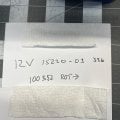
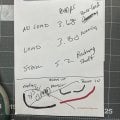
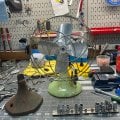
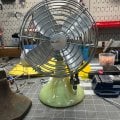
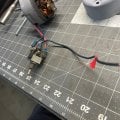
motor images show stamped info, wiring shows original two speed switch setup (I’m planning on just controlling the ‘high speed’ wire), one paper shows the motor info, the other has the readings that were my best try at getting some info. I used my fingers to pinch the shaft. These readings were taken using direct power from my vehicles battery. The last two are some possible cage/blade pairings for the fan.
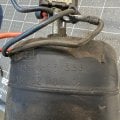
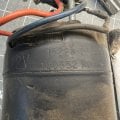
IMG_2024-12-19-144601.jpegIMG_2024-12-19-144409.jpegIMG_2024-12-19-144219.jpegIMG_2024-11-23-092710.jpegIMG_2024-11-23-092730.jpegIMG_2024-12-19-144859.jpegIMG_2024-12-19-144806.jpeg

I want to be able to dim the LED’s as needed from 0-100%. I’d also like that for the fan motor but will have to test for the lowest current needed to start the motor. I’ll have to figure out that one out one I have the dimmers. I’d like them to match and have an On/Off capability.
 

MisterBill2

Joined Jan 23, 2018
27,159
OK, since you already have the dimmers, and since we have no data at all about said dimmers, I do not see any question. If we have enough information about the dimmers to either ask more questions or mke sensible evaluations, we could do that. Presently we have no information.
 

Thread Starter

Jolands

Joined Dec 19, 2024
10
As of yet I have not purchased any dimmer speed control units. I was posting to gain information on the most appropriate small knob switches.
My apologies for the confusion. The switch picture is the 2-speed toggle switch that came with the fan. I’m wanting to replace that with a speed control/dimmer that would be appropriate to control the fan. From what I’ve seen there are a plethora of switches available for LED’s. I’m hoping to obtain a matching pair - one for each function. (Lights/fan).
I’m hoping I could get the info here To help me move for with the project without my normal “trial and error” method that tends to burn things up.
 

MisterBill2

Joined Jan 23, 2018
27,159
OK!!! Very good news about no controls yet! Now we know about the motor control, but nothing about the LED string. Probably you are not going to use all 365 UV LEDs in the light base, so we need to know their current and voltage requirement maximum for your application here.
It appears that similar PWM controller modules will work for both applications. That will be novel because probably the fan motor will also be controllable from very slow up to full speed, and a 1 RPM fan will be very uncommon and quite unusual. BUT ALSO "COOL". At this point my guess is that the LEDs will need to be split into series strings of four, and not require a series resistor.
Hopefully the power supply has an adjustment for the output voltage. A lot of the better ones do have them.
 

Thread Starter

Jolands

Joined Dec 19, 2024
10
Here a link to the LED strip light I purchased. I think it’s better that you visit the site and read the specs. The info is all greek to me. I dint mean to imply I bought 365 lights, only a 3’ strip of UV lights are 365nm.

https://store.waveformlighting.com/products/real-uv-led-strip-lights

Let me clear things up on the lights. I knew I’d never use the full strip of light “tabs”. My plan is to only use as many as needed to light up the base well. Right now I’m thinking about 6-8 will do but still have to test them And figure out if I need another splitter so I can use two short strips (3-4”) that go close to the top of the base. I haven’t tested the flexibility of the strip yet but I doubt I can bend it more than 45 feet degrees or so. First time using them.
 

Tonyr1084

Joined Sep 24, 2015
9,744
Welcome to AAC.

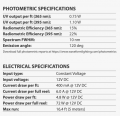
I'll focus on the LED aspect of your project for now. The spec sheet says:
Screenshot 2024-12-21 at 9.23.46 AM.png
Notice the Current Draw per Ft: This is where we need to know how many feet (or inches) of these LED's are going to be used. It's important in selecting what's called a PWM control. PWM = Pulse Width Modulation. It works by varying the time the light is on and the time the light is off. IF the light is on for 50% of the time then you get approximately 50% illumination. PWM is the way to control the brightness of the LED's.

Here's a word of caution: UV light can be harmful to the eyes. If you're using UV-C then that's the most dangerous to eyesight. I didn't notice in the spec where it said UV-A, UV-B or UV-C. The UV-C is used to sanitize, to kill bacteria, among other things.

As for the motor speed control, PWM can also be utilized as long as the controller is rated for at least 50% higher current than the stall amperage. You say you already know the stall speed amps - so - - - .

There are others who are far more versed in motor speed control. I just undertook a similar project where I took a heater circulator fan - home heating HVAC type - and swapped the induction motor for a treadmill (TM) motor. No, I'm not recommending changing the motor, but I DID find a controller that was able to control the board that powered the TM motor. I'll have to look back and see if that same controller is capable of controlling 7.5A (7500mA). That's a lot, and I suspect mine doesn't.

Don't be afraid to ask questions. The only "Dumb" question is the one nobody had the courage to ask.
 

Tonyr1084

Joined Sep 24, 2015
9,744
The PWM Controller I used is capable of accepting 3 to 30 volts as an input. Mine is currently at 3.3V. The amperage capability is 5 to 30mA. Far too low to control even your LED's. But there are more powerful controllers out there. You just have to search for it.
 

Tonyr1084

Joined Sep 24, 2015
9,744
Here's one on Amazon that reportedly can handle 10 amps. Overkill for sure, but should be able to run your fan or your LED's. It comes in a 4 pack so you'll have the two you need, one for the fan and one for the lights. The other two - well, keep them on hand for your next project.
https://www.amazon.com/Coliao-Motor-Speed-Controller-10A/dp/B0DBQ4XX8N/ref=sr_1_3
It can work from 5 volts to 16 volts. So even if you're using a battery charger as a power source, which may go as high as 15 volts, the controller shouldn't have any issues. But I'd make sure the supply I'm using is capable of the correct voltage and amperage. Automotive voltage can vary from 12.2V to 14.5V. In rare cases up to 15V. If your PS is rated for 12V and sufficient amperage for your project then you should be good to go. Even if you use a whole reel of 16.3 feet at 6 amps.
 

Thread Starter

Jolands

Joined Dec 19, 2024
10
This is the 10A, constant voltage power supply I’m using.
https://store.waveformlighting.com/products/realuv-dc-power-supply-for-led-strip

I’ve tested it - plugging in the motor and lights (whole strip) individually and they power up to full speed/brightness. The lights go on immediately. The motor seems to hesitate initially but quickly was at full speed. I was using a plug strip with a on/off switch to power things up. Don’t know if the power supply had current prior to turning on the motor would solve that. I also tested them using a splitter to provide power to both. Same results.
 

Tonyr1084

Joined Sep 24, 2015
9,744
Jolands Glad to hear that. I should caution you that this controller MIGHT have issues with controlling the brightness of the LED's. But for $10 you are ahead of the game. And you get four of them. They can be used on other projects in the future.
 

MisterBill2

Joined Jan 23, 2018
27,159
Given the apparent size of that fan base, I cant imagine it needing more than four of the foot long LED strips, for a load of 1.6 amps at full voltage. But even 8 strips will be 3.2 amps, a 5 amp PWM control has a good margin. Likewise the motor , at 3.8 amps max running and 5.2 amps stalled, similar to the locked rotor draw of some motor ratings=first instant starting current, except with a VS drive usually starting from slow. So those controls mentioned by "C" , and that supply, will have good margins all around.
 

Thread Starter

Jolands

Joined Dec 19, 2024
10
Hey! Thanks folks for all the info. I’ll be looking up those items and making some purchases. I’ll let ya know how it goes.

May have to wait. Bit for delivery, but (hey!) it gives me more time to snoop around this site more !
 

Thread Starter

Jolands

Joined Dec 19, 2024
10
Just one more thing…..
This fan is for a 7 year old and I would like the dimmer switches to have an on/off feature. Tonyr, did you happen to see one with an o/f feature you would recommend ? The one you suggested didn’t have that feature. With the multitude of choices it’s hard for a rookie to make an appropriate choice. Thanks in advance.
 

Tonyr1084

Joined Sep 24, 2015
9,744
did you happen to see one with an o/f feature
Excellent question. No, I didn't look that far ahead. I'm sure there are some out there that have that feature. I'll poke around and see if I can come up with one. Meanwhile all you need to concern yourself with is having something that can handle the maximum amount of current you'll be drawing through the circuitry.
 

MisterBill2

Joined Jan 23, 2018
27,159
I am guessing this package has mains operated power supply. Many variable resistors can have a switch off at the end of rotation,you can have the switches in parallel so that eithher or both controls switch on the mains power for the supply. AND then a 12 volt pilot liight telling that the supply is live.
 

Thread Starter

Jolands

Joined Dec 19, 2024
10
Tony,
Hey you don’t have to search. To prevent things “being left on” I‘ll just buy a small rocker switch and put it inline on the 12V output from the power supply.
Something like this on Amazon: (sorry no link)
Nilight 8PCS 12V 20A Round Blue Toggle LED Rocker Switch On-Off Control SPST 3Pins for 12V Car Truck Boat Marine Off-Road Vehicle with 24PCS Wires
 

Tonyr1084

Joined Sep 24, 2015
9,744
Would have been nice if you posted a link to the switch. Nevertheless, based on the description - that should work.

HOWEVER: My wife has a habit of turning things all the way down but not off. You don't know they're on, but they are. I once had a power supply that was left on. The cooling fan froze. It was left on for days. One afternoon I heard a "ZZZITTTT" sound. The PS was dead from overheating. Even though it wasn't doing anything the power was still on.

One possible chance for success could be a self timed switch of some sort. You turn it on and it's on for a given amount of time. After that it shuts off. Something like a chip used as a timer along with a time trigger. Touch the trigger and the fan can be operated for - say - an hour.
This fan is for a 7 year old and I would like the dimmer switches to have an on/off feature.
I don't know many 7 year olds with an attention span of more than a few minutes to maybe a few tens of minutes. Probably the switch is the best option but you'll have to limit how low the fan can be set to run and how low the light level can be set for. That way you always know when it's on. To some degree.
Here's one from Amazon:
https://www.amazon.com/Nilight-Control-Off-Road-Vehicle-Warranty/dp/B08TBZ23C1/ref=sr_1_1
$7.48 (US)

Here's the same switch found in Walmart.
https://www.walmart.com/ip/Nilight-...ehicle-24PCS-Wires-2-Years-Warrant/5472006055
This one is $20.58 (US).

Being a lighted switch you'll know when it's on.

If you use the switch to control the mains voltage like @MisterBill2 commented then you can't use the LED. You'll blow it out in an instant.
 
Last edited:

Thread Starter

Jolands

Joined Dec 19, 2024
10
Thanks for that. And yes, after the initial “WooHoo” factor is over she’ll probably move on and use it very little. It’s a novelty and a memory more than anything.

I agree. I also think the switch to indicate power is on is the way to go. I’m planning on placing the dimmers on the 12v outputs from the power supply (using a “Y” connector to power both functions individually). Not sure if trying to limit the lowest level the dimmer on the lights would matter. UV light is hard enough to see in a lighted room so it would be easy to miss. However, I’ll have to see if there is a way to limit the lowest fan speed. That may be necessary. I won’t know until I test the system. Motors have a minimum requirement for power to start the rotor turning. I’ll have to figure out what that is and if the switch will work by itself (switches have a minimum output level on their own right?) or if I have to figure out a mechanical ‘stop’ to prevent it from going below that spot.
 

Tonyr1084

Joined Sep 24, 2015
9,744
(switches have a minimum output level on their own right?)
Yes. Sort of. Well, yes and no. "No" in the sense that a switch either completes a circuit or opens a circuit. However, you wouldn't want to use a switch that is rated for 2,000 amps to switch a 30mA signal. The contacts will barely spark and the contacts will get dirty and poor. At the same time a switch rated for 3 amps will not survive running at 50 amps. The internal mechanism will melt down. And if you're switching DC, the right switch is required otherwise at high enough amperage the switch will arc and the connection will not be broken. An interesting search on YouTube might be to search for DC switching and arcing. It's an eye opener.

So while switches don't have a "Minimum" output ("output" is not the right word) there is still reason to consider the right switch for the job. Since you're using a mains powered PS supplying 12VDC at a constant voltage, capable of up to 10 amps before the voltage would fall off, the switch you're choosing will need to be on the 12 volt side of the PS. It will need to be before the splitter. This is the only way to have a switch with a 12 volt LED inside. It's MY OPINION that the right way to do this is to have a switch rated for 120VAC and have an appropriate indicator either built in or an indicator lamp added to it to control power to the PS. Otherwise the PS is going to be on as long as the plug is plugged into a 120VAC source. My OP is switching the PS on and off is the right approach. As I said before, I had a PS that was left on and burned out because it was on all the time. That doesn't say that all PS's will burn out. I have a few that are constant on and using a dimmer to control output levels going to LED strip lighting under cabinets. Not my favorite approach, and I have yet to experience any issues, but I remain of the opinion that I spoke of, that of switching the PS on and off.
 

Tonyr1084

Joined Sep 24, 2015
9,744
A quick search on Amazon turned up this:
https://www.amazon.com/mxuteuk-Illu...liances-MXU1-5-101NR/dp/B07QTPH8QZ/ref=sr_1_5
10 amps at 125VAC - and it's lighted.
The GREEN switch looks good to me. However, they don't specify a delivery date. The one they're calling "Blue" - I don't know how that would be illuminated. Nevertheless, Red or Green are good choices. Green for me because Green is a - well - green light. Whereas Red may indicate a warning. Either way, as the one who's designing and building this - the choice is yours.
 
Top