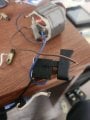
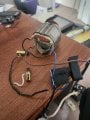
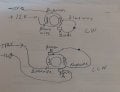
Brushed AC motor with switch wiring

MaxHeadRoom

Joined Jul 18, 2013
30,557
That would be a Universal motor if brushed AC.
The fields will go in series with the commutator for the AC in.
wire it up this way and put the switch in series with the hot power lead.
If it goes in reverse to the dir needed, reverse either fields or Com.

,
 

Thread Starter

cdretc

Joined Feb 20, 2026
3
That would be a Universal motor if brushed AC.
The fields will go in series with the commutator for the AC in.
wire it up this way and put the switch in series with the hot power lead.
If it goes in reverse to the dir needed, reverse either fields or Com.

,
Thanks for the reply. Perhaps, I didn't post this at the right forum. Can you please dumb it down for me as in what colour wire should be attached to what other wire? Sorry and thanks for your help.
 

Ian0

Joined Aug 7, 2020
13,097
You have an armature (that's the bit that goes round) and power is connected to that through the brushes,
Then you have the field coils. They don't go round. There are two field coils and they are pre-wired in series, and connection is via the brown and blue wires.

So you need the field windings in series with the armature. Mains live to brown, then out of the field windings on blue into the armature via one of the brushes. Then out of the other brush to neutral.
 

MaxHeadRoom

Joined Jul 18, 2013
30,557
I forgot to mention, wire one section of the switch to the AC input live, if you have a meter, find out the pair, If it is just the reversing switch that blew, show a bit more detail of the reversing switch, I assume it is separate from the trigger?
 

MisterBill2

Joined Jan 23, 2018
27,159
Thanks for the reply. Perhaps, I didn't post this at the right forum. Can you please dumb it down for me as in what colour wire should be attached to what other wire? Sorry and thanks for your help.
It is not likely that it can be made any simpler than MAX made it in posts #2 and #3.

My advice would have been to not disconnect the switch until you copied down how the wires were connected. Then it would be possible to see how to connect them without needing to ask. I learned that trick long ago, it can save a lot of work.
 
You can have the reverse option as well but if you do not need, here is how to wire it up:
1- assemble the motor back and mount the brushes.
2- connect the brown wire to one of the lines of any power source, that is around 12v to 20v. That voltage is more than enough to make the rotor spin. It is best to use DC (a laptop charger with 19v and ~4A is good) This keeps you safe while testing is done.
3- connect the blue wire to one of the wires that comes from the brushes and finally, connect the other brush to the other line of your power supply. If the rotor is spinning in the direction you want, then you can tape all the connections and use it
If the rotor is spinning in reverse, disconnect the blue wire from the brush wire, connect that blue wire to the other brush and use the brush wire you disconnected from the blue to connect to the power supply. That is how the drill switch reverses the rotation.
summary :aabb.JPG
 
In case you are wondering how a DC supply can run an AC motor, this sort of motors work DC as well and reversing the polarity that goes to the drill cord does not change the direction that it rotates, changing the way the motor is wired changes the rotor's direction
 

MisterBill2

Joined Jan 23, 2018
27,159
In case you are wondering how a DC supply can run an AC motor, this sort of motors work DC as well and reversing the polarity that goes to the drill cord does not change the direction that it rotates, changing the way the motor is wired changes the rotor's direction
THAT explanation is the description of what makes a universal motor UNIVERSAL!!
 
Top