board to power on/off my audiophile Hifi system

MisterBill2

Joined Jan 23, 2018
28,506
Oh WOW!!!!
I just now read thru all 60 posts about the original question. Certainly a lot of folks have a lot of concerns about switching on the power for a "classic sound system". Certainly that relay used to switch on the mains must be adequately rated for the mains voltage, the total load current, and a fair amount of inrush current on top of all that. Even more important is that the enclosure for the switching relay must be adequate to provide proper physical support for all of the parts.
To provide the actual remote control, I suggest a commercially sold , low power, mains switched package to operate the actual power switching relays. I do suggest multiple switched circuits so that the actual contact ratings needed will be reasonable.
 

MisterBill2

Joined Jan 23, 2018
28,506
Decent quality amplifiers, especially those not cheaply made, are mostly able to switch on with program material already present. Especially if they include an anti-thump speaker protection function.
Did the TS mention if it was a tube type amp, or all solid-state??
AND, REALLY! In the real world systems are required to gracefully survive momentary mains dropouts.
 

MisterBill2

Joined Jan 23, 2018
28,506
Certainly there is no portion of those sections that would be damaged or stressed by suddenly having the CORRECT mains voltage applied. Which will be the same as what you are presently using. Why are some folks being so very fearful?? Is it that the on/off switch is someplace else that is bothering them??? Can anybody provide an explanation of why they fear starting a device by plugging it in with the power switch in the on position?? Will someone explain what problem they anticipate being caused?? I am seriously asking for a reason.
 

WBahn

Joined Mar 31, 2012
33,315
Certainly there is no portion of those sections that would be damaged or stressed by suddenly having the CORRECT mains voltage applied. Which will be the same as what you are presently using. Why are some folks being so very fearful?? Is it that the on/off switch is someplace else that is bothering them??? Can anybody provide an explanation of why they fear starting a device by plugging it in with the power switch in the on position?? Will someone explain what problem they anticipate being caused?? I am seriously asking for a reason.
I think that the stance that most people that have raised concerns has been fairly consistent:
(1) There is probably no problem with using an external switch while leaving the unit in the powered on position.
(2) This can't be guaranteed because it is possible, though unlikely, that there is some kind of power up sequencing that only works correctly if the unit's switch is used.
(3) It is somewhat more likely that if this unit is part of a larger system consisting of several different units, such as a component audio system, that the system as a whole might be sensitive to the order in which some components are powered up.
(4) If either (2) or (3) apply, it is probably spelled out in the documentation.
(5) If you don't have the documentation and are willing to take a pretty small risk, the just try it and see if there appears to be any problem. It will probably work just fine.
 

MisterBill2

Joined Jan 23, 2018
28,506
The one problem that I am aware of is the unknowing individual wants to use the system and has no clue. So they switch on the selected source device, and turn up the loudness knob, and nothing is heard, so they turn it to max and then start switching other things. and eventually they get the 300 watt Crown AMPS delivering 400 distorted watts of audio to the 50 watt monitor speakers.
 

Sensacell

Joined Jun 19, 2012
3,789
(1) Avoid using "Zero Crossing" type Solid State Relays for devices with large conventional power transformers.
These, by design, will create maximum stress via inrush- every single time. A simple mechanical relay at least activates at a random phase angle.

(2) The biggest threat to your gear would be from a malfunctioning control device that cycles the power on-and-off over and over- this is a good way to break stuff.
As a kid, I killed a stereo amp simply by pushing the power button over and over, I was fascinated by all the relays clicking inside- until a curl of white smoke came out.
 

MisterBill2

Joined Jan 23, 2018
28,506
Certainly the only suitable switch device for this application will be an actual relay with adequately rated contacts and a continuous-duty coil. That much certainly needs to be understood. Rapid power cycling is a form of product abuse and certainly must be avoided in any control system. So a triac IS NOT a suitable substitute for the old-fashioned EM relay device. It MIGHT be OK if it is able to stay on across the zero volts portion of the power sine wave, but I am not sure that they really work that way.
 

crutschow

Joined Mar 14, 2008
38,913
Avoid using "Zero Crossing" type Solid State Relays for devices with large conventional power transformers.
Yes.
The do make peak-crossing SSRs for just that purpose.
Appling the voltage at the peak of the sine minimizes the transformer inrush current, as that is the point for minimum current of the inductive magnetizing current.
 

MisterBill2

Joined Jan 23, 2018
28,506
My experience was with waveform distortion near the zero crossing of the mains frequency. As the voltage rises from negative thru zero there was a bit of fast switch-on that led to a small but audible noise in the rectified DC output of the power supply. Thus my suggestion to avoid solid state mains switching. Probably you will not find much discussion of the waveform distortion near the zero crossing of the mains voltage, but understand that PN junctions do not usually switch on at zero volts.
Certainly in most switching applications it does not matter, BUT in any decent audio system the introduction of mains zero crossing frequency noise will be objectionable.

THAT noise did require adding additional disc capacitors to the amplifier power supply, which the TS may not want to do.

SO it is a valid reason to prefer an older style power relay to switch the system power. A second reason is that open relay contacts will do a much better job of blocking the nasty high voltage spikes that sometimes are present on the mains, caused by lightening strikes near the outside power lines.
 

wayneh

Joined Sep 9, 2010
18,181
does anyone have a chance to review AMP PSU Schematics? thanks!
I looked at the power supply schematic but it didn't show the power switch. I was expecting the schematic to confirm that the power switch is simply a break in the line power, same an external switch would be. But it wasn't shown.
 

MisterBill2

Joined Jan 23, 2018
28,506
I also looked at the circuit and unless the system is subjected to some serious abuse, such as rapid repeated ON/OFF switching, there is nothing in what I see that would suffer. Of course, deliberate intentional abuse could be limited by adding a timer to prevent rapid ON/OFF cycling.

AND STILL, I advocate using an actual relay with actual contacts, because I have totally smoked at least one internal switch-mode supply with a one time switch-on from a triac control device.
 

Thread Starter

thor21

Joined Sep 29, 2024
435
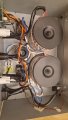
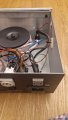
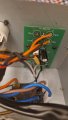
strange... these are photos of internals of PSU ...
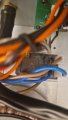
the 2 black small plastic boxes on the bottom looks like relays?

edit
from my point of view (amateur) mechanical switch power immediately small relay, which powere some circuit and that circuit controls two relays which turn on both toroid transformers?
 

Attachments

Last edited:

MisterBill2

Joined Jan 23, 2018
28,506
I do see two small relays, and possibly they might switch on those toroid transformers. OR they might switch on some DC lines.
I would be reluctant to use a relay that tiny to switch mains power. But I seldom design for cheapest price, but rather for maximum reliability.
 

Thread Starter

thor21

Joined Sep 29, 2024
435
@MisterBill2 thanks
From what i can see is how you described that.

The question would be now.. If such a design can be securely power on via another external relays as i proposed.
 

MisterBill2

Joined Jan 23, 2018
28,506
That portion certainly could be powered on safely with a mains switch, especially if none of the controls were played with while the system was off, so that the volume level was where you want it.
 

Thread Starter

thor21

Joined Sep 29, 2024
435
That portion certainly could be powered on safely with a mains switch, especially if none of the controls were played with while the system was off, so that the volume level was where you want it.
dont get it...

by mains switch you are referring to the external relays that will control 230V signal to the amp psu box?
 
Last edited:
Top