Merci. So you have two cables that are RG-58. The length makes a difference because the propagation time and hence the reflection will be different. We will focus on removing the reflection for now.
The characteristic impedance of RG-58 is 50Ω. This is independent of the length of the cable.
In order to minimize signal reflections the cable must be properly terminated at both ends with matching 50Ω impedances.
Let us start at the source (the driver, i.e. your box). You need a driver output impedance of 50Ω.
If you know the output impedance of your driver, subtract this from 50. The result will be the value of the resistor which you will put in series between your circuit and the signal pin of the BNC connector. If you don't know the output impedance of your circuit, try a series resistance of 33Ω for starters.
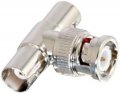
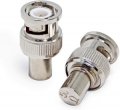
The resistor termination at the other end of the cable is easier. Apply a 50Ω resistor between signal and ground. The proper way to do this is with a BNC T connector and a BNC 50Ω terminator.
BNC T adapter
BNC 50Ω terminator.
Note that when the proper termination is applied, the signal amplitude will be reduced by a factor of 2.
Ok I try to find the output impedance on VCO_OUT in the datasheet below but I can't. So i think I will do the second manipulation you've said. Thanks a lot ! I think I can put directly a Trimmer instead of the 33k, don't you think ?
It's ideal to have the termination at both ends, but it usually is sufficient to have it at the far end, since that will eliminate any reflections from the line at the receiver.
Reflections from the near side of the cable to the driver generally don't cause any problem.
It's ideal to have the termination at both ends, but it usually is sufficient to have it at the far end, since that will eliminate any reflections from the line at the receiver.
Reflections from the near side of the cable to the driver generally don't cause any problem.
Right doesn't necessarily need perfect.
If terminating the far end gives satisfactory results then why do more?
And terminating both ends will reduce the signal level by 1/2.
The 50Ω signal generator output impedance provides a good output with a 50Ω cable even if the output is not properly terminated.
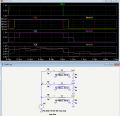
Below is the simulation of an ideal 50Ω, 100ns electrical length transmission line with three combinations of termination:
Note that the output is clean as long as either the input or the output is properly terminated.
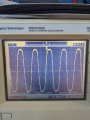
If any of those signals that we have seen is supposed to be a square wave, there are some problems. The one looks like a whole lot of ringing on both the top and the bottom, and none of them look like a square wave. Also, none look similar.
And while certainly a true square wave is the sum of a whole bunch of harmonics, I would not expect to see them on a scope screen. So what we have no clues on is the driving circuit or the actual connection scheme, except that at some point it includes a BNC pair. We do not know the length or kind of cable, either.
If any of those signals that we have seen is supposed to be a square wave, there are some problems. The one looks like a whole lot of ringing on both the top and the bottom, and none of them look like a square wave. Also, none look similar.
And while certainly a true square wave is the sum of a whole bunch of harmonics, I would not expect to see them on a scope screen. So what we have no clues on is the driving circuit or the actual connection scheme, except that at some point it includes a BNC pair. We do not know the length or kind of cable, either.
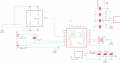
I just use the VCO part of the component, not the PLL part. And I try to be in the highest frequency zone with respect of recommandation in the datasheet. "The parallel value of R1 and R2 should be more than 2.7 kΩ" R1 >= 3k
C1min= 100 pF. And I put SMB connector to add more capacitance if I want to observe.
J3 and J2 are respectively the VCC and the input for the VCO.
So I respect all the recommandations in the datasheet I don't know where my errors are.
The first thing I don't control well is the BNC with coaxial part so I thought it is that.
And this is my PCB I retire the GND plan for visibility.
Certainly this is correct! There is no discussion about the output characteristics of the VCO as far as impedance or drive capability go, and every circuit shows it driving a digital input. So to drive any sort of capacitive load, such as a coaxial cable of any length, some sort of buffer is needed. You might be able to use the xor phase detector as a buffer with the other input held to Vcc. That would be simple to try to see if that output section is adequate to drive a short cable.
Ok guys, I have another problem on the 74HC4046(page30). I explain:
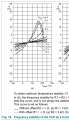
I want the output frequency of my VCO to be as stable in T° as possible for a given capacity, but when I look at this figure in the datasheet, the VCC=6V seems to be the best:
So my output is 6V of amplitude. SN74128 or MAX4201 seems to have VCCmax of 5.5V. Even the 74LVC1G04 in the article is 5V.
Will these two components, as I understand it, not be able to accept my 6V output?
Should I lower my output to 5.5 max ?
Or can I find something other than SN74128, MAX4201 or 74LVC1G04 that work fine?
The simple way will be to add a series resistor in the output. Not only will it drop the voltage, it will also add a bit of isolation. But you will need to do a bit of experimenting to find an optimum value. If the specification gives a value for the high level input current, then it should be simple to determine the resistance to drop one volt at that current.
The simple way will be to add a series resistor in the output. Not only will it drop the voltage, it will also add a bit of isolation. But you will need to do a bit of experimenting to find an optimum value. If the specification gives a value for the high level input current, then it should be simple to determine the resistance to drop one volt at that current.
Ok I did exactly what you said.
But I don't understand why this changes the pace of my signal so much ... Look at that:
Before the resistor:
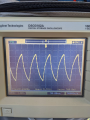
After the resistor(230ohm):
The voltage values match but I don't understand this huge change in the shape of the signal
hi Adrien,
The line capacitive load is charging and discharging on the signal via the resistor, time constant RC. exponentially.
Creating a crude triangular wave output.
E
hi A,
Going back to post #1,
Your 'wire' probe is giving a low quality VCO signal representation, the 50R BNC is providing a better impedance match for the signal, so it displays a more accurate representation of the signal.
So what is the actual problem which are reporting.?
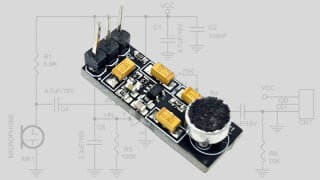
OK, now with that signal fed into a line driver IC powered with 5.0 volts, what does the signal look like? It should be a good square wave.
And certainly the 4046 PLL vco is not intended to drive any length of cable. The intended load for the VCO output is either the phase detector or the input of a frequency divider located very close by.

 Facebook
 Google
 GitHub
 Linkedin