BJT saturation mode

Danko

Joined Nov 22, 2017
2,238
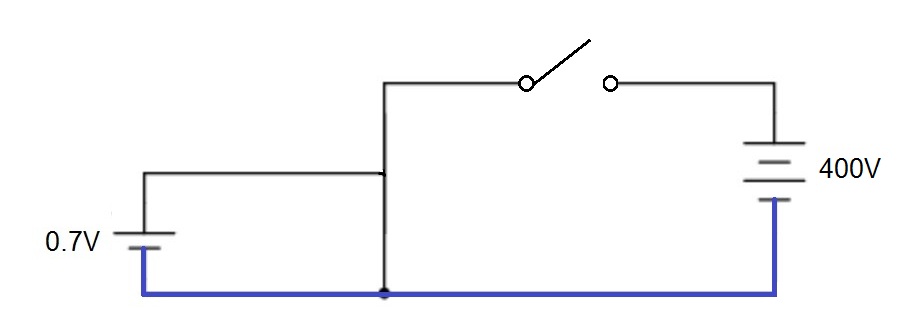
Regardless of transistor and load resistor, i see negative of big battery connected directly to the negative of smaller battery (indigo color), and assuming potential difference between the two is high, i don't understand how smaller one will not be damaged?
NPN transistor, common emitter circuit.
Emitter emits electrons. It works like particle gun. Collector collects electrons, emitted by emitter.
As gun needs primer for shooting, as emitter needs holes for electrons release.
Base lead works like trigger and base battery works as finger.
Base battery provides energy for holes flow from base to emitter.
So, energy do not go from transistor via base lead, conversely we should provide energy into transistor through base lead, proportionally to collector current we want to receive.
Therefore base battery can not be damaged by energy going from transistor, how can not be damaged finger by gun trigger in time of shooting.
 
Last edited:

Thread Starter

Nikša

Joined Mar 26, 2018
86
Emitter emits electrons. It works like particle gun..
Danko, i'm aware how electrons and "holes" move through a transistor. I never liked the idea of holes moving since there is no such thing as holes, only absence of electrons, as much as i don't like the direction of "conventional current", but that is another subject.

To understand my question better, suppose there is no transistor or load resistor in the circuit, just high voltage battery and small voltage battery connected in parallel and the circuit is open. Hopefully you now understand what troubles me, since negative terminal of the big battery is at much higher potential, is the smaller one going to be destroyed?
 

Bordodynov

Joined May 20, 2015
3,431
Yes, your circuit will explode. But why did you take that your scheme reflects reality. If the breakdown voltage of the collector junction is more than 400 V, then there is no short-circuit.You simplify the operation of the transistor too much.
 

ericgibbs

Joined Jan 29, 2010
21,573
since negative terminal of the big battery is at much higher potential, is the smaller one going to be destroyed?
hi N,
It depends upon how the transistor fails.
If the transistor fails as a Collector to Emitter short circuit, the small battery would not see a voltage, so it survives.
If the transistor fails as a Collector to Emitter open circuit, the small battery would possibly be connected across the 400V, so it would fail.

Again the short circuit current would flow thru the Collector Base junction, this high current would either blow the Collector to Base junction open circuit, the small battery may survive,
If Collector to Base short circuit, both the 400 and small battery could be damaged.

So it depends upon the failure mode of the transistor.

E
 

Thread Starter

Nikša

Joined Mar 26, 2018
86
You simplify the operation of the transistor too much.
Last question is actually not about transistors but two voltage sources of different potential.

If the transistor fails as a Collector to Emitter open circuit, the small battery would possibly be connected across the 400V, so it would fail.
Tnx, i guess you are trying to say that as long as no current flows, smaller battery will not be damaged despite big potential difference. In other words, if we take a small battery and touch it's terminal with that of a high voltage battery, as long as the circuit is not closed, potential difference itself will not damage the smaller battery.
 

ericgibbs

Joined Jan 29, 2010
21,573
In other words, if we take a small battery and touch it's terminal with that of a high voltage battery, as long as the circuit is not closed, potential difference itself will not damage the smaller battery.
Morning N,
If there is a conductive 'loop' between the two batteries, one or both could be damaged.
If the loop is Open, ie: one wire is not connected, no current will flow, so no damage.

Do you follow that OK.?
E
 

Thread Starter

Nikša

Joined Mar 26, 2018
86
Morning N,
If there is a conductive 'loop' between the two batteries, one or both could be damaged.
If the loop is Open, ie: one wire is not connected, no current will flow, so no damage.

Do you follow that OK.?
E
I follow that very well, that's what i wrote in my last post, no current - no damage. I was under impression that potential difference alone can damage the small battery just like some sensitive component, for example even a weak sparkgap signal can sometimes damage a CPU or other component if resonance induces a standing wave in it. But in general, no current no damage 'rule' stands.
 

ericgibbs

Joined Jan 29, 2010
21,573
hi,
A weak spark gap, means that the air resistance has broken down [ same as a lightning strike] so current has flowed between the two potential voltage sources.
As you say, it does not need a big spark [ usually ESD , electro static discharge] to blow a CPU's internal components.
This is why Earthing wrist straps are worn by people who handle semiconductors, the person can build up a static charge just by walking on a carpet etc.
E
 

Thread Starter

Nikša

Joined Mar 26, 2018
86
hi,
A weak spark gap, means that the air resistance has broken down [ same as a lightning strike] so current has flowed between the two potential voltage sources.
As you say, it does not need a big spark [ usually ESD , electro static discharge] to blow a CPU's internal components.
This is why Earthing wrist straps are worn by people who handle semiconductors, the person can build up a static charge just by walking on a carpet etc.
E
Actually, i meant from a distance, as EM wave, but point remains the same. If resonance builds up voltage across the component, it can damage it. Same reason why cellphones are more dangerous for the kids as their heads are closer to the size of a carrier wavelength.
 

Thread Starter

Nikša

Joined Mar 26, 2018
86
Yes, in spark gap radio, spark gap fires every time caps charge to a breakdown voltage and antenna sends out so called "damped" oscillation as caps gradually discharge.

Actually, that was the first demonstration of wireless transmission of electricity when Hertz demonstrated that alternating current flowing through one copper ring produces a spark across a spark gap in another copper ring several meters away.

Also reminds me of schottky barrier phenomena and cat's whisker radio, same phenomena why people with tooth-plumb sometimes hear radio in their mouths.
 
Last edited:

Danko

Joined Nov 22, 2017
2,238
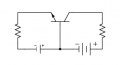
And what about common base configuration, when big battery current flows directly through the small one?
Small part of one big battery used for base-emitter feeding. What's wrong?
Inside transistor works absolutely identically as in common emitter circuit.
 
Last edited:

Thread Starter

Nikša

Joined Mar 26, 2018
86
Small part of one big battery used for base-emitter feeding. What's wrong?
Let's take the same values from before, 0.7V and 400V. I am asking how is small battery not gonna be damaged now big battery current flows through it?
 

Thread Starter

Nikša

Joined Mar 26, 2018
86
But why it should be damaged in the first place?
We determined in the previous example of common emitter that smaller battery can be damaged if current from the high voltage battery flows through it. No current - no damage part.
 

Thread Starter

Nikša

Joined Mar 26, 2018
86
If the transistor fails as a Collector to Emitter short circuit, the small battery would not see a voltage, so it survives.
If the transistor fails as a Collector to Emitter open circuit, the small battery would possibly be connected across the 400V, so it would fail.

Again the short circuit current would flow thru the Collector Base junction, this high current would either blow the Collector to Base junction open circuit, the small battery may survive,
If Collector to Base short circuit, both the 400 and small battery could be damaged.

So it depends upon the failure mode of the transistor.
Here eric explained that only If collector to emitter open circuit or collector to base short circuit, small battery will see the big voltage and thus be destroyed. I assumed in common base configuration small battery always sees the voltage since it is in series with the big one.
 

Jony130

Joined Feb 17, 2009
5,600
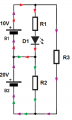
So, this situation is also not allowed ?

12a.png

Here eric explained that only If collector to emitter open circuit or collector to base short circuit, small battery will see the big voltage and thus be destroyed
But this is the extreme case, transistor failure. Not a normal situation.
 

Danko

Joined Nov 22, 2017
2,238
We determined in the previous example of common emitter that smaller battery can be damaged if current from the high voltage battery flows through it. No current - no damage part.
Small base battery connected in series with big collector battery and discharges simultaneously with big battery by the same current.
Discharge - is normal state for battery. No damage.
Edit:
400V big battery contains 267 x 1.5V small batteries. They all connected in series and simultaneously discharge by the same current. No one from 267 batteries is damaged.
 
Last edited:
Top