BJT saturation mode

danadak

Joined Mar 10, 2018
4,057
Mhz range switching, how many Mhz ?

Why does Vcesat of 7V at 5A make it a bad switch? Is it heating or?
MOSFETs can achieve << 1 ohm Rdson, depending on high V specs, so effectively a better switch.
Pdiss is certainly a consideration, wasted power.

If you go here and apply filters you can select MOSFETs. Same for IGBTs (BiCMOS).

You can also consider SiC MOSFETs -

https://www.allaboutcircuits.com/te...con-carbide-sic-fets-c3m0075120K-MOSFET-Cree/

Even better characteristics for Rdson and HV.

Regards, Dana.
 

Thread Starter

Nikša

Joined Mar 26, 2018
86
It should be act as saturation mode and it only have OF/OFF states there is no others.
That made more sense to me, i misunderstood Monica's answer at Quora.

You haven't mention that what is the load and how much current will it draw, and why you need dual power sources?
I don't know the load resistance yet. Like i said, i want to run it with function generator, so that's why two power sources.

Mhz range switching, how many Mhz ?
Up to 20MHz.

You can also consider SiC MOSFETs -
If i remember correctly, those still can be unstable, require assymetric voltages, i'd rather skip if there are simpler solutions.
 

ScottWang

Joined Aug 23, 2012
7,505
I don't know the load resistance yet. Like i said, i want to run it with function generator, so that's why two power sources.
When you use the square wave as input single, you can adjust the DC offset to reach up to 0~+V and then you just need one power source.
 

Thread Starter

Nikša

Joined Mar 26, 2018
86
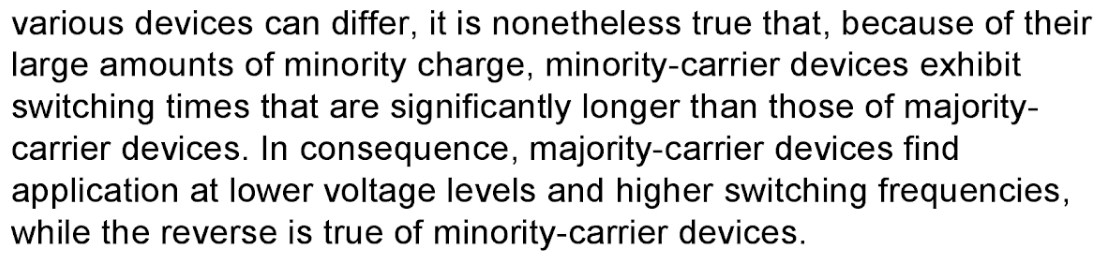
Below is a quote from the book Fundamentals of Power Electronics. Why does he say minority carrier devices are slower? I know IGBTs are slower due to large amount of minority charges that take time to recombine, but we know BJTs can handle signals up to several hundred GHz, unlike any MOSFET. So, what is the deal, does this "slower minority devices" refer only to high power devices?


ScottWang

Joined Aug 23, 2012
7,505
Below is a quote from the book Fundamentals of Power Electronics. Why does he say minority carrier devices are slower? I know IGBTs are slower due to large amount of minority charges that take time to recombine, but we know BJTs can handle signals up to several hundred GHz, unlike any MOSFET. So, what is the deal, does this "slower minority devices" refer only to high power devices?

The BJT is a current driving component and it just needs a little voltage as 0.7V to turn on the Vbe and make Vce to get into the saturation region, the MOSFET is voltage driving component and it needs a little higher voltages as 4.5V (some around 2V) to turn on the Vgs to make the Vds to get into the saturation region, you can see the popular NPN as 2N3904 has Cebo=18pF, it will affecting the input frequency, the popular N-ch MOSFET as IRF540 has Ciss(Input Capacitance)=1700pF, you can also check the Rise Time tr = 44nS, Turn-Off Delay Time td(off) = 53nS, Fall Time=43nS, those are all can affecting the input frequency.

You can also to google how the Ciss of MOSFET to affects the input frequency.
 

Thread Starter

Nikša

Joined Mar 26, 2018
86
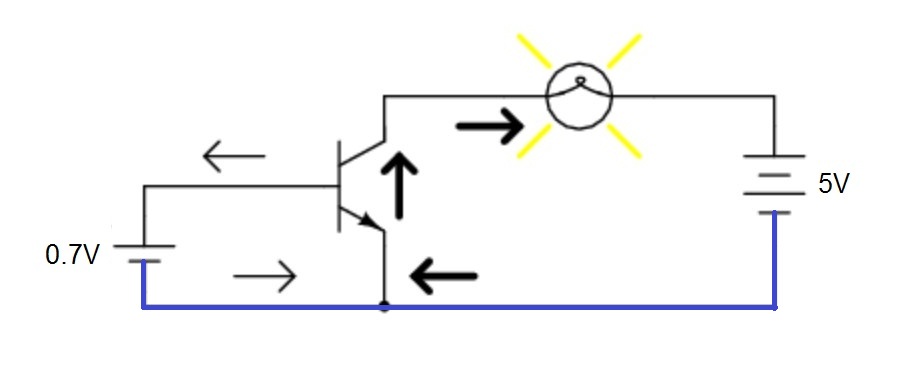
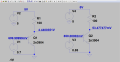
Answer another noob question, please. When BJT below goes into saturation mode and CB junction becomes forward biased (or even before that), what prevents the 5V battery to burn the 0.7V battery? I see batteries are plus to plus and minus to minus, but there is a potential difference between them, so why doesn't the smaller one get burned?


ScottWang

Joined Aug 23, 2012
7,505
Answer another noob question, please. When BJT below goes into saturation mode and CB junction becomes forward biased (or even before that), what prevents the 5V battery to burn the 0.7V battery? I see batteries are plus to plus and minus to minus, but there is a potential difference between them, so why doesn't the smaller one get burned?

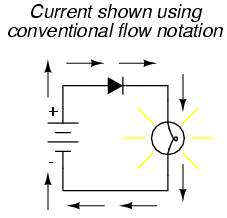
The circuit was shown that it is Electron Flow, but normally we will discuss with the Conventional Current below and the current is flowing through from the positive voltage to negative voltage, in your circuit when the bjt is turn off then the Vbc is 0.7V to 5V, so the Vbc is a reverse voltage 4.3V across on b, c, the ideally there is no current flowing, when the bjt is turn on then the Vc from 5V to 0.2V, Vbc is 0.7V to 0.2V, so the Vbc is a forward voltage 0.5V across on b, c, the ideally is 0.5V won't turn on the Vbc, but probably it has a little leakage current, 2N3904 datasheet.


Conventional Versus Electron Flow.
 

ScottWang

Joined Aug 23, 2012
7,505
And what if Vcc is slightly (or a lot) higher and BC junction DOES turn on? Will smaller battery be destroyed in that case?
If the load existing then the situation as Vbc=0.5V will keep that way, the reverse voltage of Vbc can't be exceed 60V otherwise it may damaged, although the rating voltage of Vcbo is 60V, but the better is don't use it exceed 80% as 48V, if a higher voltage destroy the b, c diode then the battery connected on the Base will be destroyed too.

2N3904 Vcbo -- Collector-Base Voltage is 60 V, please check page 1.
 

Jony130

Joined Feb 17, 2009
5,600
what prevents the 5V battery to burn the 0.7V battery
In saturation region, in NPN transistor the two transistor junction are forward biased. The base-emitter junction and the base-collector junction. This means that the voltage at the collector is smaller than the voltage at the base. And some part of the base current will flow from the 0.7 battery into BC junction and through emitter back to the 0.7V battery. The remaining part of a base current will flow through BE junction. So from the observer point of view in saturation, this Kirchhoff's law is true Ie = Ib + Ic
 
Last edited:

Thread Starter

Nikša

Joined Mar 26, 2018
86
Thank you both. And what about this part? Although no current flows from bigger battery through the smaller one, isn't bigger battery voltage going to damage the smaller battery? If not, why not?


Bordodynov

Joined May 20, 2015
3,431
You are approaching the problem of including a bipolar transistor incorrectly. You must supply control current, not voltage. Look at the bipolar transistor's datastore and you'll see that the base-emitter charge in the saturation mode can be substantially greater than 0.7 volts. It depends on the current you need. Base - the emitter voltage of the transistor depends on the temperature and type of transistor.
 

Thread Starter

Nikša

Joined Mar 26, 2018
86
You are approaching the problem of including a bipolar transistor incorrectly. You must supply control current, not voltage.
I know BJT is current controled but i still don't understand in the example above, if Vcc is substantially higher than V of the small battery connected to the base, how would it not damage it, unless there was a protective resistor to drop the voltage from the big battery to the small one. Have in mind i'm a noob so these basic things still confuse me.
 

ericgibbs

Joined Jan 29, 2010
21,573
hi N,
A Common Emitter BJT amplifier always has a current limiting load, which is connected from the Vsupply rail to the BJT's Collector.
In saturation nearly all the voltage is dropped across the load, only the Vsat appears across the transistor.
E
 

Thread Starter

Nikša

Joined Mar 26, 2018
86
hi N,
A Common Emitter BJT amplifier always has a current limiting load, which is connected from the Vsupply rail to the BJT's Collector.
In saturation nearly all the voltage is dropped across the load, only the Vsat appears across the transistor.
E
I see, so as long as load resistor is big enough, small battery doesn't have to worry. :)
 

ericgibbs

Joined Jan 29, 2010
21,573
hi N,
Obviously the resistance value of the Collector load resistor has to high enough to also limit the value of the Collector current to less than the maximum current rating of the transistor.
E
 

Thread Starter

Nikša

Joined Mar 26, 2018
86
Obviously the resistance value of the Collector load resistor has to high enough to also limit the value of the Collector current to less than the maximum current rating of the transistor.
Of course, but that's not what i meant. Regardless of transistor and load resistor, i see negative of big battery connected directly to the negative of smaller battery (indigo color), and assuming potential difference between the two is high, i don't understand how smaller one will not be damaged?

 
Last edited:
Top