BJT input voltage definition

Thread Starter

dandeeny

Joined Jul 28, 2014
22
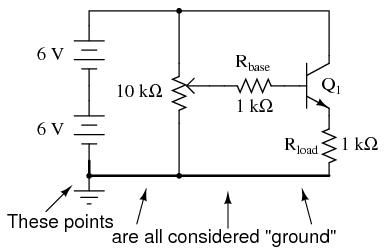
Why is the transistor input voltage considered to be between the potentiometer wiper and ground and not between Q1's base terminal and ground ? Diagram from Vol VI, Chapt 5 - Voltage Follower. Does the above definition not include Rbase as part of a separate component, ie the transistor ? Help please.


ericgibbs

Joined Jan 29, 2010
21,439
hi dan,
The transistors input voltage you state would not be from Base to Ground, but Base to Emitter [Vbe] as there is 1K from the Emitter to ground.
So the transistor input voltage in that diagram is from wiper to ground as stated.
Technically is not an 'input' voltage its an applied voltage.;)
E
 

MrChips

Joined Oct 2, 2009
34,807
Semantics. In this example there is no firm definition of "input voltage" and where it is to be measured. The author simply uses the term "input voltage" to refer to a voltage applied to the input of the circuit.

The function of Rbase is to limit the current to the base of the transistor. The voltage from the voltage divider is applied to the circuit via Rbase. Hence calling this the "input voltage" is not inappropriate.
 

Thread Starter

dandeeny

Joined Jul 28, 2014
22
Thankyou eric & Mr Chips. I'm very much a sincere learner.
Eric I dont understand your statements at all. How can the voltage I suggest (ie BJT base terminal to ground) possibly be base to emitter ? As you state there is already 1k between emitter and ground. I'm flummoxed...

Mr Chips, surely in the circuit illustrated the voltage being actually applied to the transistor is lower than the voltage at the wiper, the latter voltage having been further reduced by Rbase ?

Look forward to answers...

DanD
 

MrChips

Joined Oct 2, 2009
34,807
In BJT circuit analysis the base-emitter voltage is not as important as the base-emitter current.

Hence to perform the circuit analysis, one would be looking at the current through Rbase, not the voltage at the base.
 

Thread Starter

dandeeny

Joined Jul 28, 2014
22
Thankyou eric & Mr Chips. I'm very much a sincere learner.
Eric I dont understand your statements at all. How can the voltage I suggest (ie BJT base terminal to ground) possibly be base to emitter ? As you state there is already 1k between emitter and ground. I'm flummoxed...

Mr Chips, surely in the circuit illustrated the voltage being actually applied to the transistor is lower than the voltage at the wiper, the latter voltage having been further reduced by Rbase ?

Look forward to answers...

DanD
In BJT circuit analysis the base-emitter voltage is not as important as the base-emitter current.

Hence to perform the circuit analysis, one would be looking at the current through Rbase, not the voltage at the base.
So, MrChips, the base terminal to ground voltage in this case can actually be called the base-emitter voltage ??
 

MrChips

Joined Oct 2, 2009
34,807
No. The base-emitter voltage is the voltage across the base and emitter leads of the transistor.

For most intents and purposes, one can assume that the base-emitter voltage, Vbe, is 0.6V for a silicon BJT operating in the active region.
 

Jony130

Joined Feb 17, 2009
5,598
As for the circuit, I think that it is convenient to assume that the input voltage is a voltage between the potentiometer wiper and ground.
Because there is no strict definition where "input voltage" is.
 

Thread Starter

dandeeny

Joined Jul 28, 2014
22
My previous reply to Mr Chips seems to have got lost somehow. I said "yeah, thats what I thought." So I'm still left with the problem presented by the ericgibbs response (see second message of this thread) to my original question. Are you there eric ...? Can anyone help with that response ?
 

ericgibbs

Joined Jan 29, 2010
21,439
Eric I dont understand your statements at all. How can the voltage I suggest (ie BJT base terminal to ground) possibly be base to emitter ? As you state there is already 1k between emitter and ground. I'm flummoxed...
hi dan,
As others have explained, Vbe ie: Base to Emitter voltage is ~0.6V.
Consider for example that the emitter resistor is 1K and 1mA is flowing thru the 1K, it would create a voltage of 1V across the resistor.
So measuring the voltage from the Base to ground would give us ~1.6V.
Thats the point I was trying to make, sorry if you found it confusing.;)

Eric
 

Thread Starter

dandeeny

Joined Jul 28, 2014
22
Got
hi dan,
As others have explained, Vbe ie: Base to Emitter voltage is ~0.6V.
Consider for example that the emitter resistor is 1K and 1mA is flowing thru the 1K, it would create a voltage of 1V across the resistor.
So measuring the voltage from the Base to ground would give us ~1.6V.
Thats the point I was trying to make, sorry if you found it confusing.;)

Eric
Got It Eric. Thankyou for that.
 

Thread Starter

dandeeny

Joined Jul 28, 2014
22
Eric, thinking about the complete circuit in terms of your response: does this mean that the voltage at the collector terminal would be 10.6 (12-1.6v) with 1 mA flowing ? Also where does all of this put the voltage dropped by the potentiometer and the 1k base resistor ? If we knew what the resistance throu the potentiometer was would the figures add up ?
 

Jony130

Joined Feb 17, 2009
5,598
does this mean that the voltage at the collector terminal would be 10.6 (12-1.6v) with 1 mA flowing ?
No, the collector voltage is equal to 6V + 6V = 12V But Vce voltage is equal to :
Vc - Ve = 12V - 1V = 11V and Vcb = Vc - Vb = 12V - 1.6V = 10.4V

Also where does all of this put the voltage dropped by the potentiometer and the 1k base resistor ? If we knew what the resistance throu the potentiometer was would the figures add up ?
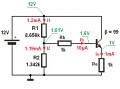
Well if we assume that the BJT current gain (Ic/Ib) is Hfe = β = 99
Then we can find base current.

Ib = Ie/(Hfe +1) = 1mA/100 = 10μA


And this diagram show all you need to know.

a2.PNG

R1 is a upper part of a POT and R2 is a lower part of a POT.
 
Last edited:

MikeML

Joined Oct 2, 2009
5,444
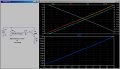
I believe that the independent variable (input?) of this problem is the pot wiper position, and the dependent variables are the various node voltages and device currents:

212a.jpg
 

Thread Starter

dandeeny

Joined Jul 28, 2014
22
I started this thread and in the starting message diagram the power source was (and still is) 2 x 6v batteries in series. The thread appears to be loosing contact with its starting questions.

DanD
 

MikeML

Joined Oct 2, 2009
5,444
...The thread appears to be loosing contact with its starting questions.
To which I say again:

"I believe that the independent variable (input?) of this problem is the pot wiper position, and the dependent variables are the various node voltages and device currents"
 
Top